Showing posts with label Japanese. Show all posts

Wednesday, March 23, 2022

Mar. 23: Kurosawa Akira, Japanese filmmaker

BORN MARCH 23:

Kurosawa Akira (1910-1998) was a Japanese filmmaker who is amongst a handful of the greatest in his craft. You can't really claim to know much about film if you don't know his. He directed thirty films over five decades, directing his first during World War II (after starting out as a painter and then working in the industry for most of a decade). Sixteen of his films featured the actor Toshiro Mifune. Some of his more significant works were Rashomon, famous for telling the same story (with variations) from different points of view; Ikiru, which examines the struggles of a terminally ill Tokyo bureaucrat and his final quest for meaning; Seven Samurai, the inspiration for Hollywood's The Magnificent Seven; Yojimbo, about two crime bosses vying for the services of a masterless samurai (the inspiration for the Spaghetti Western A Fistful of Dollars); Kagemusha, about a lower-class criminal who impersonates a dying warlord to discourage advances by his enemies; and Ran, with a plot derived from Shakespeare's King Lear. Kurosawa received the Academy Award for Lifetime Achievement in 1990.


Navigation:


Tuesday, February 1, 2022

Feb. 1: Ikkyu, Japanese Zen monk

BORN FEBRUARY 1:

Ikkyu (1394-1481) Iconoclastic Japanese Zen monk and poet who rejected rules of abstinence from sex, alcohol, and the eating of flesh. An avid student (and somewhat the patron saint) of the shakuhachi or bamboo flute. Some of his writings have been collected as The Crazy Cloud Anthology; Crow With No Mouth is also good.


Navigation:


Monday, January 31, 2022

Jan. 31: Oe Kenzaburo, Japanese novelist

BORN JANUARY 31:

Oe Kenzaburo (1935 - ) Japanese novelist, short story writer, and essayist. A major literary figure in his home country, he was influenced in his early days by French and American literature, and has used his insights to oppose nuclear weapons and power, the power wielded by the Japanese Imperial household, and other issues. He was awarded the Nobel Prize in Literature in 1994. The semi-autobiographical novel A Personal Matter tells the story of a young father grappling with the severe mental disability of his newborn son; The Silent Cry tells the story of two brothers in the early 1960s who, after decades of separation, deal with their own crises on a visit to their ancestral village in the countryside.


Navigation:


Friday, January 14, 2022

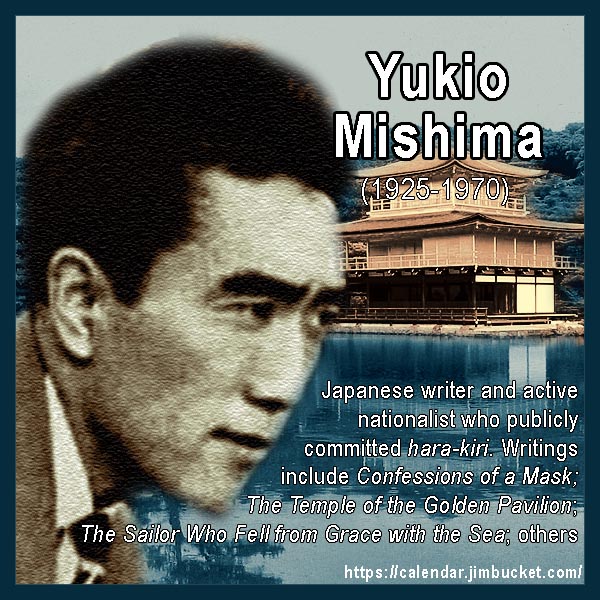
Jan. 14: Yukio Mishima, Japanese writer

BORN JANUARY 14:

Yukio Mishima (1925-1970) stunningly evocative Japanese novelist, playwright, poet, short story writer, and essayist. A Shintoist and active right-wing nationalist, he opposed Japan's increasing western-style materialism and postwar turn to democracy and globalism. To prove his point, he and four followers entered a Tokyo military base and took its commandant hostage, attempting to overthrow Japan's 1947 Constitution. After a speech and a cry of "Long live the Emperor!", he committed seppuku ("hara-kiri"), the favored mode of death of the samurai. Works include Confessions of a Mask; The Temple of the Golden Pavilion; The Sailor Who Fell from Grace with the Sea; The Sea of Fertility tetralogy (Spring Snow; Runaway Horses; The Temple of Dawn; The Decay of the Angel); and Hagakure Nyumon, which examines living the Samurai Way in modern life.


Navigation:


Tuesday, November 2, 2021

Nov. 2: Ryokan Taigu, Japanese monk and poet

BORN NOVEMBER 2:

Ryokan Taigu (1758-1831) Japanese monk who wrote numerous short poems. Perhaps his most famous involves the time his hut was robbed. There was nothing there to steal, but as the thief left, Ryokan chased after him to give him the clothes he was wearing! He then went home and sat down naked to write a poem declaring that at least the thief who robbed his hut had left the moon at his window.


Navigation:


Wednesday, October 13, 2021

Oct. 13: Kobayashi Takiji, Japanese novelist

BORN OCTOBER 13th:

Kobayashi Takiji (1903-1933) Japanese novelist who wrote The Crab Cannery Ship (Kanikosen), which tells of the hard life of cannery workers, fishermen, and seamen, and the beginning of their revolt against their employer. It was banned by government censors. A leftist author of "proletarian literature," he died of a heart attack while being tortured by the police. For fear of the authorities, no hospital would perform an autopsy.


Navigation: