Showing posts with label Essayist. Show all posts

Sunday, May 29, 2022

May 29: G. K. Chesterton, English novelist and lay theologian

BORN MAY 29:

G. K. Chesterton (1874-1936) was an English novelist, poet, philosopher, dramatist, journalist, lay theologian, and critic. Some of his theological works, such as Orthodoxy and The Everlasting Man, anticipate the point-of-view and style of C. S. Lewis. He wrote around 80 books, several hundred poems, around 200 short stories, 4,000 essays (mostly as newspaper columns), and several plays. He also wrote articles for the 14th edition (1929) of the Encyclopædia Britannica, including the entry on Charles Dickens and part of the entry on Humor. Among his more popular novels are The Napoleon of Notting Hill, in which a randomly selected King of England enacts some inane laws, and a local young man--the eponymous "Napoleon"--exploits them; and The Man Who Was Thursday, a send-up of anarchism in which most of the leading anarchists turn out to be secret policemen meant to defeat anarchism. Most of us today, though, will know him for the Father Brown stories, often adapted for film, radio, TV, and other media.


Navigation:


Wednesday, May 25, 2022

May 25: Ralph Waldo Emerson, American writer and philosopher

BORN MAY 25:

Ralph Waldo Emerson (1803-1882) was an American writer and perhaps the young country's first original philosopher. He was an essayist, lecturer, abolitionist, and poet, and a leader of the mid-19th century transcendentalist movement. In true American mode, he championed individualism, disseminating his ideology through dozens of published essays and more than 1,500 public lectures across the United States. Starting out as a pastor (like his father), he struck out on his own with the publication of his 1836 essay "Nature," which expressed the philosophy of transcendentalism. He would often lecture on a topic, then revise his notes to publish as essays. Some of the more important of these are "The American Scholar," "Self-Reliance," "The Over-Soul," "Experience," and others. He returned again and again to the ideas of individuality, freedom, the ability of humankind to achieve almost anything, and the relationship between the soul and the outside world. He was also a mentor and friend of Henry David Thoreau, another transcendentalist.


Navigation:


Tuesday, May 24, 2022

May 24: Joseph Brodsky, Russian-American poet and essayist

BORN MAY 24:

Joseph Brodsky (1940-1996) was a Russian-born American poet and essayist who was "strongly advised" to emigrate by the Soviet authorities. W. H. Auden and other supporters helped him settle in the US in 1972. He taught at Mount Holyoke College, and at various universities such as Yale, Columbia, Cambridge, and Michigan. In 1987, he received the Nobel Prize in Literature for works "imbued with clarity of thought and poetic intensity." And in 1991, he was appointed US Poet Laureate. His works include the forty-page long poem Gorbunov and Gorchakov, about two patients in a mental asylum that serves as a metaphor for the Soviet State; and the collection of literary and autobiographical essays, Less Than One.

Navigation:


Saturday, May 21, 2022

May 21: Alexander Pope, English poet

BORN MAY 21:

Alexander Pope (1688-1744) was an English poet and man of letters of the Augustan period (first half of the 18th century to the 1740s), and one of its "stars." The foremost English poet of the time, and a master of the heroic couplet, he is best known for his satires, like The Rape of the Lock, a mock-epic in which a lock of hair is stolen ("rape" here is an old sense of "snatch, grab, carry off"), and The Dunciad, featuring the goddess "Dulness." He also wrote a long poem, An Essay on Criticism, with such famous lines as "To err is human; to forgive, divine," "A little learning is a dang'rous thing," and "Fools rush in where angels fear to tread"; and he is noted for his translation of Homer. He is the second-most quoted author in The Oxford Dictionary of Quotations (after Shakespeare), and, like the Bard, many of his lines, like those just mentioned, have crept into common speech, as have "damning with faint praise," "to err is human; to forgive, divine," and many more. His major works number nearly 20, and there are many more besides.


Navigation:


Sunday, April 3, 2022

Apr. 3: Washington Irving, American writer

BORN APRIL 3:

Washington Irving (1783-1859), American short story writer, essayist, and historian, is considered to be the first American author to become a best-seller in Europe. His best-known works are short stories like "Rip Van Winkle," about a man who falls asleep in the woods for over 20 years; and "The Legend of Sleepy Hollow," about a "Headless Horseman" playing a prank on poor schoolteacher Ichabod Crane. Though these popular tales are lighthearted, Irving was quite a serious author, who drew on local history for these stories, and was in fact as much a historiographer and biographer as he was a storyteller. He wrote biographies of great men like George Washington (in five volumes!) and Muhammad, as well as histories of Spain (he was in fact U.S. ambassador to Spain between 1842 and 1846). Irving was named for George Washington, whom he was lucky enough to meet at age six. In addition to his own work, Washington Irving inspired such 19th-century American greats as Nathaniel Hawthorne, Herman Melville, Henry Wadsworth Longfellow), and Edgar Allan Poe.


Navigation:


Wednesday, March 16, 2022

Mar. 16: A. K. Ramanujan, Indian poet and scholar

BORN MARCH 16:

A. K. Ramanujan (1929-1993) was an Indian poet, scholar, professor, philologist, folklorist, translator, and playwright. Though he wrote widely and across many genres, he is best remembered for his poetry. However, one of his academic essays stirred interest--and controversy. "Three Hundred Ramayanas" demonstrates the spread of one of India's two greatest epics and its cultural impact beyond India itself, having been adapted to various languages, societies, religions, and periods. Hardline Hindu groups believe Ramanujan's work offends Hindu beliefs, and its inclusion in curricula has been the subject of protest actions--pro and con--in India's universities. Despite the title, Ramanujan's essay actually focuses on five "tellings" (by Valmiki, Kamban, the Jains, the Thais, and South Indian folk tellings); the figure of 300 is suggested by the work of another scholar.


Navigation:


Tuesday, March 1, 2022

Mar. 1: Charles Fletcher Lummis, American character


BORN MARCH 1:

Charles Fletcher Lummis (1829-1928) American journalist, historian, ethnographer, archaeologist, poet, L.A. City Librarian, and Southwest Museum founder. It's not often I get to celebrate a personal hero, and this month I'll celebrate two (Joseph Campbell comes up on the 26th). I have been to El Alisal, the house Lummis built on the edge of Arroyo Seco in northeast L.A.; I have traipsed the places he traipsed in New Mexico; and own and have read hard copies of a half-dozen of his works (and countless books and articles online) plus three biographies. He edited a booster-ish SoCal mag called Land of Sunshine (later called Out West), which helped create an influx of easterners coming west. Books like Some Strange Corners of Our CountryThe Land of Poco Tiempo, and Flowers Of Our Lost Romance helped romanticize the Spanish era; and A Tramp Across the Continent, an account of his walk from Ohio to L.A. and the hardships along the way, made both his legend and his career.


Navigation:


Monday, February 28, 2022

Feb. 28: Montaigne, French essayist

BORN FEBRUARY 28:

Michel Eyquem de Montaigne (1533-1592), known simply as Montaigne, was a French essayist. Though the French word "essayer," meaning "to try or attempt," existed before Montaigne, it was his use of the word that led to our understanding of the term today as a short piece of writing exploring a particular subject. ("Attempt" or "try" is still a secondary meaning.) His 107 essays cover a wide range of subjects, from "Of Sadness and Sorrow" to "Of Conscience," from "Of Smells" to "Of Posting [Letters]." Nothing escaped his keen mind and clear expression.


Navigation:


Monday, February 21, 2022

Feb. 21: W.H. Auden, British-American poet

BORN FEBRUARY 21:

W.H. Auden (1907-1973) was an British-American poet and essayist whose common themes included love ("Funeral Blues," which begins, "Stop all the clocks, cut off the telephone..."), political and social themes ("September 1, 1939" and "The Shield of Achilles"), cultural and psychological themes (the long poem The Age of Anxiety, which won the Pulitzer Prize in Poetry in 1947), and religion ("For the Time Being" and "Horae Canonicae").


Navigation:


Thursday, February 10, 2022

Feb. 10: Charles Lamb, English author

BORN FEBRUARY 10:

Charles Lamb (1775-1834) English author whose Essays of Elia are considered his greatest work, exploring a variety of subjects in a charming, conversational manner. He is also known for writing, with his sister (whom I recently learned had, in a fit of madness, stabbed their mother to death) the Tales from Shakespeare for young readers, and, on his own, The Adventures of Ulysses for a similar audience.


Navigation:


Monday, January 31, 2022

Jan. 31: Oe Kenzaburo, Japanese novelist

BORN JANUARY 31:

Oe Kenzaburo (1935 - ) Japanese novelist, short story writer, and essayist. A major literary figure in his home country, he was influenced in his early days by French and American literature, and has used his insights to oppose nuclear weapons and power, the power wielded by the Japanese Imperial household, and other issues. He was awarded the Nobel Prize in Literature in 1994. The semi-autobiographical novel A Personal Matter tells the story of a young father grappling with the severe mental disability of his newborn son; The Silent Cry tells the story of two brothers in the early 1960s who, after decades of separation, deal with their own crises on a visit to their ancestral village in the countryside.


Navigation:


Saturday, January 29, 2022

Jan. 29: Edward Abbey, American environmental writer

BORN JANUARY 29:

Edward Abbey (1927-1989) American novelist and essayist who became an icon of the environmental movement. Desert Solitaire, based on his experience as a ranger at Arches National Monument (now a national park) is a model of "nature autobiography"; his novel The Monkey Wrench Gang depicts the use of sabotage to protest environmentally damaging activities in the Southwest.


Navigation:


Tuesday, January 18, 2022

Jan. 18: A. A. Milne, British writer

BORN JANUARY 18:

A. A. (Alan Alexander) Milne (1882-1956) English novelist, essayist, poet, playwright, and short-story writer, and, most notably, author of children's literature: he was the "father" of Winnie-the-Pooh (and the father of Christopher Robin Milne)


Navigation:


Friday, January 14, 2022

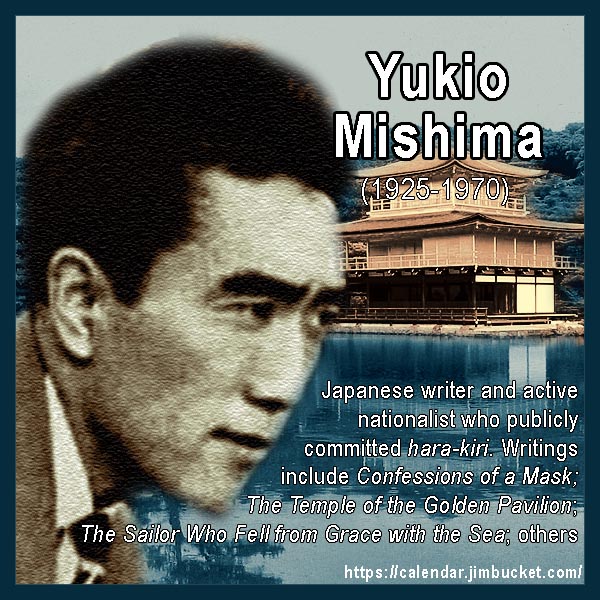
Jan. 14: Yukio Mishima, Japanese writer

BORN JANUARY 14:

Yukio Mishima (1925-1970) stunningly evocative Japanese novelist, playwright, poet, short story writer, and essayist. A Shintoist and active right-wing nationalist, he opposed Japan's increasing western-style materialism and postwar turn to democracy and globalism. To prove his point, he and four followers entered a Tokyo military base and took its commandant hostage, attempting to overthrow Japan's 1947 Constitution. After a speech and a cry of "Long live the Emperor!", he committed seppuku ("hara-kiri"), the favored mode of death of the samurai. Works include Confessions of a Mask; The Temple of the Golden Pavilion; The Sailor Who Fell from Grace with the Sea; The Sea of Fertility tetralogy (Spring Snow; Runaway Horses; The Temple of Dawn; The Decay of the Angel); and Hagakure Nyumon, which examines living the Samurai Way in modern life.


Navigation:


Wednesday, January 12, 2022

Jan. 12: Jack London, American writer

BORN JANUARY 12:

Jack London (1876-1916) American novelist, short story writer, journalist, and activist, and one of the first American authors to become an international celebrity and earn a large fortune from writing. His rough-and-ready novels include The Call of the Wild, White Fang, and The Sea Wolf; and stories "To Build a Fire," "An Odyssey of the North," "Love of Life," "The Pearls of Parlay," and "The Heathen"; the non-fiction work The People of the Abyss was an exposé of the conditions of the working class in the east end of London.


Navigation:


Wednesday, January 5, 2022

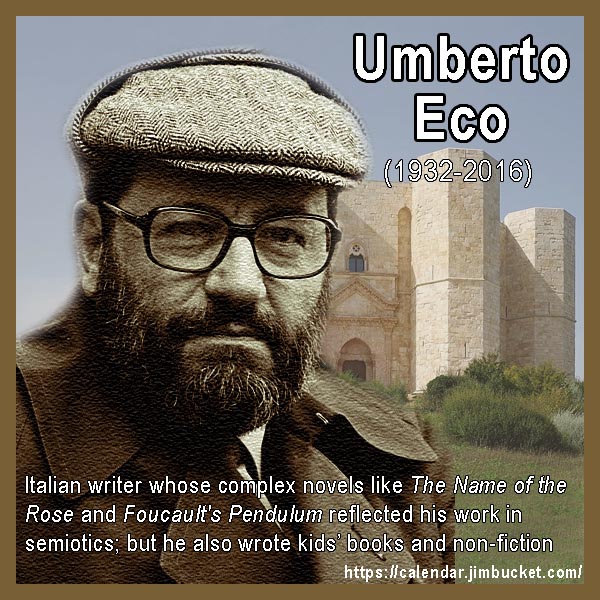
Jan. 5: Umberto Eco, Italian writer

BORN JANUARY 5:

Umberto Eco (1932-2016) Italian novelist, critic, and philosopher whose complex novels reflected his work in semiotics; The Name of the Rose; Foucault's Pendulum; The Island of the Day Before; The Prague Cemetery. But he also wrote children's books, and far more non-fiction than his "mere" seven novels.


Navigation:


Sunday, January 2, 2022

Jan. 2: Isaac Asimov, American sci-fi writer and scientist

BORN JANUARY 2:

Isaac Asimov (1920-1992) prolific American sci-fi writer and professor of biochemistry; with Robert A. Heinlein and Arthur C. Clarke, considered one of the "Big Three" science fiction writers. The Foundation series (seven books) is required reading; then, maybe, the stories in I, Robot; the Galactic Empire series; the Robot series; Nightfall; and essay collections.


Navigation:


Friday, December 24, 2021

Dec. 24: Matthew Arnold, British writer

BORN DECEMBER 24:

Matthew Arnold (1822-1888) English poet and critic, as well as school inspector. Poems: The pessimistic "Dover Beach" is perhaps his most-anthologized work today (love is the answer to modern despair); "The Scholar-Gipsy" is based on undercover work by an impoverished 17th-century Oxford student; "Thyrsis" was written at the death of the poet Arthur Hugh Clough; books include Culture and Anarchy and Literature and Dogma among others.


Navigation:


Thursday, December 23, 2021

Dec. 23: Charles Augustin Sainte-Beuve, French writer

BORN DECEMBER 23:

Charles Augustin Sainte-Beuve (1804-1869) French literary critic widely translated into English. Port-Royal--considered his masterpiece--is an exhaustive history of an abbey near Paris, a work which influenced later writers on writing about religious belief, as well as areas of philosophy and esthetics. He also wrote "What Is a Classic?" and a notable essay on "Montaigne."


Navigation:


Sunday, December 19, 2021

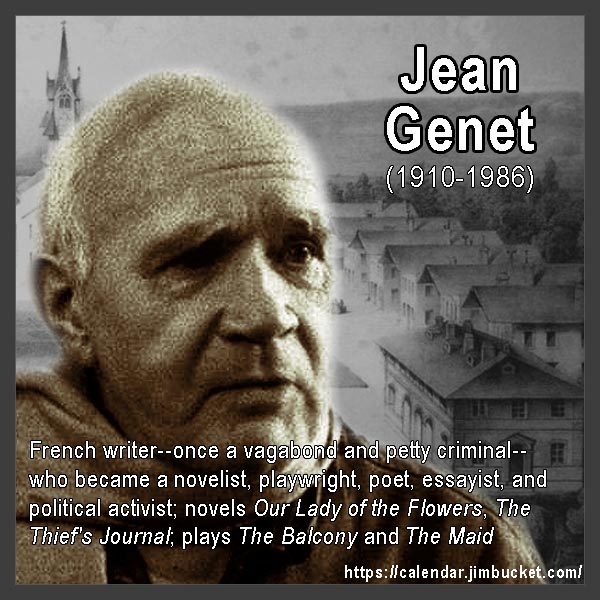
Dec. 19: Jean Genet, French writer

BORN DECEMBER 19:

Jean Genet (1910-1986) French writer--once a vagabond and petty criminal--who became a novelist, playwright, poet, essayist, and political activist; novels include the largely-autobiographical Our Lady of the Flowers and The Thief's Journal (only partly autobiographical); and the plays The Balcony and The Maids (not at all autobiographical, as far as I can tell).


Navigation: