Showing posts with label Renaissance. Show all posts

Tuesday, May 3, 2022

May 3: Niccolo Machiavelli, Italian Renaissance author

BORN MAY 3:

Niccolo Machiavelli (1469-1527) was an Italian Renaissance diplomat, author, philosopher, and historian best known for The Prince (Il Principe), written about 1513 but not published until 1532. He also wrote comedies, songs, and poetry, but in most people's minds he was a ruthless political animal who advocated the unscrupulous acts in The Prince. One of his leadership maxims was, "It is better to be feared than to be loved"; he claimed that throughout the course of  history, politics had always been played with deception, treachery, and criminal acts: any action could be excused if it benefited the ruler. Some are unsure whether Machiavelli believed these things and was recommending them to rulers, or perhaps was just publicizing them as a warning to an unwary public. Some even see them as satire, a serious jester's slap at bad rulers. In any case, the term "Machiavellian" has come to describe these cunning, scheming, and unscrupulous actions.


Navigation:


Tuesday, April 26, 2022

Apr. 26: William Shakespeare, English playwright and poet

BAPTIZED APRIL 26:

William Shakespeare (1564-1616) pre-eminent English playwright and poet. He was baptized on this day, and may have been born three days earlier, according to some calculations. Modern scholarship suggests that, including collaborations, he is responsible for all or part of 39 plays, in addition to his 154 sonnets, four narrative poems, and a few other verses. Outstanding among his plays (there are so many!) are The Tempest; Hamlet; King Lear; Macbeth; Othello; Romeo and Juliet; A Midsummer Night's Dream; and more. The long poems are Venus and Adonis; The Rape of Lucrece; A Lover's Complaint; and--I'm not kidding--The Phoenix and the Turtle. Several of the Sonnets stand out, notably

  • #18 "Shall I compare thee to a summer's day?"
  • #29 "When in disgrace with fortune and men's eyes"
  • #116 "Let me not to the marriage of true minds" and 
  • #130 "My mistress' eyes are nothing like the sun"


Navigation:


Monday, April 18, 2022

Apr. 18: Thomas Middleton, English playwright and poet

BORN APRIL 18:

Thomas Middleton (1580-1627) was an English playwright and poet whose life overlapped that of Shakespeare. Some scholars believe that he collaborated with The Bard on All's Well That Ends Well and Timon of Athens; another play, A Yorkshire Tragedy, was long attributed to Shakespeare, but modern critics have examined the style and determined it to be Middleton's. With John Fletcher and Ben Jonson, Middleton was one of the most successful playwrights of the Jacobean period (the reign of King James, successor to Queen Elizabeth). Proficient at writing both comedy and tragedy, he also wrote a large number of masques and pageants (elaborate productions that included pantomime and dancing, and later dialogue and song, given by amateur and professional actors). His plays are still staged, and the number of productions is increasing. T. S. Eliot thought him second only to Shakespeare.


Navigation:


Friday, April 15, 2022

Apr. 15: Leonardo da Vinci, Italian "Renaissance Man"

BORN APRIL 15:

Leonardo da Vinci (1452-1519) was an Italian polymath. When people say "Renaissance Man," I think of Leonardo. Bastard son of a pencil-pushing lawyer and a lower-class mom named Caterina, he was followed by a dozen half-siblings much younger than he, one by some 40 years. (Dad was busy.) Both his mother and father married--to other people--the year after he was born. But he had the good fortune to grow up 20 miles from Florence, where he studied and worked for the artist Verrocchio (who himself was a student of the great sculptor Donatello). But beyond the Mona Lisa and the Last Supper, he worked as a military engineer. His Notebooks and manuscripts run to around 13,000 pages, including some rather mundane things like lists of groceries and people who owed him money. But there are also sketches for paintings and projects never realized; scientific studies of anatomy and biology; architectural drawings; "flying machines," including a prototype for a helicopter; a sort of tank; a chariot with spinning scythes out in front of the horses; shoes for walking on water; musical instruments; a mechanical knight; hydraulic pumps; finned mortar shells; and a steam-powered cannon. He may well have been homosexual. His tenderness for animals (he purchased caged birds and released them, but this may have been to observe their flight) suggests he may have been vegetarian.


Navigation:


Thursday, April 14, 2022

Apr. 14: Christiaan Huygens, Dutch mathematician and scientist

BORN APRIL 14:

Christiaan Huygens (1629-1695) was a Dutch mathematician, astronomer, and physicist who made groundbreaking contributions in mechanics and optics (where, he is best known for his wave theory of light; the Treatise on Light is one of his major works). He has been called the first theoretical physicist and is one of the founders of modern mathematical physics. He improved the design of telescopes and discovered Saturn's largest moon, Titan (the first to be discovered). He also invented the pendulum clock, a breakthrough in timekeeping and the most accurate way of keeping time for almost 300 years.


Navigation:


Monday, March 21, 2022

Mar. 21: Johann Sebastian Bach, German composer

BORN MARCH 21:

Johann Sebastian Bach (1685-1750) German Baroque composer and musician. In "Top Ten" lists of the greatest composers of classical music, either Beethoven or Bach will likely be in the #1 slot. (If not, look to Mozart.) Composing for orchestra, keyboard, or voice, J. S. Bach (there were many other Bachs) was born in a musical family and orphaned at age 10. In the manner of a true genius, he often found it difficult to get along with his employers. He died of complications from eye surgery in 1750 at the age of 65. Among his more popular shorter pieces are "Jesu, Joy of Man's Desiring," Air on the G String, "Sheep May Safely Graze"; for longer listening try The Brandenburg Concertos; The Goldberg Variations; St. Matthew Passion; and The Well-Tempered Clavier. On the organ, the best is Toccata and Fugue in D minor. A true giant.


Navigation:


Sunday, March 6, 2022

Mar. 6: Michelangelo Buonarroti, Italian artist

BORN MARCH 6:

Michelangelo Buonarroti (1475-1564) was an Italian sculptor, painter, architect, poet, to some the epitome of an artist ("His work is good, but he's no Michelangelo"). His contemporaries called him Il Divino, "The Divine One." Not particularly well-known today for his homoerotic poetry, he is better remembered for his monumental sculpture of David (relaxed but alert just before slaying Goliath, sling draped over his shoulder); the excruciating Pietà, with the crucified Christ in his mother's lap; the painting of The Last Judgment with over 300 figures, covering the whole altar wall of the Sistine Chapel; and of course the astonishing, awe-inspiring ceiling of that same chamber, with a similar number of figures. Il Divino indeed.


Navigation:


Monday, February 28, 2022

Feb. 28: Montaigne, French essayist

BORN FEBRUARY 28:

Michel Eyquem de Montaigne (1533-1592), known simply as Montaigne, was a French essayist. Though the French word "essayer," meaning "to try or attempt," existed before Montaigne, it was his use of the word that led to our understanding of the term today as a short piece of writing exploring a particular subject. ("Attempt" or "try" is still a secondary meaning.) His 107 essays cover a wide range of subjects, from "Of Sadness and Sorrow" to "Of Conscience," from "Of Smells" to "Of Posting [Letters]." Nothing escaped his keen mind and clear expression.


Navigation:


Saturday, February 19, 2022

Feb. 19: Nicolaus Copernicus, German/Polish astronomer

BORN FEBRUARY 19:

Nicolaus Copernicus (1473-1543) German/Polish astronomer. Until his time, the accepted "truth" was that the earth was the center of the universe (after all, didn't God choose to put humans here?) and all celestial bodies revolved around it. But as observation of planetary motion became more refined, anomalies appeared. Copernicus resolved this by creating a model that placed the sun at the center of our solar system (heliocentrism). He published his findings in De revolutionibus orbium coelestium (On the Revolutions of the Heavenly Spheres) just before his death in 1543; it was a revolution in more ways than one. Galileo and others took up the charge and today everything is in its right place.


Navigation:


Tuesday, February 15, 2022

Feb. 15: Galileo Galilei, Italian astronomer

BORN FEBRUARY 15:

Galileo Galilei (1564-1642) Italian astronomer, physicist and engineer variously called the "father" of observational astronomy, modern physics, the scientific method, and modern science, who studied applied physics and used the telescope to observe the phases of Venus, the four largest satellites of Jupiter, Saturn's rings, and lunar craters, and sunspots. His observations were published in the marvelously-titled The Starry Messenger. His advocacy of the Copernican view that the earth revolves around the sun got him in hot water with the Roman Inquisition, which concluded that the theory contradicted Holy Scripture. Galileo defended his views in Dialogue Concerning the Two Chief World Systems (the Copernican and the traditional Ptolemaic, which said that everything circled the earth). He was tried by the Inquisition and forced to recant, and spent the rest of his life under house arrest.


Navigation:


Sunday, February 6, 2022

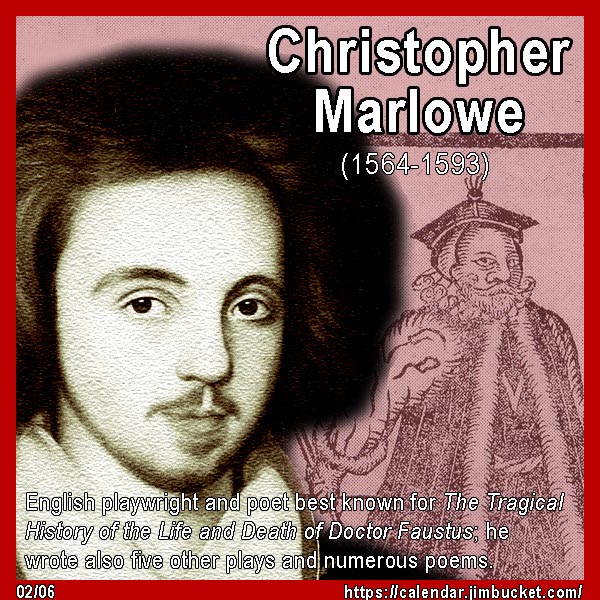
Feb. 6: Christopher Marlowe, English playwright and poet

BORN FEBRUARY 6:

Christopher Marlowe (1564-1593) English playwright and poet. It must have been tough to be a good playwright when Shakespeare (with whom he was baptized in the same year) was your competitor. Seen any good productions of Dr. Faustus lately? Or Edward the Second? Tamburlaine? No? But these were some of Kit Marlowe's greatest hits. (He is credited with only six plays in his 29 years.) He was London's pre-eminent playwright--even bigger than Will--until his supposedly mysterious death in 1593, 13 years before the Bard. (In 1925 records came to light showing he died in a knife fight over a bar bill, though the witnesses may not be credible.) What might he have become?


Navigation:


Monday, December 27, 2021

Dec. 27: Johannes Kepler, German astronomer

BORN DECEMBER 27:

Johannes Kepler (1571-1630) German astronomer and mathematician who codified the laws of planetary motion; he wrote Astronomia Nova (New Astronomy); Harmonices Mundi (The Harmony of the World); and Epitome Astronomiae Copernicanae (Epitome of Copernican Astronomy).


Navigation:


Monday, December 6, 2021

Dec. 6: Baldassare Castiglione, Italian courtier

BORN DECEMBER 6:

Baldassare Castiglione (1478-1529) a sort of Italian Renaissance "Emily Post" or "Miss Manners" who wrote an etiquette handbook, "The Courtier" (Il Cortegiano), for other courtiers. Rank, physical strength, modesty, and pleasant physique were some of the virtues bandied about by the participants in a (fictional) four-night conversation.


Navigation:


Monday, October 4, 2021

Oct. 4: Rembrandt van Rijn, Dutch painter


DIED OCTOBER 4th:

Rembrandt van Rijn (1606-1669) Dutch painter whose paintings include The Night Watch; The Anatomy Lesson of Dr. Nicolaes Tulp; and Syndics of the Drapers' Guild. The opulence of his works reflects the wealth of the Netherlands in his times, the so-called "Dutch Golden Age." Despite the vast explorations of his countrymen, the artist himself never left home, yet was inspired by the influx of cultural artifacts brought home by others, including Italian art.


Navigation:


Wednesday, September 8, 2021

Sep. 8: Ludovico Ariosto, Italian poet

BORN SEPTEMBER 8th:

Ludovico Ariosto (1474-1533) Italian poet known for Orlando Furioso, a satire on the customs of chivalry featuring Roland (Italian "Orlando"), one of Charlemagne's knights. The "real" Roland had been killed by treachery after defending France against the Saracens (Moors) in Spain; this Roland made a trip to the moon!


Navigation:


Sunday, September 5, 2021

Sep. 5: Tommaso Campanella, Italian philosopher-monk

BORN SEPTEMBER 5th:

Tommaso Campanella (1568-1639) Italian philosopher-monk and poet known for his heterodox views, for which he was tortured and then imprisoned for 27 years, where he wrote among other works his utopian novel La città del Sole (The City of the Sun).


Navigation: