Showing posts with label May. Show all posts

Monday, May 30, 2022

May 30: Countee Cullen, American poet and writer

BORN MAY 30:

Countee Cullen (1903-1946) was a Black American poet, novelist, children's writer, and playwright, and part of the Harlem Renaissance. Rare for a Black man in his time, he graduated with a master's degree in English from Harvard (after graduating Phi Beta Kappa from NYU). He was briefly married to the daughter of civil rights icon W.E.B. Du Bois; she filed for divorce when a few months after their wedding, he wrote her a letter confessing his love for men. Ten years later he married another woman and lived with her until his death some six years later. Overshadowed today by his colleague Langston Hughes, Cullen's work nevertheless expresses the experience of Black people in his day; one of his better-known poems, "Heritage," repeats its first line as a refrain: "What is Africa to me?" as he places his imagined homeland against his life as a "Christian" and an American. Also notable is his, "Yet Do I Marvel."


Navigation:


Sunday, May 29, 2022

May 29: G. K. Chesterton, English novelist and lay theologian

BORN MAY 29:

G. K. Chesterton (1874-1936) was an English novelist, poet, philosopher, dramatist, journalist, lay theologian, and critic. Some of his theological works, such as Orthodoxy and The Everlasting Man, anticipate the point-of-view and style of C. S. Lewis. He wrote around 80 books, several hundred poems, around 200 short stories, 4,000 essays (mostly as newspaper columns), and several plays. He also wrote articles for the 14th edition (1929) of the Encyclopædia Britannica, including the entry on Charles Dickens and part of the entry on Humor. Among his more popular novels are The Napoleon of Notting Hill, in which a randomly selected King of England enacts some inane laws, and a local young man--the eponymous "Napoleon"--exploits them; and The Man Who Was Thursday, a send-up of anarchism in which most of the leading anarchists turn out to be secret policemen meant to defeat anarchism. Most of us today, though, will know him for the Father Brown stories, often adapted for film, radio, TV, and other media.


Navigation:


Saturday, May 28, 2022

May 28: Ian Fleming, British spy novelist

BORN MAY 28:

Ian Fleming (1908-1964) was an English author. Like Arthur Conan Doyle and J. M. Barrie, virtually everything he did was forced to live in the shadow of his One Great Character, in this case: Bond, James Bond. (One exception is his children's book Chitty-Chitty-Bang-Bang, perhaps because of its "loosely based" 1968 film version, scripted by Roald Dahl and starring Dick Van Dyke when he was still a hot commodity.) Anyway, there were 14 Bond novels (by Fleming) and nine short stories; since Fleming's death, there have been nearly 50 Bond books by other authors, including John Gardner and Sebastian Faulks. Several of them are set in Bond's childhood. The character has long outlived his creator, who was himself a British naval intelligence officer during World War II. Oh yeah, I forgot to mention the 27 film appearances of Bond, played by seven actors.


Navigation:


Friday, May 27, 2022

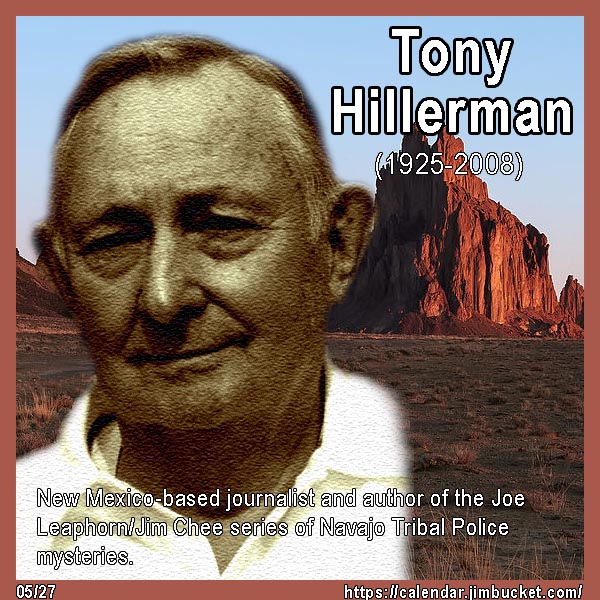
May 27: Tony Hillerman, American detective novelist

BORN MAY 27:

Tony Hillerman (1925-2008) was an American author of detective novels and non-fiction works who wrote the "Joe Leaphorn" and "Jim Chee" series (The Blessing Way, etc.) about Navajo Tribal Police. Hillerman was born in a town in Oklahoma that had been an Indian mission, and was comfortable with some of their folkways. Later, he worked as a journalist in New Mexico, and took a master's degree from the University of New Mexico in Albuquerque. He wrote 18 Leaphorn/Chee novels and four non-series novels, as well as seven non-fiction books. His daughter Anne Hillerman has continued the Leaphorn/Chee series since his death--seven novels, so far.


Navigation:


Wednesday, May 25, 2022

May 25: Ralph Waldo Emerson, American writer and philosopher

BORN MAY 25:

Ralph Waldo Emerson (1803-1882) was an American writer and perhaps the young country's first original philosopher. He was an essayist, lecturer, abolitionist, and poet, and a leader of the mid-19th century transcendentalist movement. In true American mode, he championed individualism, disseminating his ideology through dozens of published essays and more than 1,500 public lectures across the United States. Starting out as a pastor (like his father), he struck out on his own with the publication of his 1836 essay "Nature," which expressed the philosophy of transcendentalism. He would often lecture on a topic, then revise his notes to publish as essays. Some of the more important of these are "The American Scholar," "Self-Reliance," "The Over-Soul," "Experience," and others. He returned again and again to the ideas of individuality, freedom, the ability of humankind to achieve almost anything, and the relationship between the soul and the outside world. He was also a mentor and friend of Henry David Thoreau, another transcendentalist.


Navigation:


Tuesday, May 24, 2022

May 24: Joseph Brodsky, Russian-American poet and essayist

BORN MAY 24:

Joseph Brodsky (1940-1996) was a Russian-born American poet and essayist who was "strongly advised" to emigrate by the Soviet authorities. W. H. Auden and other supporters helped him settle in the US in 1972. He taught at Mount Holyoke College, and at various universities such as Yale, Columbia, Cambridge, and Michigan. In 1987, he received the Nobel Prize in Literature for works "imbued with clarity of thought and poetic intensity." And in 1991, he was appointed US Poet Laureate. His works include the forty-page long poem Gorbunov and Gorchakov, about two patients in a mental asylum that serves as a metaphor for the Soviet State; and the collection of literary and autobiographical essays, Less Than One.

Navigation:


Monday, May 23, 2022

May 23: Susan Cooper, English YA author

BORN MAY 23:

Susan Cooper (1935 - ) is an English author of Young Adult literature. In the past 15 years or so I've had the pleasure of reading a number of excellent series of YA fantasy literature, and few stand out in my mind like Cooper's The Dark is Rising pentalogy. Like Narnia, it features the adventures of a group of siblings, here Simon, Jane, and Barnabas (Barney) Drew. In the second novel, they meet Will Stanton, the seventh son of a seventh son; on his 11th birthday he undergoes a magical awakening and a rise to power as the last of the Old Ones--not unlike Harry Potter, a "chosen one." Cooper draws upon Arthurian legends, Celtic mythology, Norse mythology, and English folklore for the adventures of these young people, as did Lloyd Alexander in his The Chronicles of Prydain. The five books are Over Sea, Under Stone; The Dark Is Rising (which lent the series its name); Greenwitch; The Grey King; and Silver on the Tree. I may as well mention here the two books by Alan Garner, The Weirdstone of Brisingamen: A Tale of Alderley and its sequel, The Moon of Gomrath, as being of the same ilk. These five (Cooper's, Narnia, Potter, Prydain, and the two Alderley books) would make a terrific summer reading spate. They all give Tolkien a run for his money.


Navigation:


Sunday, May 22, 2022

May 22: Richard Wagner, German composer

BORN MAY 22:

Richard Wagner (1813-1883) was a German composer mainly known for his operas. Thanks to Bugs Bunny and others, when most people think of opera they think of large women with horned helmets: that's a parody of Wagner. Much of his work centers on German legends and folklore; the complexity of his music is exhibited in his Tristan und Isolde (about ill-fated lovers), sometimes considered the beginning of modern music. His other works include Tannhauser, about a knight and minstrel whose music violates the rules of courtly (Platonic) love; Lohengrin, about another knight, a mysterious one, who arrives in a boat drawn by a swan to save a damsel in distress; Parsifal, based on Wolfram von Eschenbach's 13th-century account of that knight's quest for the Holy Grail; and above all his four-opera cycle Der Ring des Nibelungen (The Ring of the Nibelungs), a masterful blending of stories from Norse legendary sagas and the Nibelungenlied ("Song of the Nibelungs," the adventures of one Siegfried). Wagner's last years were turbulent, but his influence can be seen in many of the arts of the 20th century, including philosophy, literature, the visual arts, and theater. Wagner's most important stage works continue to be performed at a festival run by his descendants.


Navigation:


Saturday, May 21, 2022

May 21: Alexander Pope, English poet

BORN MAY 21:

Alexander Pope (1688-1744) was an English poet and man of letters of the Augustan period (first half of the 18th century to the 1740s), and one of its "stars." The foremost English poet of the time, and a master of the heroic couplet, he is best known for his satires, like The Rape of the Lock, a mock-epic in which a lock of hair is stolen ("rape" here is an old sense of "snatch, grab, carry off"), and The Dunciad, featuring the goddess "Dulness." He also wrote a long poem, An Essay on Criticism, with such famous lines as "To err is human; to forgive, divine," "A little learning is a dang'rous thing," and "Fools rush in where angels fear to tread"; and he is noted for his translation of Homer. He is the second-most quoted author in The Oxford Dictionary of Quotations (after Shakespeare), and, like the Bard, many of his lines, like those just mentioned, have crept into common speech, as have "damning with faint praise," "to err is human; to forgive, divine," and many more. His major works number nearly 20, and there are many more besides.


Navigation:


Friday, May 20, 2022

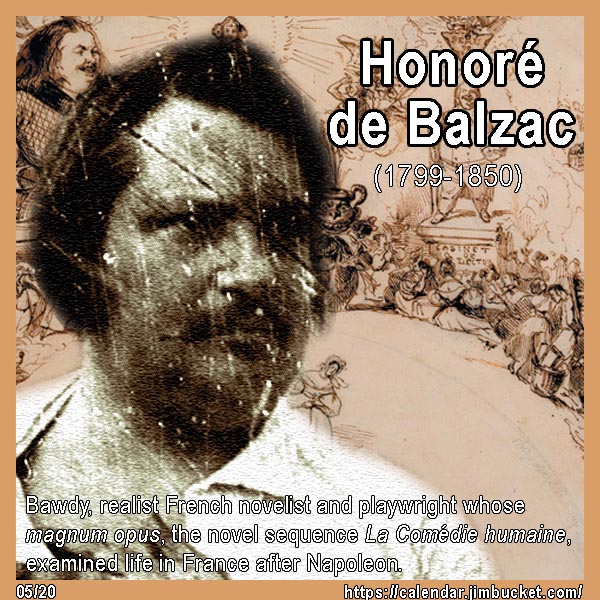
May 20: Honoré de Balzac, French novelist and playwright

BORN MAY 20:

Honoré de Balzac (1799-1850) was a famously bawdy French novelist and playwright. His magnum opus is the novel sequence La Comédie humaine (The Human Comedy), a panorama of post-Napoleonic French life. Regarded as a founder of realism in European literature, he is remembered for his multi-faceted characters; his writing influenced writers such as Zola, Dickens, Flaubert, and Henry James. He suffered from health problems (and the effects of an irascible character) throughout his life; his family relations were often strained by financial and personal drama. La Comédie humaine consists of 91 finished novels, stories, and essays, and another 46 unfinished (some of which exist only as titles). Balzac published 49 novels and novellas during his lifetime, including Eugénie Grandet,  Le Père Goriot, and La Cousine Bette; around a dozen more were published posthumously. He also published seven plays and numerous short stories. Many of his works have been adapted into films and television series.


Navigation:


Thursday, May 19, 2022

May 19: Malcolm X, American Muslim minister and civil rights activist

BORN MAY 19:

Malcolm X (1925-1965) was an American Muslim minister and icon of the civil rights movement. Born Malcolm Little, upon his release from prison at age 22 (for larceny and breaking and entering), he changed his name to "X," eschewing his "white slavemaster name" and using "X" as a signifier for his unknown African name. (After making the pilgrimage to Mecca as a member of the Nation of Islam--he had converted in prison--he changed his name again to el-Hajj Malik el-Shabazz). He stood against the mainstream non-violent civil rights movement--he called Martin Luther King Jr. a "chump" for his perceived cooperation with the "white establishment." Rejecting that strategy, he famously argued that black people should advance their cause "by any means necessary." Dozens of streets, schools, colleges, and libraries have been named after Malcolm X. He was assassinated in 1965, most likely at the hands of the Nation of Islam, though some look to the NYPD, the FBI, or the CIA.


Navigation:


Wednesday, May 18, 2022

May 18: Bertrand Russell, British philosopher and mathematician

BORN MAY 18:

Bertrand Russell (1872-1970) was a British philosopher, mathematician, historian, and activist who wrote the Principia Mathematica with Alfred North Whitehead, as well as a number of atheistic pieces such as What I Believe and Why I Am Not a Christian. He also wrote a wonderful History of Western Philosophy. Surprising, then, that given his skepticism, he received a Nobel Prize in Literature in 1950, which cited his "varied and significant writings in which he champions humanitarian ideals and freedom of thought."


Navigation:


Tuesday, May 17, 2022

May 17: Edward Jenner, English physician and scientist

BORN MAY 17:

Edward Jenner (1749-1823) was an English physician and scientist who, in creating the first smallpox vaccine, pioneered the very concept of vaccines themselves. The "father of immunology," he is a hero. In his day, smallpox was killing around 10% of the population, and as high as 20% in more densely-populated areas (towns and cities) where infection spread more easily. Had he lived today, however, he could probably not have accomplished this feat: he tested his hypothesis by injecting pus acquired from a woman with cowpox into both arms of an eight-year-old boy, the son of his gardener. The boy suffered a fever, but no full-blown infection. He then twice exposed the boy to a weakened ("variolated") form of smallpox, and he showed no signs of the disease. Jenner went on to great scientific and political achievements, and died of a stroke at 73.


Navigation:


Monday, May 16, 2022

May 16: Louis "Studs" Terkel, American author

BORN MAY 16:

Louis "Studs" Terkel (1912-2008) was an American author and historian best known for oral histories of "everyday Americans." Born in NYC, at age 8 he moved with his family to Chicago, then America's "second city," with which he was ever after associated. Though he took a law degree at U of C, he went to work in radio, taking various jobs until he landed The Studs Terkel Program in 1952, which ran 45 years until 1997; on tis show he interviewed such diverse guests as Martin Luther King Jr., Leonard Bernstein, Bob Dylan, Dorothy Parker, Tennessee Williams, and Frank Zappa. In the meantime (late '40s and early '50s) he did the unscripted Studs' Place on TV, in which famous people and interesting characters passed through his greasy-spoon diner in Chicago. All this interviewing got him into the oral history racket, for which most of us outside of Chicago know him. In the '70s he wrote Hard Times, about the Great Depression, and Working, in which (per the subtitle) "People Talk About What They Do All Day and How They Feel About What They Do." In 1985 he won a Pulitzer Prize for General Non-Fiction for "The Good War": An Oral History of World War Two. The nickname "Studs," by the way, comes from the time he was reading James T. Farrell's Studs Lonigan trilogy while acting in a play with another actor named "Louis."


Navigation:


Sunday, May 15, 2022

May 15: L. Frank Baum, American children's author

BORN MAY 15:

L. Frank Baum (1856-1919) was an American children's author best known for the Wizard of Oz and its 13 sequels. He also wrote 41 other novels, 83 short stories, over 200 poems, and at least 42 scripts, but his place in history (and in my heart) depends on the 1939 film adaptation of WoO, a perfect "hook" on which to hang Joseph Campbell's teachings about "The Hero's Journey"--especially since this time he's a she. Born in New York state, and spending most of his career in the Midwest, he died in Los Angeles trying to establish a movie studio focused on producing films for children.


Navigation:


Saturday, May 14, 2022

May 14: Thomas Gainsborough, English painter

BORN MAY 14:

Thomas Gainsborough (1727-1788) was an English painter best known--in my world, at least--for his The Blue Boy which hung (and hangs) at the Huntington Library, about five or six miles (an easy bike ride) from my childhood home. Until I was around 40, entry was free, and in my teen years I went often (often with a girl, to take pictures of her in the lush gardens). Anyway, uh, Gainsborough, yeah: One of the most important British artists of the second half of the 18th century, he was a prolific painter of portraits, also known for his landscapes. Gainsborough was a founding member of the Royal Academy. Other famous paintings (he made more than 300, 220 of which were portraits) include Mr. and Mrs. Andrews; The Watering Place; and the charming Girl with Pigs.


Navigation:


Friday, May 13, 2022

May 13: Georges Braque, French cubist

BORN MAY 13:

Name Georges Braque (1882-1963) was a French artist who co-founded (with Picasso) the modern style known as Cubism. After identifying with the Fauvist "wild beasts" from 1905, he became closely associated with Picasso until 1912. For a time the work of one was indistinguishable from that of the other, though Picasso's brash showmanship finally eclipsed Braque's fame. His later works reflect a softening of the sometimes-harsh cubist style. Cubism, by the way, is essentially an early-20th-century style in which objects are analyzed, broken up, and reassembled in an abstracted form; instead of depicting them from a single viewpoint, the artist depicts the subject from a multitude of viewpoints simultaneously to represent it in a greater context. One listing of Braque's works names 243 paintings and drawings, aside from sculptures.


Navigation:


Thursday, May 12, 2022

May 12: Dante Gabriel Rossetti, English poet and painter

BORN MAY 12:

Dante Gabriel Rossetti (actually Gabriel Charles Dante Rossetti, 1828-1882) was an English poet and painter, and one of the Rossetti clan. Co-founder of the Pre-Raphaelite Brotherhood (with William Holman Hunt and John Everett Millais), he was later the main inspiration for a second generation of artists and writers influenced by the movement, including William Morris and Edward Burne-Jones. His sensual art was part of a "medieval revival," influenced by Dante and Sir Thomas Malory, among others. His poetry includes "The Blessed Damozel" and the sonnet sequence, The House of Life.


Navigation:


Wednesday, May 11, 2022

May 11: Salvador Dali, Spanish surrealist artist

BORN MAY 11:

Salvador Dali (1904-1989) was a Spanish surrealist artist known for the striking and bizarre images in his work. He lived in France during the Spanish Civil War, and the U.S. during World War II. His genres included painting, graphic arts, film, sculpture, design, and photography, sometimes in collaboration with other artists. He also wrote: fiction, poetry, autobiography, essays, and criticism. But his public persona is perhaps better remembered than anything he produced: the mustache, the pet ocelot ("Babou"), and the public behavior that might best be interpreted as "performance art." One of his best-known paintings is the one with the dripping clocks, Persistence of Memory; the disjointed figure in Soft Construction with Boiled Beans (Premonition of Civil War); the slightly more traditional (less surrealistic) Christ of Saint John of the Cross and Crucifixion (Corpus Hypercubus); and way out there on the edge, The Hallucinogenic Toreador.


Navigation:


Tuesday, May 10, 2022

May 10: Karl Barth, Swiss theologian

BORN MAY 10:

Karl Barth (1886-1968) was a Swiss theologian known for his commentary on The Epistle to the Romans, and as part of the Confessing Church, which opposed Protestant cooperation with the Nazis. He was also working on an unfinished multi-volume Church Dogmatics. (The fourth of a planned five volumes was published mainly in note form, and the fifth was never started. What was finished was published in thirteen books.) His influence reached beyond theologians like Dietrich Bonhoeffer, Rudolf Bultmann, Hans Küng, and Reinhold Niebuhr, to novelists such as Flannery O'Connor and John Updike. A pastor like his father, he was also a university professor who lectured in the United States on a visit in 1962. In the same year he was featured on the cover of Time magazine.


Navigation: