Showing posts with label French. Show all posts

Friday, May 20, 2022

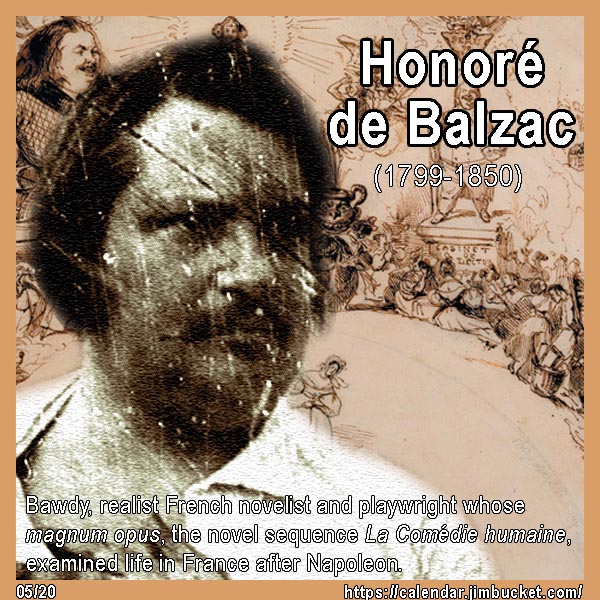
May 20: Honoré de Balzac, French novelist and playwright

BORN MAY 20:

Honoré de Balzac (1799-1850) was a famously bawdy French novelist and playwright. His magnum opus is the novel sequence La Comédie humaine (The Human Comedy), a panorama of post-Napoleonic French life. Regarded as a founder of realism in European literature, he is remembered for his multi-faceted characters; his writing influenced writers such as Zola, Dickens, Flaubert, and Henry James. He suffered from health problems (and the effects of an irascible character) throughout his life; his family relations were often strained by financial and personal drama. La Comédie humaine consists of 91 finished novels, stories, and essays, and another 46 unfinished (some of which exist only as titles). Balzac published 49 novels and novellas during his lifetime, including Eugénie Grandet,  Le Père Goriot, and La Cousine Bette; around a dozen more were published posthumously. He also published seven plays and numerous short stories. Many of his works have been adapted into films and television series.


Navigation:


Friday, May 13, 2022

May 13: Georges Braque, French cubist

BORN MAY 13:

Name Georges Braque (1882-1963) was a French artist who co-founded (with Picasso) the modern style known as Cubism. After identifying with the Fauvist "wild beasts" from 1905, he became closely associated with Picasso until 1912. For a time the work of one was indistinguishable from that of the other, though Picasso's brash showmanship finally eclipsed Braque's fame. His later works reflect a softening of the sometimes-harsh cubist style. Cubism, by the way, is essentially an early-20th-century style in which objects are analyzed, broken up, and reassembled in an abstracted form; instead of depicting them from a single viewpoint, the artist depicts the subject from a multitude of viewpoints simultaneously to represent it in a greater context. One listing of Braque's works names 243 paintings and drawings, aside from sculptures.


Navigation:


Saturday, April 16, 2022

Apr. 16: Anatole France, French "man of letters"

BORN APRIL 16:

Anatole France (born François-Anatole Thibault, 1844-1924) was a French poet, journalist, and novelist; he had several best-sellers, and was considered the "ideal French man of letters" in his day--indeed, the citation for his 1921 Nobel Prize in Literature mentioned that he had "a true Gallic temperament." He grew up in his father's bookstore, which specialized in the French Revolution. His many novels include Thaïs, about a legendary 4th-century female Egyptian saint; At the Sign of the Reine Pédauque, about the tribulations of a young man at the beginning of the 18th century; Penguin Island, a satirical fictional history, in which a nearly-blind missionary baptizes a bunch of birds and the Lord, to fix the problem, turns the birds into humans (they establish Penguinia, a country with a history which mirrors that of France); The Gods Are Athirst, about the rise and fall of a painter-turned-jurist in the dark years of the Reign of Terror during the French Revolution; and The Revolt of the Angels, about the well-known story of the war in heaven between the angels led by the Archangel Michael and those led by Satan. He also wrote poetry, memoirs, plays, and literary and social criticism.


Navigation:


Saturday, April 9, 2022

Apr. 9: Charles Baudelaire, French poet

BORN APRIL 9:

Charles Baudelaire (1821-1867) was a French poet, essayist, and art critic. Though his poems are Romantic in some respects, unlike those flights of fancy they are based on observations of real life. His most famous work was a book of lyric poetry entitled Les Fleurs du mal (The Flowers of Evil), which expresses the changing concepts of beauty as France industrialized during the mid-19th century. He seems to have coined the term modernity to describe the fleeting experience of life in the city, and the urgency for artists to capture that experience. His work influenced later French poets like Paul Verlaine, Arthur Rimbaud, and Stéphane Mallarmé, among many others.


Navigation:


Sunday, March 13, 2022

Mar. 13: Mircea Eliade, Romanian historian of religion

BORN MARCH 13:

Mircea Eliade (1907-1986) Romanian historian of religion, philosopher, and fiction writer. Few thinkers have influenced my worldview as much as has Dr. Eliade (the advisor for my unfinished PhD had Eliade as his advisor for his PhD). His framing of religious thought in works like The Sacred and the Profane (the "two modes of being in the world") or The Myth of the Eternal Return: Cosmos and History is as useful as anything I've encountered. The books are short but deep, and deserve (require!) rereading. His book Shamanism popularized that word in religious discourse in English; From Primitives to Zen is a collection of religious texts that go, well, from indigenous cultures to Zen Buddhism (but excluding Judaism and Christianity as already readily available). Eliade is a must-read for anyone interested in humanity's approaches to "that world."


Navigation:


Monday, March 7, 2022

Mar. 7: Maurice Ravel, French composer

BORN MARCH 7:

Maurice Ravel (1875-1937) was a French composer, pianist and conductor who shot to popular acclaim when his Bolero was used as the soundtrack for the Blake Edwards comedy 10 (which also bought Bo Derek her 15 minutes of fame). The piece was still under copyright at the time, and generated an estimated $1 million in royalties for Ravel's estate, making him the best-selling classical composer 40 years after his death. Among his other notable works is the orchestration for Mussorgsky's Pictures at an Exhibition, originally a piano suite. He was also among the first composers to recognize the potential of recording to bring their music to a wider public, and was internationally regarded as France's greatest living composer in the 1920s and 1930s.


Navigation:


Monday, February 28, 2022

Feb. 28: Montaigne, French essayist

BORN FEBRUARY 28:

Michel Eyquem de Montaigne (1533-1592), known simply as Montaigne, was a French essayist. Though the French word "essayer," meaning "to try or attempt," existed before Montaigne, it was his use of the word that led to our understanding of the term today as a short piece of writing exploring a particular subject. ("Attempt" or "try" is still a secondary meaning.) His 107 essays cover a wide range of subjects, from "Of Sadness and Sorrow" to "Of Conscience," from "Of Smells" to "Of Posting [Letters]." Nothing escaped his keen mind and clear expression.


Navigation:


Saturday, February 26, 2022

Feb. 26: Victor Hugo, French author

BORN FEBRUARY 26:

Victor Hugo (1802-1885) French author, considered one of the greatest writers in the French language. Exiled for political reasons for 15 years in mid-life, he returned a national hero. As he entered his 80th year, Paris celebrated by holding a six-hour parade past his house, and the street he lived on was renamed in his honor. Best known as a poet in French, he's better known to readers of English for two novels: Notre-Dame de Paris (English title The Hunchback of Notre-Dame), and Les Miserables, a book far more complex than the movies (and musical) based on it. Hugo is buried in the Pantheon, a place of honor, with the likes of Rousseau, Voltaire, Dumas, and the Curies; and his face has been used on French currency.


Navigation:


Friday, February 25, 2022

Feb. 25: Pierre-Auguste Renoir, French artist

BORN FEBRUARY 25:

Pierre-Auguste Renoir (1841-1919) was a French artist and a leader in the development of Impressionism, a celebrator of beauty and especially feminine sensuality. At times in his student days he could not afford to buy paint; in 1990 one of his paintings sold for $78.1 million. His sons Pierre, Jean, and Claude all became artists (an actor, filmmaker, and ceramicist respectively). Outstanding among his several thousand paintings are Dance at Le Moulin de la Galette, Luncheon of the Boating Party, Girls at the Piano, and A Girl with a Watering Can.


Navigation:


Tuesday, February 8, 2022

Feb. 8: Jules Verne, French novelist

BORN FEBRUARY 8:

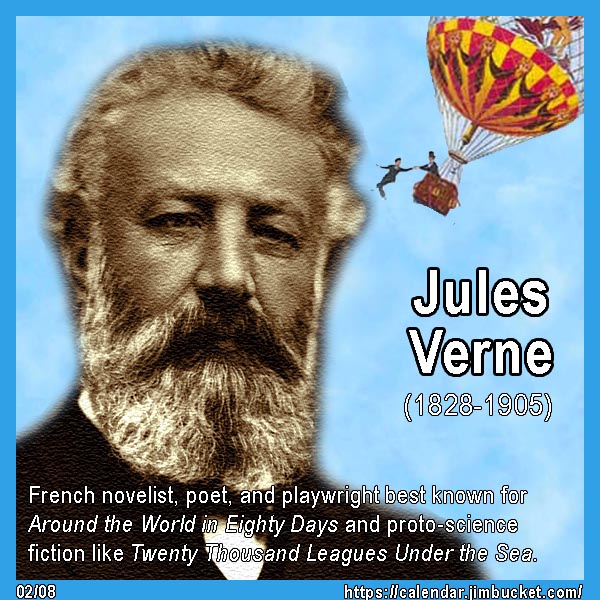
Jules Verne (1828-1905) famed French novelist, poet, and playwright who contributed greatly to the development of science fiction. Perhaps his best-known work (due to its filmed versions) is Around the World in Eighty Days, and for the same reason Twenty Thousand Leagues Under the Sea. But Journey to the Center of the Earth and From the Earth to the Moon have also proven enduring; alas about 50 more not so much.


Navigation:


Friday, February 4, 2022

Feb. 4: Francois Rabelais, French writer, physician, and monk

BORN FEBRUARY 4:

Francois Rabelais (1494-1553) French humanist writer, physician, and monk primarily known as a writer of satire, of the grotesque, and of bawdy jokes and songs. Best known is Gargantua and Pantagruel (which gives us the word "gargantuan"), peopled by giants to expose his outsized parody of the outdated (medieval) views of the institutions of his day--including the church which he served. "Rabelaisian" has come to mean "marked by gross robust humor, extravagance of caricature, or bold naturalism" (per Merriam-Webster). [N.B.: Many sources express doubt about the date (and even the year) of his birth; this one seems traditional.]


Navigation:


Friday, January 28, 2022

Jan. 28: Colette, French novelist

BORN JANUARY 28:

Colette (1873-1954) French novelist who wrote Gigi, about a sixteen-year-old trained to catch a wealthy lover but who married him instead. With her first husband Henry Gauthier-Villars (known as "Willy"), she co-wrote the four novels known as the "Claudine stories," purporting to be the diary of a fifteen-year-old girl growing to adulthood. How much was written by Willy (under whose name the books first appeared) and how much by Collette (a model for the protagonist) has never been determined.

Navigation:


Sunday, January 23, 2022

Jan. 23: Stendhal, French novelist

BORN JANUARY 23:

Stendhal (born Marie-Henri Beyle; 1783-1842) French realist novelist. He wrote Le Rouge et le Noir (The Red and the Black, referencing the protagonist's tension between secular and clerical interests) and La Chartreuse de Parme (The Charterhouse of Parma), about the adventures of a young Italian nobleman.


Navigation:


Sunday, January 9, 2022

Jan. 9: Simone de Beauvoir, French writer and philosopher

BORN JANUARY 9:

Simone de Beauvoir (1908-1986) French novelist, philosopher, and pioneering feminist (though she would have rejected the label); She Came to Stay; The Second Sex; Memoirs of a Dutiful Daughter.


Navigation:


Friday, December 31, 2021

Dec. 31: Henri Matisse, French artist

BORN DECEMBER 31:

Henri Matisse (1869-1954) French artist, one of the Fauves (wild beasts) known for their use of intense color. He is commonly regarded, with Picasso, as one of the artists responsible for significant developments in 20th-century arts. Representative works include Woman with a Hat; The Joy of Life; Nu bleu; and La Danse.


Navigation:


Thursday, December 23, 2021

Dec. 23: Charles Augustin Sainte-Beuve, French writer

BORN DECEMBER 23:

Charles Augustin Sainte-Beuve (1804-1869) French literary critic widely translated into English. Port-Royal--considered his masterpiece--is an exhaustive history of an abbey near Paris, a work which influenced later writers on writing about religious belief, as well as areas of philosophy and esthetics. He also wrote "What Is a Classic?" and a notable essay on "Montaigne."


Navigation:


Wednesday, December 22, 2021

Dec. 22: Jean-Henri Fabre, French scientist and writer

BORN DECEMBER 22:

Jean-Henri Fabre (1823-1915) French naturalist, entomologist, and author who wrote works on insects, especially for younger readers. Known for his "lively style," Fabre was the rare individual who could teach something about bugs while keeping it "fun." Try Fabre's Book of Insects, a retelling of his Souvenirs entomologiques (also worth a look--if you read French).


Navigation:


Sunday, December 19, 2021

Dec. 19: Jean Genet, French writer

BORN DECEMBER 19:

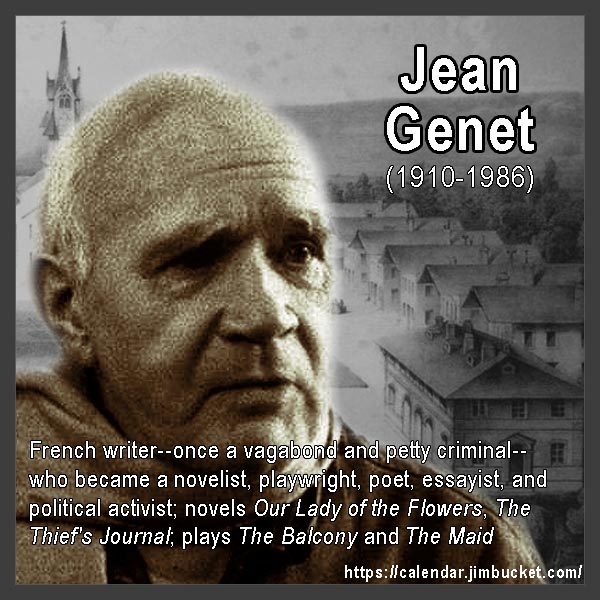
Jean Genet (1910-1986) French writer--once a vagabond and petty criminal--who became a novelist, playwright, poet, essayist, and political activist; novels include the largely-autobiographical Our Lady of the Flowers and The Thief's Journal (only partly autobiographical); and the plays The Balcony and The Maids (not at all autobiographical, as far as I can tell).


Navigation:


Sunday, December 12, 2021

Dec. 12: Gustave Flaubert, French writer

BORN DECEMBER 12:

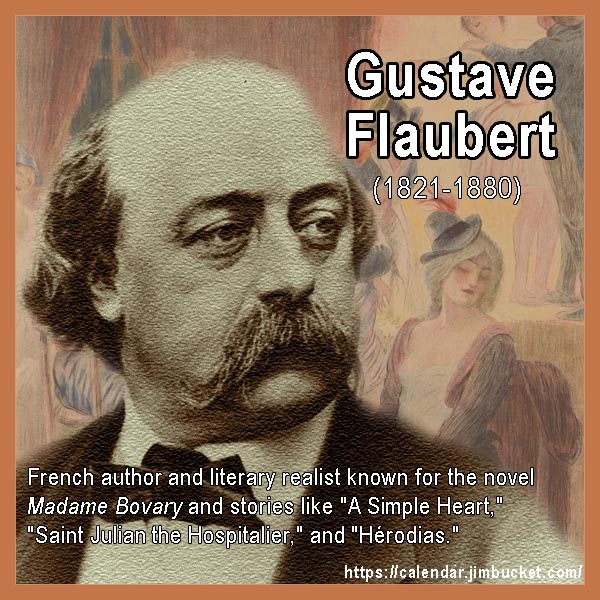
Gustave Flaubert (1821-1880) French author, and leading French exponent of literary realism in his country. His debut novel Madame Bovary made his name; no less than Guy de Maupassant was his protégé. His stories include "A Simple Heart," "Saint Julian the Hospitalier," and "Hérodias."


Navigation:


Thursday, December 2, 2021

Dec. 2: Georges Seurat, French painter

BORN DECEMBER 2:

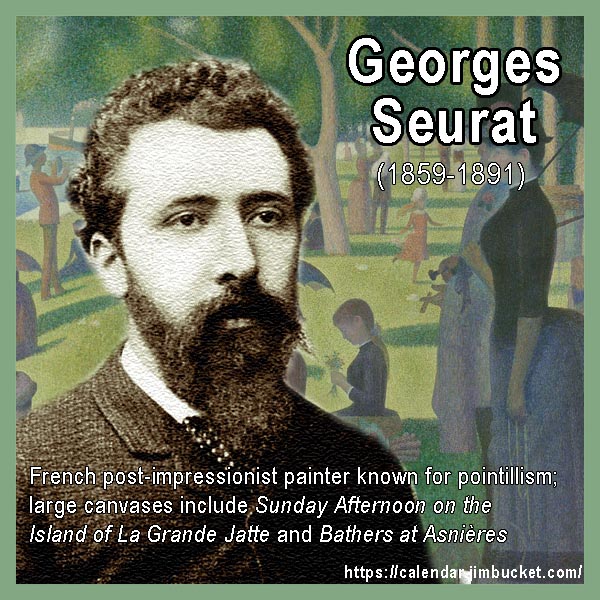
Georges Seurat (1859-1891) French post-impressionist painter known for pointillism, the formation of an image out of monochrome dots--not unlike the use of pixels today. His large 1886 Sunday Afternoon on the Island of La Grande Jatte (6.6 × 9.8 feet, or 2 x 3 meters) inspired Stephen Sondheim's 1984 Pulitzer Prize-winning Broadway musical Sunday in the Park with George. Seurat's other large work of about the same size, Bathers at Asnières, prompted a critic to call it "monstrous" and "conceived in a coarse, vulgar, and commonplace mind." Posterity differs.


Navigation: