Showing posts with label April. Show all posts

Saturday, April 30, 2022

Apr. 30: Annie Dillard, American writer

BORN APRIL 30:

Annie Dillard (1945 - ) is an American writer whose Pilgrim at Tinker Creek won the 1975 Pulitzer Prize for General Nonfiction. It is a first-person account of the narrator's explorations near her home with various contemplations on nature and life. It is divided into four sections, each indicating a season of a single year. It is based on Dillard's personal journals; it should come as no surprise to learn that her master's thesis was about Thoreau's Walden. Tinker Creek itself is outside Roanoke, Virginia, in the Blue Ridge Mountains. She taught for over 20 years at Wesleyan University; in addition to Pilgrim she has written poetry, two novels, essays, prose, literary criticism, and one memoir.


Navigation:


Friday, April 29, 2022

Apr. 29: Duke Ellington, American jazz composer and performer

BORN APRIL 29:

(Edward Kennedy) "Duke" Ellington (1899-1974) was an American jazz composer and performer who fronted his own jazz orchestra for half a century. Some of jazz's biggest names were associated with his work, including singers Billie Holiday and Ella Fitzgerald, saxophonist Johnny Hodges, composer-arranger-pianist Billy Strayhorn, trumpeter Cootie Williams, and many more. He performed on radio, in film ,and on TV, touring Europe and crossing color lines. His compositions (too many to number) include "Take the "A" Train"; "In a Sentimental Mood"; "Mood Indigo"; "It Don't Mean a Thing (If It Ain't Got That Swing)"; "Cocktails for Two"; "Black and Tan Fantasy"; " Solitude"; and many more. Nearly 80 of his performances hit the charts, and he earned 14 Grammy awards between 1959 and 2000 (three of them posthumous) out of a total 24 nominations. One of these was a Lifetime Achievement Award, and nine of his recordings (seven singles and two albums) are in the Grammy Hall of Fame.


Navigation:


Thursday, April 28, 2022

Apr. 28: Harper Lee, American novelist

BORN APRIL 28:

(Nelle) Harper Lee (1926-2016) was an American novelist. When her first (and almost only) novel, To Kill a Mockingbird, was published in 1960 (and won the 1961 Pulitzer Prize for Fiction), she was not an unknown in the publishing world. She was a lifelong friend of Truman Capote ("Dill" in TKAM was based on him). His first novel was published in 1948, and Breakfast at Tiffany's ten years later; she lived near him in Manhattan, and accompanied him to Kansas to do the research on In Cold Blood. At Christmas in 1956, friends gave her a gift of a year's wages with a note: "You have one year off from your job to write whatever you please. Merry Christmas." What she wrote was a mangled manuscript called Go Set a Watchman. With the help of seasoned editor Tay Hohoff at Lippincott, it became the polished To Kill a Mockingbird, a book which she said was not a "coming of age" story but a look at the irrational prejudices of adults as seen through the eyes of children. She was never to publish another novel until in 2015, HarperCollins announced it would publish Go Set a Watchman, first described as a "sequel" to TKAM, but later admitted to be an early draft. Allegations that unscrupulous background players (a lawyer, an agent, etc.) coerced Lee into doing what she said she never would--publish another novel--were never proven, though it is suspicious that this all happened just two and a half months after her sister--a lawyer who had been her protector--passed away. (I refuse to read it, not least because it portrays my one of my fictional heroes, Atticus Finch, as something of a racist.)


Navigation:


Wednesday, April 27, 2022

Apr. 27: Edward Gibbon, English historian

BORN APRIL 27:

Edward Gibbon (1737-1794) was an English historian whose modern reputation rests almost solely on his monumental six-volume The Decline and Fall of the Roman Empire. The work exhibited meticulous sourcing and a full frontal criticism of organized religion; it traces Western civilization (as well as the Islamic and Mongolian conquests) from the height of the Roman Empire to the fall of Byzantium in the fifteenth century.


Navigation:


Monday, April 25, 2022

Apr. 25: Ella Fitzgerald, American jazz singer

BORN APRIL 25:

Ella Fitzgerald (1917-1996) was an American jazz singer who got saddled with silly nicknames like "the First Lady of Song", "Queen of Jazz", and "Lady Ella." These don't come close to expressing the purity of her voice or her masterful phrasing, timing, and intonation. Her ability to improvise (including "scat singing") put her in a class by herself. Her rendition of the nursery rhyme "A-Tisket, A-Tasket" with the Chick Webb orchestra put her on the map; her association with manager Norman Granz led to the formation of Verve Records to produce her music. She did movies and TV guest spots, and had long, fruitful collaborations with Louis Armstrong, Duke Ellington, and The Ink Spots among others. She gave her last performance at age 76 and died three years later in poor health, having received fourteen Grammy Awards, the National Medal of Arts, and the Presidential Medal of Freedom. It's impossible to pick out single performances, but try "Mr. Paganini," "How High the Moon," and "It Don't Mean a Thing (If It Ain't Got That Swing)" for starters.

#TJBLCalendar


Navigation:


Sunday, April 24, 2022

Apr. 24: Anthony Trollope, English novelist

BORN APRIL 24:

Anthony Trollope (1815-1882) was an English novelist probably best known today for the the six novels of the series The Chronicles of Barsetshire, which included Barchester Towers. He wrote another series of six, a series of five, and 30 stand alone novels; over 40 short stories; 17 works of non-fiction; at least 20 articles; two plays; and several volumes of collected letters. This raises the question: how did he become "one of the most prolific writers of all time" while fulfilling his duties as a postal clerk and inspector? The answer was: a new-found discipline (previously he had been known as unpunctual and insubordinate) that pushed him to write on the trains during his inspection journeys. (There's a lesson in this for you, Jim Bucket!)


Navigation:


Saturday, April 23, 2022

Apr. 23: J. M. W. Turner, English painter

BORN APRIL 23:

J. M. W. Turner (1775-1851) was an English painter known for the expressive use of light and color in his paintings, as well as his imaginative landscapes. He produced over 550 oil paintings, 2,000 watercolors, and 30,000 works on paper. Today he is regarded as having elevated landscape painting to equal the eminence of painting historical subjects. He was a very private person who never married, but fathered two daughters by his housekeeper. In his final years he lived in squalor and poor health. His works include Dido building Carthage; The Burning of the Houses of Lords and Commons; Agrippina Landing with the Ashes of Germanicus; and Sunrise with Sea Monsters (a favorite, which--though incomplete--epitomizes his style).


Navigation:


Friday, April 22, 2022

Apr. 22: Otto Rank, Austrian psychoanalyst

BORN APRIL 22:

Otto Rank (1884-1939) was an Austrian psychoanalyst, writer, and teacher; never anyone's household name, he influenced my thinking by laying much of the groundwork for the ideas of Joseph Campbell in his The Myth of the Birth of the Hero. (Other spicy titles include The Incest Theme in Literature and Legend and The Trauma of Birth.) He is said to have influenced such seemingly-disparate thinkers and creators as Matthew Fox, Anaïs Nin, Henry Miller, Lawrence Durrell, Nella Larsen, Salvador Dalí, Martha Graham, and Samuel Beckett.


Navigation:


Thursday, April 21, 2022

Apr. 21: John Muir, Scottish-born Californian conservationist

BORN APRIL 21:

Name John Muir (1838-1914) was a Scottish-born Californian conservationist who was called "John of the Mountains" and "Father of the National Parks" for his influence on the wilderness preservation policies of the U.S. He was a self-taught botanist, zoologist, glaciologist, naturalist, author, and environmental philosopher. According to one article, "at least one high school, 21 elementary schools, six middle schools, and one college" have been "named after him, as well as a glacier, a mountain, a woods, a cabin, an inlet, a highway, a library, a motel, a medical center, a tea room and a minor planet." He helped preserve the Yosemite Valley and Sequoia National Park, and co-founded The Sierra Club, a prominent American conservation organization. His letters, essays, and books have been read by millions. Alas, in recent years his racism toward Native Americans and Blacks has emerged, and the Sierra Club has found itself apologizing for his views and taking steps to correct the harm done by this part of his legacy. Notable books include The Mountains of California; Our National Parks; My First Summer in the Sierra; and The Yosemite.


Navigation:


Wednesday, April 20, 2022

Apr. 20: Joan Miró , Spanish painter and sculptor

BORN APRIL 20:

Joan Miró (1893-1983) was a Spanish painter and sculptor born in Barcelona, where a museum has been dedicated to his work. He earned international acclaim for his Surrealistic work with a personal style. Its childlike nature reflects his interest in the human unconscious or subconscious mind. An iconoclast, he stated his contempt for conventional painting methods as a way of supporting bourgeois society, and declared an "assassination of painting" in favor of upsetting established paintings' visual elements.


Navigation:

Tuesday, April 19, 2022

Apr. 19: José Echegaray, Spanish dramatist

BORN APRIL 19:

José Echegaray (1832-1916) was one of the leading Spanish dramatists of the end of the 19th century, and received the 1904 Nobel Prize for Literature (shared with the Provençal poet Frédéric Mistral) for reviving "the great traditions of the Spanish drama." After a career as a professor of mathematics and engineering, and another as a government minister (starting after the revolution of 1868 overthrew the monarchy, and ending when the First Spanish Republic ended in 1874), he indulged in what had always been the love of his life: drama. It is said that he replicated the achievements of his predecessors of the Spanish Golden Age, such as Lope de Vega. One of his greatest works, El Gran Galeoto, is based on the story of Paolo and Francesca in Dante's Divine Comedy, itself derived from the story of Lancelot and Guinevere. Echegaray was a prolific author; one catalog lists nearly 80 plays written from 1874, and nearly 30 works of non-fiction.


Navigation:


Monday, April 18, 2022

Apr. 18: Thomas Middleton, English playwright and poet

BORN APRIL 18:

Thomas Middleton (1580-1627) was an English playwright and poet whose life overlapped that of Shakespeare. Some scholars believe that he collaborated with The Bard on All's Well That Ends Well and Timon of Athens; another play, A Yorkshire Tragedy, was long attributed to Shakespeare, but modern critics have examined the style and determined it to be Middleton's. With John Fletcher and Ben Jonson, Middleton was one of the most successful playwrights of the Jacobean period (the reign of King James, successor to Queen Elizabeth). Proficient at writing both comedy and tragedy, he also wrote a large number of masques and pageants (elaborate productions that included pantomime and dancing, and later dialogue and song, given by amateur and professional actors). His plays are still staged, and the number of productions is increasing. T. S. Eliot thought him second only to Shakespeare.


Navigation:


Saturday, April 16, 2022

Apr. 16: Anatole France, French "man of letters"

BORN APRIL 16:

Anatole France (born François-Anatole Thibault, 1844-1924) was a French poet, journalist, and novelist; he had several best-sellers, and was considered the "ideal French man of letters" in his day--indeed, the citation for his 1921 Nobel Prize in Literature mentioned that he had "a true Gallic temperament." He grew up in his father's bookstore, which specialized in the French Revolution. His many novels include Thaïs, about a legendary 4th-century female Egyptian saint; At the Sign of the Reine Pédauque, about the tribulations of a young man at the beginning of the 18th century; Penguin Island, a satirical fictional history, in which a nearly-blind missionary baptizes a bunch of birds and the Lord, to fix the problem, turns the birds into humans (they establish Penguinia, a country with a history which mirrors that of France); The Gods Are Athirst, about the rise and fall of a painter-turned-jurist in the dark years of the Reign of Terror during the French Revolution; and The Revolt of the Angels, about the well-known story of the war in heaven between the angels led by the Archangel Michael and those led by Satan. He also wrote poetry, memoirs, plays, and literary and social criticism.


Navigation:


Friday, April 15, 2022

Apr. 15: Leonardo da Vinci, Italian "Renaissance Man"

BORN APRIL 15:

Leonardo da Vinci (1452-1519) was an Italian polymath. When people say "Renaissance Man," I think of Leonardo. Bastard son of a pencil-pushing lawyer and a lower-class mom named Caterina, he was followed by a dozen half-siblings much younger than he, one by some 40 years. (Dad was busy.) Both his mother and father married--to other people--the year after he was born. But he had the good fortune to grow up 20 miles from Florence, where he studied and worked for the artist Verrocchio (who himself was a student of the great sculptor Donatello). But beyond the Mona Lisa and the Last Supper, he worked as a military engineer. His Notebooks and manuscripts run to around 13,000 pages, including some rather mundane things like lists of groceries and people who owed him money. But there are also sketches for paintings and projects never realized; scientific studies of anatomy and biology; architectural drawings; "flying machines," including a prototype for a helicopter; a sort of tank; a chariot with spinning scythes out in front of the horses; shoes for walking on water; musical instruments; a mechanical knight; hydraulic pumps; finned mortar shells; and a steam-powered cannon. He may well have been homosexual. His tenderness for animals (he purchased caged birds and released them, but this may have been to observe their flight) suggests he may have been vegetarian.


Navigation:


Thursday, April 14, 2022

Apr. 14: Christiaan Huygens, Dutch mathematician and scientist

BORN APRIL 14:

Christiaan Huygens (1629-1695) was a Dutch mathematician, astronomer, and physicist who made groundbreaking contributions in mechanics and optics (where, he is best known for his wave theory of light; the Treatise on Light is one of his major works). He has been called the first theoretical physicist and is one of the founders of modern mathematical physics. He improved the design of telescopes and discovered Saturn's largest moon, Titan (the first to be discovered). He also invented the pendulum clock, a breakthrough in timekeeping and the most accurate way of keeping time for almost 300 years.


Navigation:


Wednesday, April 13, 2022

Apr. 13: Thomas Jefferson, American president and polymath

BORN APRIL 13:

Thomas Jefferson (1743-1826) was an American statesman, lawyer, architect, philosopher, and U.S. Founding Father who was the new nation's first secretary of state (under George Washington), second vice president (under John Adams) and third president. His resume was such that President John F. Kennedy in 1962 told a group of Nobel Prize winners at a White House dinner: "I think this is the most extraordinary collection of talent, of human knowledge, that has ever been gathered together at the White House, with the possible exception of when Thomas Jefferson dined alone. Someone once said that Thomas Jefferson was a gentleman of 32 who could calculate an eclipse, survey an estate, tie an artery, plan an edifice, try a cause, break a horse, and dance the minuet." His reputation has been tarnished by the keeping of over 600 slaves on his plantation, Monticello, but at least he took one step toward eventual emancipation by signing the Act Prohibiting Importation of Slaves in 1807. Nevertheless, he fathered at least six children with Sally Hemings, a mixed-race enslaved woman who was his late wife's half-sister. He was a man of many accomplishments: the principal author of the Declaration of Independence; president of the American Philosophical Society; knew several languages; founded the University of Virginia; made the Louisiana Purchase (doubling the nation's size) and sending out Lewis and Clark's "Corps of Discovery" to obtain scientific, geographic, and ethnological knowledge. Jefferson died on July 4, 1826, the 50th anniversary of U.S. independence, and the same day as his long-time friend (and sometime political rival) John Adams. Historians generally rank Thomas Jefferson as one of the greatest presidents in American history.


Navigation:


Tuesday, April 12, 2022

Apr. 12: Francisco Garces, Spanish Franciscan missionary

BORN APRIL 12:

Name Francisco Garces (1738-1781) was a pioneering Spanish Franciscan missionary and explorer of northern Mexico, the American southwest, and both Californias. Born in Aragon in north-central Spain, he was ordained a priest in 1763. He was among the Franciscans who replaced the Jesuits when the King of Spain expelled them from his domains, and was assigned to the renowned Mission San Xavier del Bac now near Tucson, Arizona. (He was in the group of Franciscans that took charge of present-day Sonora, Mexico and Arizona, USA. Other Franciscans, under the doughty Junípero Serra, took Baja California and expanded into what is now the state of California, USA.) Not resting on his laurels, Garcés conducted extensive explorations in the Sonoran, Colorado, and Mojave Deserts, along the Gila River, and the Colorado River from the Gulf of California and Lower Colorado River Valley to the Grand Canyon, recording encounters with the Native American tribes along the way. Twice he traveled with the conquistador Juan Bautista de Anza, and also entered the San Joaquin Valley in 1776. With Juan Díaz he established two missions on the lower Colorado River near modern Yuma; in July 1781, he and his fellow friars were killed in a violent native uprising. He left behind two diaries (available online in English and Spanish), one covering the first de Anza expedition (January-July, 1774) and the other covering the second (October-December, 1776).


Navigation:


Monday, April 11, 2022

Apr. 11: Leo Rosten, American humorist

BORN APRIL 11:

Leo Rosten (1908-1997) was an American humorist once called "the Jewish James Thurber." He was well-known for New Yorker short stories about his character "Hyman Kaplan," but I treasure him for his humorous dictionary, The Joys of Yiddish, containing a lexicon of common words and phrases of "Yinglish"--Yiddish English--origin. In virtually every case his explanations were followed by a joke. A well-known example: chutzpah is "that quality enshrined in a man who, having killed his mother and father, throws himself on the mercy of the court because he is an orphan." Brilliant.


Navigation:


Sunday, April 10, 2022

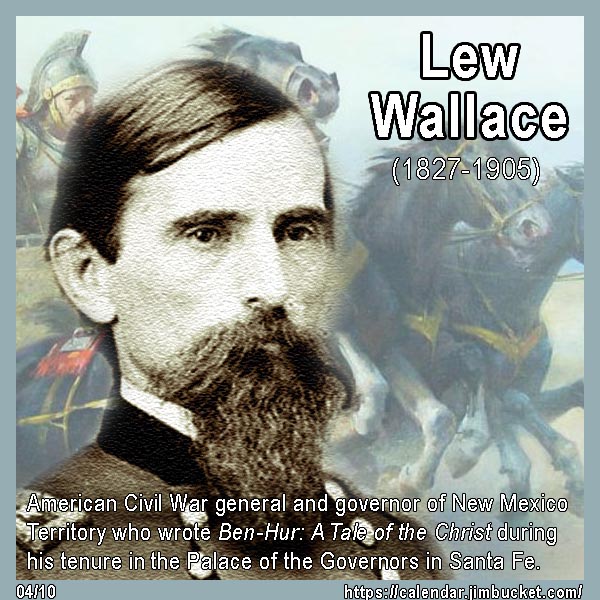
Apr. 10: Lew Wallace, American writer

BORN APRIL 10:

Lew Wallace (1827-1905) was an American lawyer and a Union general in the American Civil War. (He also served on the military commission for the trials of the Lincoln assassination conspirators.) He later served as governor of the New Mexico Territory, during which time he completed his most famous work (while living at the Palace of the Governors in Santa Fe), Ben-Hur, subtitled A Tale of the Christ. It has been called "the most influential Christian book of the nineteenth century," and is known to a certain generation of moviegoers for the epic 1959 film version, which won a record 11 Academy Awards in 1960. Published in 1880, it was the first book to dislodge Harriet Beecher Stowe's 1852 Uncle Tom's Cabin in sales, and was itself not bumped from the top of the US all-time bestseller list until 1936 with the publication of Margaret Mitchell's Gone with the Wind. The protagonist, Judah Ben-Hur, was a Jewish prince from Jerusalem enslaved by the Romans at the beginning of the first century CE. Parallel to his narrative is that of Jesus, from the same region and around the same age. The two young men's lives intersect throughout the story, and Judah converts to Christianity late in the story.


Navigation:


Saturday, April 9, 2022

Apr. 9: Charles Baudelaire, French poet

BORN APRIL 9:

Charles Baudelaire (1821-1867) was a French poet, essayist, and art critic. Though his poems are Romantic in some respects, unlike those flights of fancy they are based on observations of real life. His most famous work was a book of lyric poetry entitled Les Fleurs du mal (The Flowers of Evil), which expresses the changing concepts of beauty as France industrialized during the mid-19th century. He seems to have coined the term modernity to describe the fleeting experience of life in the city, and the urgency for artists to capture that experience. His work influenced later French poets like Paul Verlaine, Arthur Rimbaud, and Stéphane Mallarmé, among many others.


Navigation: