Showing posts with label Italian. Show all posts

Tuesday, May 3, 2022

May 3: Niccolo Machiavelli, Italian Renaissance author

BORN MAY 3:

Niccolo Machiavelli (1469-1527) was an Italian Renaissance diplomat, author, philosopher, and historian best known for The Prince (Il Principe), written about 1513 but not published until 1532. He also wrote comedies, songs, and poetry, but in most people's minds he was a ruthless political animal who advocated the unscrupulous acts in The Prince. One of his leadership maxims was, "It is better to be feared than to be loved"; he claimed that throughout the course of  history, politics had always been played with deception, treachery, and criminal acts: any action could be excused if it benefited the ruler. Some are unsure whether Machiavelli believed these things and was recommending them to rulers, or perhaps was just publicizing them as a warning to an unwary public. Some even see them as satire, a serious jester's slap at bad rulers. In any case, the term "Machiavellian" has come to describe these cunning, scheming, and unscrupulous actions.


Navigation:


Friday, April 15, 2022

Apr. 15: Leonardo da Vinci, Italian "Renaissance Man"

BORN APRIL 15:

Leonardo da Vinci (1452-1519) was an Italian polymath. When people say "Renaissance Man," I think of Leonardo. Bastard son of a pencil-pushing lawyer and a lower-class mom named Caterina, he was followed by a dozen half-siblings much younger than he, one by some 40 years. (Dad was busy.) Both his mother and father married--to other people--the year after he was born. But he had the good fortune to grow up 20 miles from Florence, where he studied and worked for the artist Verrocchio (who himself was a student of the great sculptor Donatello). But beyond the Mona Lisa and the Last Supper, he worked as a military engineer. His Notebooks and manuscripts run to around 13,000 pages, including some rather mundane things like lists of groceries and people who owed him money. But there are also sketches for paintings and projects never realized; scientific studies of anatomy and biology; architectural drawings; "flying machines," including a prototype for a helicopter; a sort of tank; a chariot with spinning scythes out in front of the horses; shoes for walking on water; musical instruments; a mechanical knight; hydraulic pumps; finned mortar shells; and a steam-powered cannon. He may well have been homosexual. His tenderness for animals (he purchased caged birds and released them, but this may have been to observe their flight) suggests he may have been vegetarian.


Navigation:


Tuesday, March 15, 2022

Mar. 15: Cesare Beccaria, Italian philosopher and jurist

BORN MARCH 15:

Cesare Beccaria (1738-1794) was an Enlightenment-era Italian philosopher with some truly enlightened ideas. A criminologist and jurist, he is well-remembered for his work On Crimes and Punishments (1764), which argued against torture and the death penalty. This was a founding work in the fields of penology and criminology. Thus, Beccaria is considered the "father of modern criminal law" and the "father of criminal justice." As such, his ideas had a profound effect on the Founding Fathers of the United States as they framed the rights enumerated in the Constitution and its Bill of Rights.


Navigation:


Sunday, March 6, 2022

Mar. 6: Michelangelo Buonarroti, Italian artist

BORN MARCH 6:

Michelangelo Buonarroti (1475-1564) was an Italian sculptor, painter, architect, poet, to some the epitome of an artist ("His work is good, but he's no Michelangelo"). His contemporaries called him Il Divino, "The Divine One." Not particularly well-known today for his homoerotic poetry, he is better remembered for his monumental sculpture of David (relaxed but alert just before slaying Goliath, sling draped over his shoulder); the excruciating Pietà, with the crucified Christ in his mother's lap; the painting of The Last Judgment with over 300 figures, covering the whole altar wall of the Sistine Chapel; and of course the astonishing, awe-inspiring ceiling of that same chamber, with a similar number of figures. Il Divino indeed.


Navigation:


Friday, March 4, 2022

Mar. 4: Antonio Vivaldi, Italian composer

BORN MARCH 4:

Antonio Vivaldi (1678-1741) was an Italian Baroque composer, virtuoso violinist, teacher, impresario, and Roman Catholic priest (active for only 18 months, perhaps due to poor health, but he remained ordained the rest of his life). Born in Venice, and regarded as one of the greatest Baroque composers, he was influential across Europe during his lifetime, influencing among others Johann Sebastian Bach. His best-known piece is a suite of four violin concertos called the Four Seasons. Within a year of his death he moved to Vienna; his patron died shortly after his arrival, and he shortly after that, in poverty. His works are still being rediscovered, literally, one as recently as 2006.


Navigation:


Tuesday, February 15, 2022

Feb. 15: Galileo Galilei, Italian astronomer

BORN FEBRUARY 15:

Galileo Galilei (1564-1642) Italian astronomer, physicist and engineer variously called the "father" of observational astronomy, modern physics, the scientific method, and modern science, who studied applied physics and used the telescope to observe the phases of Venus, the four largest satellites of Jupiter, Saturn's rings, and lunar craters, and sunspots. His observations were published in the marvelously-titled The Starry Messenger. His advocacy of the Copernican view that the earth revolves around the sun got him in hot water with the Roman Inquisition, which concluded that the theory contradicted Holy Scripture. Galileo defended his views in Dialogue Concerning the Two Chief World Systems (the Copernican and the traditional Ptolemaic, which said that everything circled the earth). He was tried by the Inquisition and forced to recant, and spent the rest of his life under house arrest.


Navigation:


Thursday, January 20, 2022

Jan. 20: Federico Fellini, Italian filmmaker

BORN JANUARY 20:

Federico Fellini (1920-1993) Italian filmmaker recognized as one of the greatest of all time, whose work blends fantasy with earthiness, and who made La Strada; Nights of Cabiria; La Dolce Vita; 8-1/2; Satyricon; and Amarcord. He was nominated for twelve Academy Awards, and won four.


Navigation:


Wednesday, January 5, 2022

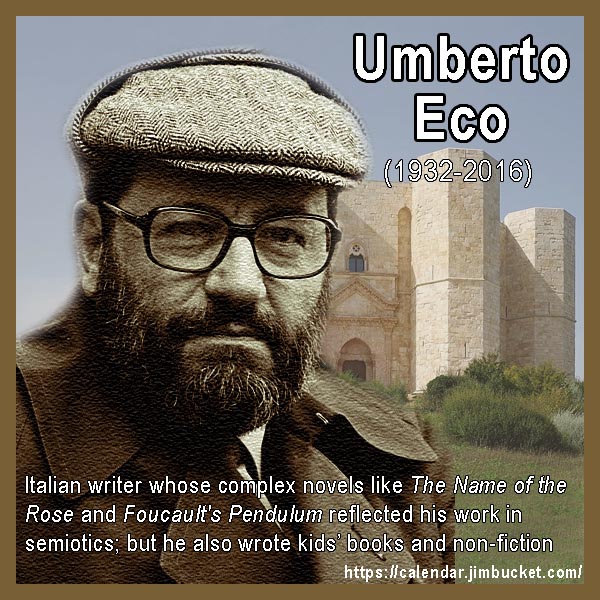
Jan. 5: Umberto Eco, Italian writer

BORN JANUARY 5:

Umberto Eco (1932-2016) Italian novelist, critic, and philosopher whose complex novels reflected his work in semiotics; The Name of the Rose; Foucault's Pendulum; The Island of the Day Before; The Prague Cemetery. But he also wrote children's books, and far more non-fiction than his "mere" seven novels.


Navigation:


Monday, December 6, 2021

Dec. 6: Baldassare Castiglione, Italian courtier

BORN DECEMBER 6:

Baldassare Castiglione (1478-1529) a sort of Italian Renaissance "Emily Post" or "Miss Manners" who wrote an etiquette handbook, "The Courtier" (Il Cortegiano), for other courtiers. Rank, physical strength, modesty, and pleasant physique were some of the virtues bandied about by the participants in a (fictional) four-night conversation.


Navigation:


Wednesday, September 8, 2021

Sep. 8: Ludovico Ariosto, Italian poet

BORN SEPTEMBER 8th:

Ludovico Ariosto (1474-1533) Italian poet known for Orlando Furioso, a satire on the customs of chivalry featuring Roland (Italian "Orlando"), one of Charlemagne's knights. The "real" Roland had been killed by treachery after defending France against the Saracens (Moors) in Spain; this Roland made a trip to the moon!


Navigation:


Sunday, September 5, 2021

Sep. 5: Tommaso Campanella, Italian philosopher-monk

BORN SEPTEMBER 5th:

Tommaso Campanella (1568-1639) Italian philosopher-monk and poet known for his heterodox views, for which he was tortured and then imprisoned for 27 years, where he wrote among other works his utopian novel La città del Sole (The City of the Sun).


Navigation: