Showing posts with label Author. Show all posts

Monday, May 30, 2022

May 30: Countee Cullen, American poet and writer

BORN MAY 30:

Countee Cullen (1903-1946) was a Black American poet, novelist, children's writer, and playwright, and part of the Harlem Renaissance. Rare for a Black man in his time, he graduated with a master's degree in English from Harvard (after graduating Phi Beta Kappa from NYU). He was briefly married to the daughter of civil rights icon W.E.B. Du Bois; she filed for divorce when a few months after their wedding, he wrote her a letter confessing his love for men. Ten years later he married another woman and lived with her until his death some six years later. Overshadowed today by his colleague Langston Hughes, Cullen's work nevertheless expresses the experience of Black people in his day; one of his better-known poems, "Heritage," repeats its first line as a refrain: "What is Africa to me?" as he places his imagined homeland against his life as a "Christian" and an American. Also notable is his, "Yet Do I Marvel."


Navigation:


Saturday, May 28, 2022

May 28: Ian Fleming, British spy novelist

BORN MAY 28:

Ian Fleming (1908-1964) was an English author. Like Arthur Conan Doyle and J. M. Barrie, virtually everything he did was forced to live in the shadow of his One Great Character, in this case: Bond, James Bond. (One exception is his children's book Chitty-Chitty-Bang-Bang, perhaps because of its "loosely based" 1968 film version, scripted by Roald Dahl and starring Dick Van Dyke when he was still a hot commodity.) Anyway, there were 14 Bond novels (by Fleming) and nine short stories; since Fleming's death, there have been nearly 50 Bond books by other authors, including John Gardner and Sebastian Faulks. Several of them are set in Bond's childhood. The character has long outlived his creator, who was himself a British naval intelligence officer during World War II. Oh yeah, I forgot to mention the 27 film appearances of Bond, played by seven actors.


Navigation:


Wednesday, May 25, 2022

May 25: Ralph Waldo Emerson, American writer and philosopher

BORN MAY 25:

Ralph Waldo Emerson (1803-1882) was an American writer and perhaps the young country's first original philosopher. He was an essayist, lecturer, abolitionist, and poet, and a leader of the mid-19th century transcendentalist movement. In true American mode, he championed individualism, disseminating his ideology through dozens of published essays and more than 1,500 public lectures across the United States. Starting out as a pastor (like his father), he struck out on his own with the publication of his 1836 essay "Nature," which expressed the philosophy of transcendentalism. He would often lecture on a topic, then revise his notes to publish as essays. Some of the more important of these are "The American Scholar," "Self-Reliance," "The Over-Soul," "Experience," and others. He returned again and again to the ideas of individuality, freedom, the ability of humankind to achieve almost anything, and the relationship between the soul and the outside world. He was also a mentor and friend of Henry David Thoreau, another transcendentalist.


Navigation:


Sunday, May 15, 2022

May 15: L. Frank Baum, American children's author

BORN MAY 15:

L. Frank Baum (1856-1919) was an American children's author best known for the Wizard of Oz and its 13 sequels. He also wrote 41 other novels, 83 short stories, over 200 poems, and at least 42 scripts, but his place in history (and in my heart) depends on the 1939 film adaptation of WoO, a perfect "hook" on which to hang Joseph Campbell's teachings about "The Hero's Journey"--especially since this time he's a she. Born in New York state, and spending most of his career in the Midwest, he died in Los Angeles trying to establish a movie studio focused on producing films for children.


Navigation:


Friday, May 6, 2022

May 6: Sigmund Freud, Austrian founder of psychoanalysis

BORN MAY 6:

Sigmund Freud (1856-1939) was an Austrian neurologist and the founder of psychoanalysis who, like Darwin and Marx, was a shaper of the world we live in. Before Freud, the person-in-the-street wouldn't be throwing around phrases like Oedipus complex, denial, ego, libido, death wish, defense mechanism, phallic symbol, projection, transference--or Freudian slip. His formal ideas--the importance of dreams and the unconscious; the model of the psychic structure comprising the id, the ego, and the super-ego; the psychosexual development of the individual--have penetrated everyday awareness in extraordinary ways. He popularized (if not invented) something called "talk therapy," the evaluation and treatment of psychological problems through doctor/patient dialogue. Some of his shorter works are quite readable (the titles are more-or-less self explanatory, from the shortest up until about 250 pages): Five Lectures on Psycho-Analysis; The Ego and the Id; The Future of an Illusion (on religion); Beyond the Pleasure Principle; Civilization and Its Discontents; Moses and Monotheism; and Totem and Taboo. Nearly 700 pages but worth skimming: The Interpretation of Dreams.


Navigation:


Thursday, May 5, 2022

May 5: Karl Marx, German philosopher

BORN MAY 5:

Karl Marx (1818-1883) was a German philosopher and with a handful of others--Darwin and Freud come to mind--a creator of the world in which we live. Politics since Marx either follows his thought or opposes it, but it can't ignore "Marxism" or "Marxist ideology." With his wife and children, he lived in London for decades, collaborating with another German thinker, Friedrich Engels. Much of his research was done in the Reading Room of the British Museum. Marxism 101 says that in history, human societies develop through class conflict. In capitalism, this is conflict between the ruling classes (the bourgeoisie) and the working classes (the proletariat). Capitalism, he said, produces internal tensions that will lead to its self-destruction and replacement by a new system: socialism. He advocated an organized revolution of the working class. His most important works are The Communist Manifesto (with Friedrich Engels--a mere pamphlet) and the monumental three-volume Das Kapital (Capital).


Navigation:


Tuesday, May 3, 2022

May 3: Niccolo Machiavelli, Italian Renaissance author

BORN MAY 3:

Niccolo Machiavelli (1469-1527) was an Italian Renaissance diplomat, author, philosopher, and historian best known for The Prince (Il Principe), written about 1513 but not published until 1532. He also wrote comedies, songs, and poetry, but in most people's minds he was a ruthless political animal who advocated the unscrupulous acts in The Prince. One of his leadership maxims was, "It is better to be feared than to be loved"; he claimed that throughout the course of  history, politics had always been played with deception, treachery, and criminal acts: any action could be excused if it benefited the ruler. Some are unsure whether Machiavelli believed these things and was recommending them to rulers, or perhaps was just publicizing them as a warning to an unwary public. Some even see them as satire, a serious jester's slap at bad rulers. In any case, the term "Machiavellian" has come to describe these cunning, scheming, and unscrupulous actions.


Navigation:


Wednesday, April 27, 2022

Apr. 27: Edward Gibbon, English historian

BORN APRIL 27:

Edward Gibbon (1737-1794) was an English historian whose modern reputation rests almost solely on his monumental six-volume The Decline and Fall of the Roman Empire. The work exhibited meticulous sourcing and a full frontal criticism of organized religion; it traces Western civilization (as well as the Islamic and Mongolian conquests) from the height of the Roman Empire to the fall of Byzantium in the fifteenth century.


Navigation:


Tuesday, April 26, 2022

Apr. 26: William Shakespeare, English playwright and poet

BAPTIZED APRIL 26:

William Shakespeare (1564-1616) pre-eminent English playwright and poet. He was baptized on this day, and may have been born three days earlier, according to some calculations. Modern scholarship suggests that, including collaborations, he is responsible for all or part of 39 plays, in addition to his 154 sonnets, four narrative poems, and a few other verses. Outstanding among his plays (there are so many!) are The Tempest; Hamlet; King Lear; Macbeth; Othello; Romeo and Juliet; A Midsummer Night's Dream; and more. The long poems are Venus and Adonis; The Rape of Lucrece; A Lover's Complaint; and--I'm not kidding--The Phoenix and the Turtle. Several of the Sonnets stand out, notably

  • #18 "Shall I compare thee to a summer's day?"
  • #29 "When in disgrace with fortune and men's eyes"
  • #116 "Let me not to the marriage of true minds" and 
  • #130 "My mistress' eyes are nothing like the sun"


Navigation:


Sunday, April 24, 2022

Apr. 24: Anthony Trollope, English novelist

BORN APRIL 24:

Anthony Trollope (1815-1882) was an English novelist probably best known today for the the six novels of the series The Chronicles of Barsetshire, which included Barchester Towers. He wrote another series of six, a series of five, and 30 stand alone novels; over 40 short stories; 17 works of non-fiction; at least 20 articles; two plays; and several volumes of collected letters. This raises the question: how did he become "one of the most prolific writers of all time" while fulfilling his duties as a postal clerk and inspector? The answer was: a new-found discipline (previously he had been known as unpunctual and insubordinate) that pushed him to write on the trains during his inspection journeys. (There's a lesson in this for you, Jim Bucket!)


Navigation:


Friday, April 22, 2022

Apr. 22: Otto Rank, Austrian psychoanalyst

BORN APRIL 22:

Otto Rank (1884-1939) was an Austrian psychoanalyst, writer, and teacher; never anyone's household name, he influenced my thinking by laying much of the groundwork for the ideas of Joseph Campbell in his The Myth of the Birth of the Hero. (Other spicy titles include The Incest Theme in Literature and Legend and The Trauma of Birth.) He is said to have influenced such seemingly-disparate thinkers and creators as Matthew Fox, Anaïs Nin, Henry Miller, Lawrence Durrell, Nella Larsen, Salvador Dalí, Martha Graham, and Samuel Beckett.


Navigation:


Sunday, April 17, 2022

Apr. 17: Isak Dinesen, Danish author

BORN APRIL 17:

Isak Dinesen (1885-1962) was a Danish author who wrote novels, poems, and short stories, and was known for Out of Africa; Seven Gothic Tales; and "Babette's Feast." She was a woman of many names: born Karen Dinesen, "Isak" is a pen name, as was Tania Blixen, Osceola, and Pierre Andrézel. She married Baron Bror Fredrik von Blixen-Finecke, and ended up with the weighty name Baroness Karen Christenze von Blixen-Finecke. "Isak Dinesen" will do nicely. Out of Africa, which became a film starring Meryl Streep and Robert Redford that won Best Picture and Best Director (Sydney Pollack) Oscars, was based on her life while living in Kenya (1914-1931); the film version of her story "Babette's Feast" won the Oscar for Best Foreign Language Film.


Navigation:


Wednesday, April 13, 2022

Apr. 13: Thomas Jefferson, American president and polymath

BORN APRIL 13:

Thomas Jefferson (1743-1826) was an American statesman, lawyer, architect, philosopher, and U.S. Founding Father who was the new nation's first secretary of state (under George Washington), second vice president (under John Adams) and third president. His resume was such that President John F. Kennedy in 1962 told a group of Nobel Prize winners at a White House dinner: "I think this is the most extraordinary collection of talent, of human knowledge, that has ever been gathered together at the White House, with the possible exception of when Thomas Jefferson dined alone. Someone once said that Thomas Jefferson was a gentleman of 32 who could calculate an eclipse, survey an estate, tie an artery, plan an edifice, try a cause, break a horse, and dance the minuet." His reputation has been tarnished by the keeping of over 600 slaves on his plantation, Monticello, but at least he took one step toward eventual emancipation by signing the Act Prohibiting Importation of Slaves in 1807. Nevertheless, he fathered at least six children with Sally Hemings, a mixed-race enslaved woman who was his late wife's half-sister. He was a man of many accomplishments: the principal author of the Declaration of Independence; president of the American Philosophical Society; knew several languages; founded the University of Virginia; made the Louisiana Purchase (doubling the nation's size) and sending out Lewis and Clark's "Corps of Discovery" to obtain scientific, geographic, and ethnological knowledge. Jefferson died on July 4, 1826, the 50th anniversary of U.S. independence, and the same day as his long-time friend (and sometime political rival) John Adams. Historians generally rank Thomas Jefferson as one of the greatest presidents in American history.


Navigation:


Friday, April 8, 2022

Apr. 8: J. Smeaton Chase, English-American travel writer

BORN APRIL 8:

J. Smeaton Chase (1864-1923) was an English-born American author, traveler, and photographer. Born in London, he moved to Southern California in 1890, where among other jobs he worked as a tutor to the children of a wealthy rancher in the San Gabriel Valley. He traveled on horseback from Los Angeles to San Diego in 1910; in 1911 he rode from Mexico to Oregon, a journey chronicled in his California Coast Trails. Later came the publication of California Desert Trails, based on two years riding alone in that harsh environment. Another of his books--The Penance of Magdalena, of which I own a first edition--is a charming collection of five tales, each set in one of the southern California missions.


Navigation:


Tuesday, April 5, 2022

Apr. 5: Booker T. Washington, American educator, author, and presidential advisor

BORN APRIL 5:

Booker T. Washington (1856-1915) was an American educator, author, and presidential advisor. He was born enslaved on a Virginia plantation and taught himself to read and write around age 9 or 10. He worked hard to put himself through college and, at 25 years old, was chosen to lead a new teacher's training college in Alabama, the Tuskegee Institute. He oversaw students in building the school, which emphasized practical trades: his students would not just learn to make buildings and to grow crops and farm animals, but to teach others to do the same. He saw education as the solution to the oppression of American blacks, especially in the South. His two autobiographies, The Story of My Life and Work and Up From Slavery, are worth reading, though the latter is a more polished version of the first and might be read alone.


Navigation:


Saturday, April 2, 2022

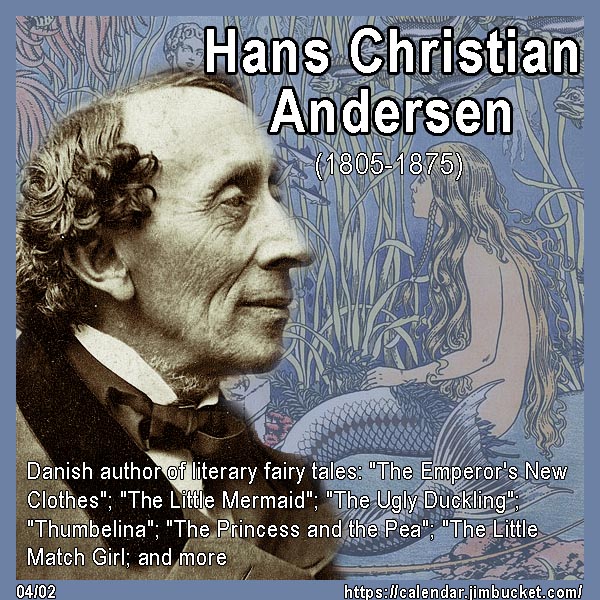
Apr. 2: Hans Christian Andersen, Danish author of fairy tales

BORN APRIL 2:

Hans Christian Andersen (1805-1875) was a Danish author who actually wrote plays, travel literature, novels, and poems, but we remember him today for his 156 fairy tales. One list of his "top ten" includes "The Emperor's New Clothes," about a vain emperor who gets exposed before his subjects; "The Little Mermaid," who wants to gain a human soul; "The Nightingale," in which the real thing competes with a mechanical bird for an emperor's favor; "The Steadfast Tin Soldier," who loves a paper ballerina; "The Red Shoes," about a vain girl forced to dance non-stop in her fancy footwear; "The Princess and the Pea," about a young woman whose sensitivity proves her royal ancestry; "The Snow Queen," on the struggle between good and evil as played out in the love between two children, Gerda and her friend Kai; "The Ugly Duckling," about a baby bird who is more than he seems; "The Little Match Girl," about a dying child's dreams and hope; and "Thumbelina," about a tiny girl who dodges loathsome critters to marry a flower-fairy prince. Many of Andersen's stories have inspired ballets, plays, and animated and live-action films.


Navigation:


Monday, March 28, 2022

Mar. 28: Mario Vargas Llosa, Peruvian author

BORN MARCH 28:

Mario Vargas Llosa (1936 - ) is a Peruvian novelist, journalist, short story writer, essayist, and former politician. He won the Nobel Prize in Literature in 2010 (among others), and is a leading representative of the so-called "Latin American Boom," writing about the Peruvian experience. Novels like The Time of the Hero, The Green House, and Conversation in the Cathedral brought him to international fame; Captain Pantoja and the Special Service and Aunt Julia and the Scriptwriter have been made into feature films. According to one source, he has written fifteen novels and three short story collections, as well as several collections of essays. His books have been translated into more than thirty languages.


Navigation:


Saturday, March 26, 2022

Mar. 26: Joseph Campbell, American mythologist, writer and lecturer

BORN MARCH 26:

Joseph Campbell (1904-1987) was an American mythologist, writer and lecturer. Campbell was born in New York City and spent most of his life teaching there at Sarah Lawrence College. His first major work was also one of his most important and best-known: The Hero with a Thousand Faces, in which he finds a common structure underlying the hero stories of virtually every culture. His work was consulted by George Lucas when he began writing his Star Wars mythos; Lucas later funded the library that holds Campbell's collection. Something of an amateur and a popularizer, Campbell's work has been criticized by professionals in the field, but they can't deny his influence. His philosophy is summed up in the usually-misunderstood saying, "Follow your bliss." He also wrote the four-volume Masks of God series; numerous other works have been published of his essays, interviews (most famously Bill Moyers's The Power of Myth), and even travel journals.


Navigation:


Friday, March 25, 2022

Mar. 25: Flannery O'Connor, American writer

BORN MARCH 25:

Flannery O'Connor (1925-1964) was an American novelist, short story writer, and essayist who wrote two novels and 32 short stories, as well as other works. She often wrote in a sardonic Southern Gothic style and relied heavily on misfits in regional settings. A staunch Roman Catholic, she frequently examined questions of morality and ethics. Her novel Wise Blood is about a wounded returning WWII vet and how he copes with his loss of religious faith; the other one, The Violent Bear It Away, tells of a fourteen-year-old boy trying to escape his uncle's plans to make him a religious "prophet." Two of her short stories stand out: "A Good Man Is Hard to Find" (her best-known work) examines morality through the encounter of a family with an escaped convict. "Everything That Rises Must Converge" tells of the experience of a boy and his mother on a bus after the integration of their city's transportation system.


Navigation:


Saturday, March 19, 2022

Mar. 19: Richard Francis Burton, British explorer and writer

BORN MARCH 19:

Richard Francis Burton (1821-1890) was a British explorer and writer. Not so many men are cut from this cloth: a genuine adventurer who also wrote books of lasting interest. According to one count, he spoke twenty-nine European, Asian, and African languages (and tried to learn "monkey"); visited the Muslim holy city of Mecca when it was forbidden to Europeans on pain of death; translated The One Thousand and One Nights and The Kama Sutra; and traveled with the first Europeans to visit the Great Lakes of Africa in search of the source of the Nile. He also produced a "pseudotranslation," The Kasidah, claiming to be a translation of an original Persian text on Sufism, but in fact a wholly original work written by Burton. All this in addition to careers in the British Army in India and the diplomatic service in Equatorial Guinea, Brazil, Syria, and Italy. He was knighted by Queen Victoria in 1886.


Navigation: