Showing posts with label Dramatist. Show all posts

Friday, May 20, 2022

May 20: Honoré de Balzac, French novelist and playwright

BORN MAY 20:

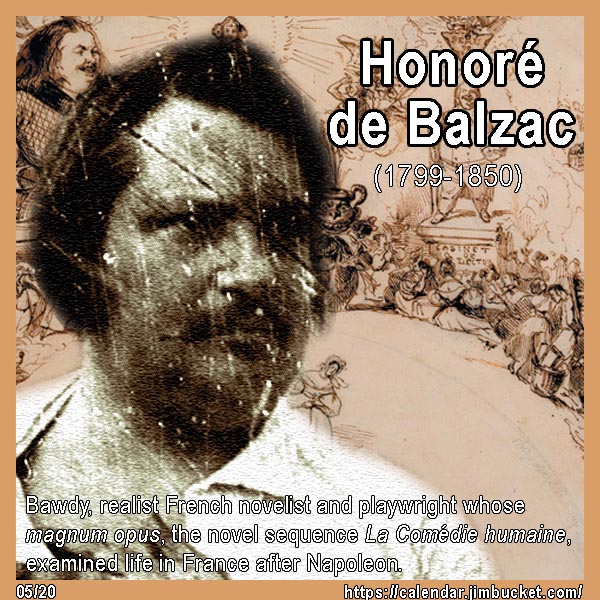
Honoré de Balzac (1799-1850) was a famously bawdy French novelist and playwright. His magnum opus is the novel sequence La Comédie humaine (The Human Comedy), a panorama of post-Napoleonic French life. Regarded as a founder of realism in European literature, he is remembered for his multi-faceted characters; his writing influenced writers such as Zola, Dickens, Flaubert, and Henry James. He suffered from health problems (and the effects of an irascible character) throughout his life; his family relations were often strained by financial and personal drama. La Comédie humaine consists of 91 finished novels, stories, and essays, and another 46 unfinished (some of which exist only as titles). Balzac published 49 novels and novellas during his lifetime, including Eugénie GrandetLe Père Goriot, and La Cousine Bette; around a dozen more were published posthumously. He also published seven plays and numerous short stories. Many of his works have been adapted into films and television series.


Navigation:


Monday, May 9, 2022

May 9: J. M. Barrie, Scottish novelist and playwright

BORN MAY 9:

J. M. Barrie (1860-1937) was a Scottish novelist and playwright whose other works (there were nearly 70) were overshadowed by that one annoying character who showed up in five of Barrie's novels and plays: Peter Pan. The character grew, as did Carroll's Alice (in Wonderland), from Barrie's close acquaintance with the children of a family (raising the usual unfounded speculations posthumously). The boy on whom the character was based, Peter Llewelyn Davies, threw himself under a train as it was pulling into a London Underground station when he was 63. Anyway, the story may also have popularized (if not downright introduced) the name Wendy. His best-known non-Peter work may be The Admirable Crichton, written for the stage and adapted to film, TV, and radio at least five times.


Navigation:


Monday, May 2, 2022

May 2: Jerome K. Jerome, British humorist

BORN MAY 2:

Name Jerome K. Jerome (1859-1927) was an English humorist and playwright who wrote the comic travelogue Three Men in a Boat and its sequel Three Men on the Bummel, as well as the books of essays Idle Thoughts of an Idle Fellow and Second Thoughts of an Idle Fellow. Three Men in a Boat--the story of, well, three men messing about in a boat on the Thames--was a phenomenon, and popularized boating on the Thames such that boat registrations went up 50% the year after it was published. It has never been out of print, and has been adapted into films, TV, radio shows, stage plays, and even a musical. None of his subsequent novels (at least 10), essay collections (at least 15), short stories (at least 11), plays (at least 24), nor his autobiography ever achieved the success of that first silly book.


Navigation:


Tuesday, April 26, 2022

Apr. 26: William Shakespeare, English playwright and poet

BAPTIZED APRIL 26:

William Shakespeare (1564-1616) pre-eminent English playwright and poet. He was baptized on this day, and may have been born three days earlier, according to some calculations. Modern scholarship suggests that, including collaborations, he is responsible for all or part of 39 plays, in addition to his 154 sonnets, four narrative poems, and a few other verses. Outstanding among his plays (there are so many!) are The Tempest; Hamlet; King Lear; Macbeth; Othello; Romeo and Juliet; A Midsummer Night's Dream; and more. The long poems are Venus and Adonis; The Rape of Lucrece; A Lover's Complaint; and--I'm not kidding--The Phoenix and the Turtle. Several of the Sonnets stand out, notably

  • #18 "Shall I compare thee to a summer's day?"
  • #29 "When in disgrace with fortune and men's eyes"
  • #116 "Let me not to the marriage of true minds" and 
  • #130 "My mistress' eyes are nothing like the sun"


Navigation:


Tuesday, April 19, 2022

Apr. 19: José Echegaray, Spanish dramatist

BORN APRIL 19:

José Echegaray (1832-1916) was one of the leading Spanish dramatists of the end of the 19th century, and received the 1904 Nobel Prize for Literature (shared with the Provençal poet Frédéric Mistral) for reviving "the great traditions of the Spanish drama." After a career as a professor of mathematics and engineering, and another as a government minister (starting after the revolution of 1868 overthrew the monarchy, and ending when the First Spanish Republic ended in 1874), he indulged in what had always been the love of his life: drama. It is said that he replicated the achievements of his predecessors of the Spanish Golden Age, such as Lope de Vega. One of his greatest works, El Gran Galeoto, is based on the story of Paolo and Francesca in Dante's Divine Comedy, itself derived from the story of Lancelot and Guinevere. Echegaray was a prolific author; one catalog lists nearly 80 plays written from 1874, and nearly 30 works of non-fiction.


Navigation:


Monday, April 18, 2022

Apr. 18: Thomas Middleton, English playwright and poet

BORN APRIL 18:

Thomas Middleton (1580-1627) was an English playwright and poet whose life overlapped that of Shakespeare. Some scholars believe that he collaborated with The Bard on All's Well That Ends Well and Timon of Athens; another play, A Yorkshire Tragedy, was long attributed to Shakespeare, but modern critics have examined the style and determined it to be Middleton's. With John Fletcher and Ben Jonson, Middleton was one of the most successful playwrights of the Jacobean period (the reign of King James, successor to Queen Elizabeth). Proficient at writing both comedy and tragedy, he also wrote a large number of masques and pageants (elaborate productions that included pantomime and dancing, and later dialogue and song, given by amateur and professional actors). His plays are still staged, and the number of productions is increasing. T. S. Eliot thought him second only to Shakespeare.


Navigation:


Tuesday, February 8, 2022

Feb. 8: Jules Verne, French novelist

BORN FEBRUARY 8:

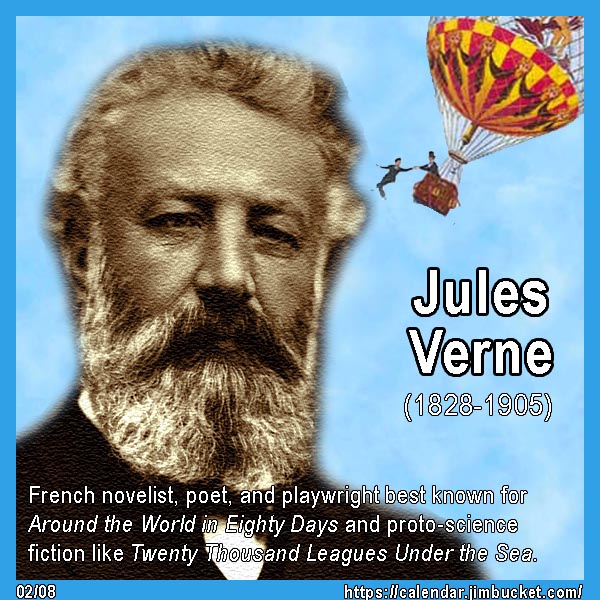
Jules Verne (1828-1905) famed French novelist, poet, and playwright who contributed greatly to the development of science fiction. Perhaps his best-known work (due to its filmed versions) is Around the World in Eighty Days, and for the same reason Twenty Thousand Leagues Under the Sea. But Journey to the Center of the Earth and From the Earth to the Moon have also proven enduring; alas about 50 more not so much.


Navigation:


Sunday, February 6, 2022

Feb. 6: Christopher Marlowe, English playwright and poet

BORN FEBRUARY 6:

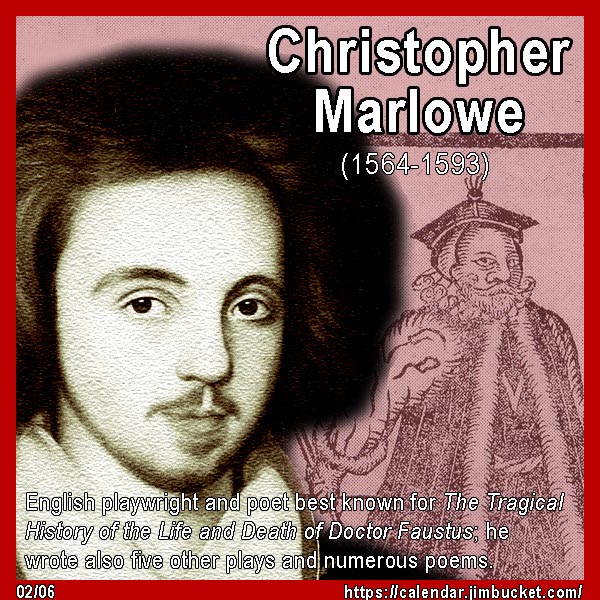
Christopher Marlowe (1564-1593) English playwright and poet. It must have been tough to be a good playwright when Shakespeare (with whom he was baptized in the same year) was your competitor. Seen any good productions of Dr. Faustus lately? Or Edward the Second? Tamburlaine? No? But these were some of Kit Marlowe's greatest hits. (He is credited with only six plays in his 29 years.) He was London's pre-eminent playwright--even bigger than Will--until his supposedly mysterious death in 1593, 13 years before the Bard. (In 1925 records came to light showing he died in a knife fight over a bar bill, though the witnesses may not be credible.) What might he have become?


Navigation:


Thursday, February 3, 2022

Feb. 3: Gertrude Stein, American author and patron

BORN FEBRUARY 3:

Gertrude Stein (1874-1946) American novelist, poet, playwright and patron of the arts. Based in Paris from 1903, she and her brother Leo encouraged modern artists, and ran the "Stein salon" whose regular attendees included Picasso, Hemingway, Fitzgerald, Sinclair Lewis, Ezra Pound, Thornton Wilder, Sherwood Anderson, and Henri Matisse. This had a greater impact than her books, which included most famously The Autobiography of Alice B. Toklas, a sort of memoir of her Paris years in the voice of her life partner, Alice B. Toklas.


Navigation:


Tuesday, January 18, 2022

Jan. 18: A. A. Milne, British writer

BORN JANUARY 18:

A. A. (Alan Alexander) Milne (1882-1956) English novelist, essayist, poet, playwright, and short-story writer, and, most notably, author of children's literature: he was the "father" of Winnie-the-Pooh (and the father of Christopher Robin Milne)


Navigation:


Friday, January 14, 2022

Jan. 14: Yukio Mishima, Japanese writer

BORN JANUARY 14:

Yukio Mishima (1925-1970) stunningly evocative Japanese novelist, playwright, poet, short story writer, and essayist. A Shintoist and active right-wing nationalist, he opposed Japan's increasing western-style materialism and postwar turn to democracy and globalism. To prove his point, he and four followers entered a Tokyo military base and took its commandant hostage, attempting to overthrow Japan's 1947 Constitution. After a speech and a cry of "Long live the Emperor!", he committed seppuku ("hara-kiri"), the favored mode of death of the samurai. Works include Confessions of a Mask; The Temple of the Golden Pavilion; The Sailor Who Fell from Grace with the Sea; The Sea of Fertility tetralogy (Spring Snow; Runaway Horses; The Temple of Dawn; The Decay of the Angel); and Hagakure Nyumon, which examines living the Samurai Way in modern life.


Navigation:


Friday, January 7, 2022

Jan. 7: Zora Neale Hurston, American writer

BORN JANUARY 7:

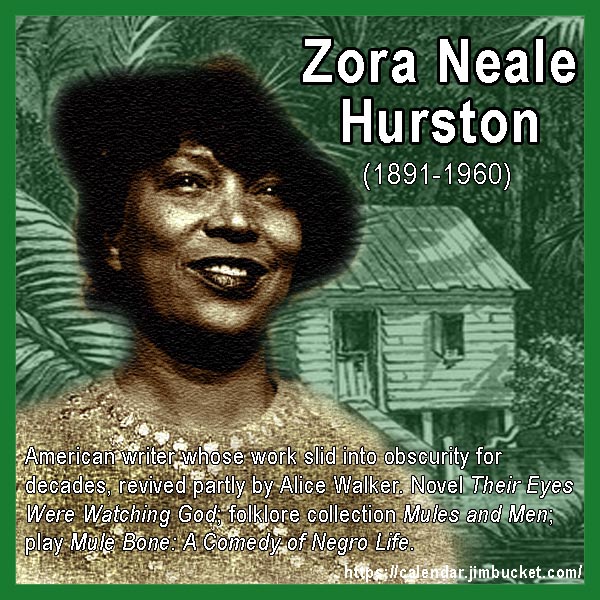
Zora Neale Hurston (1891-1960) American novelist, short story writer, and anthropologist whose work slid into obscurity for decades; interest was revived partly through the efforts of author Alice Walker. Novel Their Eyes Were Watching God; folklore collection Mules and Men; play (co-written with Langston Hughes) Mule Bone: A Comedy of Negro Life.


Navigation:


Sunday, December 19, 2021

Dec. 19: Jean Genet, French writer

BORN DECEMBER 19:

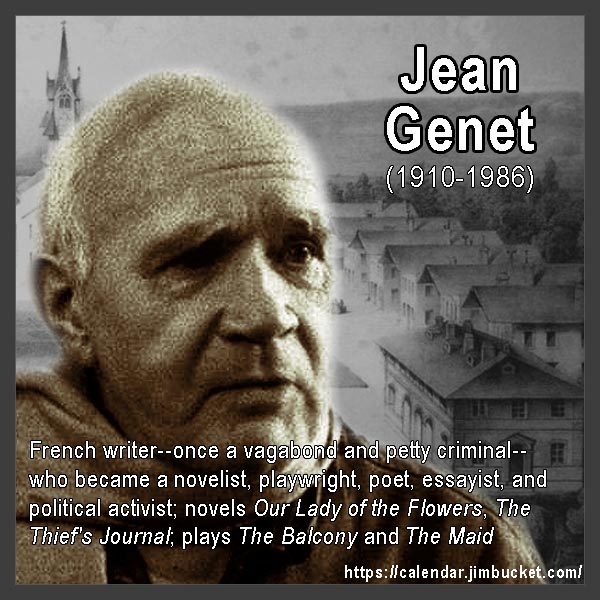
Jean Genet (1910-1986) French writer--once a vagabond and petty criminal--who became a novelist, playwright, poet, essayist, and political activist; novels include the largely-autobiographical Our Lady of the Flowers and The Thief's Journal (only partly autobiographical); and the plays The Balcony and The Maids (not at all autobiographical, as far as I can tell).


Navigation:


Friday, November 26, 2021

Nov. 26: Eugene Ionesco, Romanian-French writer

BORN NOVEMBER 26:

Eugene Ionesco (1909-1994) Romanian-French playwright; The Bald Soprano; The Killer; Rhinoceros. Born in Romania but spending much of his life in France, he wrote mostly in French. The Bald Soprano has been called an "anti play" (as have others), an absurdist work which avoids such unnecessary details of drama as coherent plot and resolution.


Navigation:


Sunday, November 21, 2021

Nov. 21: Voltaire, French philosopher and satirist

BORN NOVEMBER 21:

Voltaire (1694-1778) French philosopher and satirist born François-Marie Arouet; his pen name may be based on an anagram of his surname. He was famed for his wit, his criticism of the Church, and his advocacy of such Enlightenment values as freedom of speech, freedom of religion, and separation of church and state. Known especially for Candide, as well as Micromégas, Zadig, and others.


Navigation:


Saturday, October 16, 2021

Oct. 16: Oscar Wilde, Irish author

BORN OCTOBER 16:

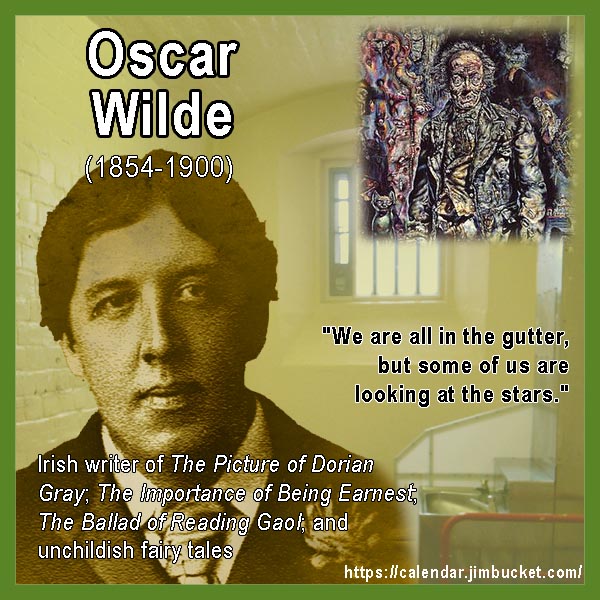
Oscar Wilde (1854-1900) Irish playwright, novelist, essayist, and poet. He wrote (among others) The Picture of Dorian Gray; The Importance of Being Earnest; and The Ballad of Reading Gaol; also, the very un-child-like fairy tales "The Happy Prince"; "The Nightingale and the Rose"; and "The Selfish Giant."

Wilde was not as clever as he thought: when the father of one of his lovers accused him (correctly) of homosexuality, Wilde sued him for criminal libel--and lost. Evidence brought forth in the trial led to Wilde's criminal conviction for "gross indecency," and he was jailed for two years.

He died in self-imposed exile, of meningitis, at age 46.


Navigation:


Sunday, October 10, 2021

Oct. 10: Harold Pinter, English playwright

BORN OCTOBER 10th:

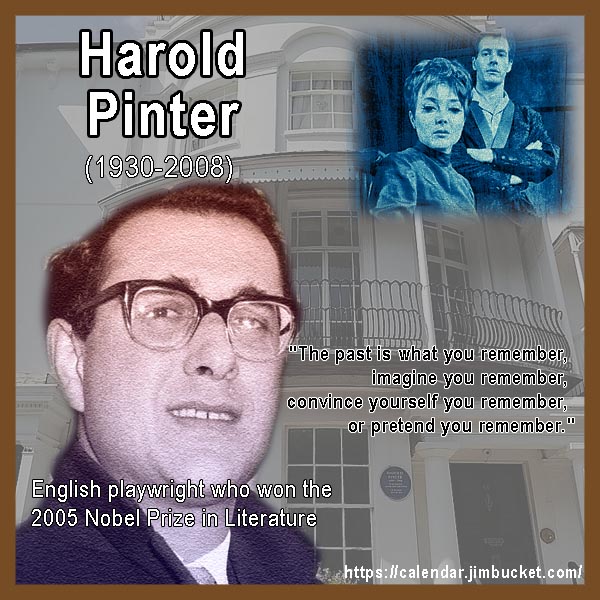
Harold Pinter (1930-2008) English playwright who wrote The Birthday Party, The Homecoming, and Betrayal. Pinter won the Nobel Prize in Literature in 2005. He is perhaps better known to a wider audience for his screen adaptations of the works of others, such as John Fowles's The French Lieutenant's Woman and the 2007 film version of Anthony Shaffer's play, Sleuth.


Navigation: