Showing posts with label Poet. Show all posts

Monday, May 30, 2022

May 30: Countee Cullen, American poet and writer

BORN MAY 30:

Countee Cullen (1903-1946) was a Black American poet, novelist, children's writer, and playwright, and part of the Harlem Renaissance. Rare for a Black man in his time, he graduated with a master's degree in English from Harvard (after graduating Phi Beta Kappa from NYU). He was briefly married to the daughter of civil rights icon W.E.B. Du Bois; she filed for divorce when a few months after their wedding, he wrote her a letter confessing his love for men. Ten years later he married another woman and lived with her until his death some six years later. Overshadowed today by his colleague Langston Hughes, Cullen's work nevertheless expresses the experience of Black people in his day; one of his better-known poems, "Heritage," repeats its first line as a refrain: "What is Africa to me?" as he places his imagined homeland against his life as a "Christian" and an American. Also notable is his, "Yet Do I Marvel."


Navigation:


Sunday, May 29, 2022

May 29: G. K. Chesterton, English novelist and lay theologian

BORN MAY 29:

G. K. Chesterton (1874-1936) was an English novelist, poet, philosopher, dramatist, journalist, lay theologian, and critic. Some of his theological works, such as Orthodoxy and The Everlasting Man, anticipate the point-of-view and style of C. S. Lewis. He wrote around 80 books, several hundred poems, around 200 short stories, 4,000 essays (mostly as newspaper columns), and several plays. He also wrote articles for the 14th edition (1929) of the Encyclopædia Britannica, including the entry on Charles Dickens and part of the entry on Humor. Among his more popular novels are The Napoleon of Notting Hill, in which a randomly selected King of England enacts some inane laws, and a local young man--the eponymous "Napoleon"--exploits them; and The Man Who Was Thursday, a send-up of anarchism in which most of the leading anarchists turn out to be secret policemen meant to defeat anarchism. Most of us today, though, will know him for the Father Brown stories, often adapted for film, radio, TV, and other media.


Navigation:


Wednesday, May 25, 2022

May 25: Ralph Waldo Emerson, American writer and philosopher

BORN MAY 25:

Ralph Waldo Emerson (1803-1882) was an American writer and perhaps the young country's first original philosopher. He was an essayist, lecturer, abolitionist, and poet, and a leader of the mid-19th century transcendentalist movement. In true American mode, he championed individualism, disseminating his ideology through dozens of published essays and more than 1,500 public lectures across the United States. Starting out as a pastor (like his father), he struck out on his own with the publication of his 1836 essay "Nature," which expressed the philosophy of transcendentalism. He would often lecture on a topic, then revise his notes to publish as essays. Some of the more important of these are "The American Scholar," "Self-Reliance," "The Over-Soul," "Experience," and others. He returned again and again to the ideas of individuality, freedom, the ability of humankind to achieve almost anything, and the relationship between the soul and the outside world. He was also a mentor and friend of Henry David Thoreau, another transcendentalist.


Navigation:


Tuesday, May 24, 2022

May 24: Joseph Brodsky, Russian-American poet and essayist

BORN MAY 24:

Joseph Brodsky (1940-1996) was a Russian-born American poet and essayist who was "strongly advised" to emigrate by the Soviet authorities. W. H. Auden and other supporters helped him settle in the US in 1972. He taught at Mount Holyoke College, and at various universities such as Yale, Columbia, Cambridge, and Michigan. In 1987, he received the Nobel Prize in Literature for works "imbued with clarity of thought and poetic intensity." And in 1991, he was appointed US Poet Laureate. His works include the forty-page long poem Gorbunov and Gorchakov, about two patients in a mental asylum that serves as a metaphor for the Soviet State; and the collection of literary and autobiographical essays, Less Than One.

Navigation:


Saturday, May 21, 2022

May 21: Alexander Pope, English poet

BORN MAY 21:

Alexander Pope (1688-1744) was an English poet and man of letters of the Augustan period (first half of the 18th century to the 1740s), and one of its "stars." The foremost English poet of the time, and a master of the heroic couplet, he is best known for his satires, like The Rape of the Lock, a mock-epic in which a lock of hair is stolen ("rape" here is an old sense of "snatch, grab, carry off"), and The Dunciad, featuring the goddess "Dulness." He also wrote a long poem, An Essay on Criticism, with such famous lines as "To err is human; to forgive, divine," "A little learning is a dang'rous thing," and "Fools rush in where angels fear to tread"; and he is noted for his translation of Homer. He is the second-most quoted author in The Oxford Dictionary of Quotations (after Shakespeare), and, like the Bard, many of his lines, like those just mentioned, have crept into common speech, as have "damning with faint praise," "to err is human; to forgive, divine," and many more. His major works number nearly 20, and there are many more besides.


Navigation:


Thursday, May 12, 2022

May 12: Dante Gabriel Rossetti, English poet and painter

BORN MAY 12:

Dante Gabriel Rossetti (actually Gabriel Charles Dante Rossetti, 1828-1882) was an English poet and painter, and one of the Rossetti clan. Co-founder of the Pre-Raphaelite Brotherhood (with William Holman Hunt and John Everett Millais), he was later the main inspiration for a second generation of artists and writers influenced by the movement, including William Morris and Edward Burne-Jones. His sensual art was part of a "medieval revival," influenced by Dante and Sir Thomas Malory, among others. His poetry includes "The Blessed Damozel" and the sonnet sequence, The House of Life.


Navigation:


Sunday, May 8, 2022

May 8: Gary Snyder, American poet

BORN MAY 8:

Gary Snyder (1930 - ) is an American man of letters best known as a Beat-type poet, but also an essayist, lecturer, and environmental activist (see his "Smokey the Bear Sutra"). He won a Pulitzer Prize for Poetry for his 1974 book Turtle Island, poems and essays on Snyder's vision for humans to live in harmony with the earth and all its creatures. ("Turtle Island" is a name for the continent of North America used by many Native American tribes.) He is also a translator of Buddhist literature from ancient Chinese and modern Japanese; a long-time Buddhist with strong connections to Japan, he was the inspiration for the character "Japhy Ryder" in Jack Kerouac's novel The Dharma Bums. He is now professor emeritus of English at the University of California, Davis, where he began teaching writing in 1986.


Navigation:


Tuesday, April 26, 2022

Apr. 26: William Shakespeare, English playwright and poet

BAPTIZED APRIL 26:

William Shakespeare (1564-1616) pre-eminent English playwright and poet. He was baptized on this day, and may have been born three days earlier, according to some calculations. Modern scholarship suggests that, including collaborations, he is responsible for all or part of 39 plays, in addition to his 154 sonnets, four narrative poems, and a few other verses. Outstanding among his plays (there are so many!) are The Tempest; Hamlet; King Lear; Macbeth; Othello; Romeo and Juliet; A Midsummer Night's Dream; and more. The long poems are Venus and Adonis; The Rape of Lucrece; A Lover's Complaint; and--I'm not kidding--The Phoenix and the Turtle. Several of the Sonnets stand out, notably

  • #18 "Shall I compare thee to a summer's day?"
  • #29 "When in disgrace with fortune and men's eyes"
  • #116 "Let me not to the marriage of true minds" and 
  • #130 "My mistress' eyes are nothing like the sun"


Navigation:


Monday, April 18, 2022

Apr. 18: Thomas Middleton, English playwright and poet

BORN APRIL 18:

Thomas Middleton (1580-1627) was an English playwright and poet whose life overlapped that of Shakespeare. Some scholars believe that he collaborated with The Bard on All's Well That Ends Well and Timon of Athens; another play, A Yorkshire Tragedy, was long attributed to Shakespeare, but modern critics have examined the style and determined it to be Middleton's. With John Fletcher and Ben Jonson, Middleton was one of the most successful playwrights of the Jacobean period (the reign of King James, successor to Queen Elizabeth). Proficient at writing both comedy and tragedy, he also wrote a large number of masques and pageants (elaborate productions that included pantomime and dancing, and later dialogue and song, given by amateur and professional actors). His plays are still staged, and the number of productions is increasing. T. S. Eliot thought him second only to Shakespeare.


Navigation:


Sunday, April 17, 2022

Apr. 17: Isak Dinesen, Danish author

BORN APRIL 17:

Isak Dinesen (1885-1962) was a Danish author who wrote novels, poems, and short stories, and was known for Out of Africa; Seven Gothic Tales; and "Babette's Feast." She was a woman of many names: born Karen Dinesen, "Isak" is a pen name, as was Tania Blixen, Osceola, and Pierre Andrézel. She married Baron Bror Fredrik von Blixen-Finecke, and ended up with the weighty name Baroness Karen Christenze von Blixen-Finecke. "Isak Dinesen" will do nicely. Out of Africa, which became a film starring Meryl Streep and Robert Redford that won Best Picture and Best Director (Sydney Pollack) Oscars, was based on her life while living in Kenya (1914-1931); the film version of her story "Babette's Feast" won the Oscar for Best Foreign Language Film.


Navigation:


Saturday, April 16, 2022

Apr. 16: Anatole France, French "man of letters"

BORN APRIL 16:

Anatole France (born François-Anatole Thibault, 1844-1924) was a French poet, journalist, and novelist; he had several best-sellers, and was considered the "ideal French man of letters" in his day--indeed, the citation for his 1921 Nobel Prize in Literature mentioned that he had "a true Gallic temperament." He grew up in his father's bookstore, which specialized in the French Revolution. His many novels include Thaïs, about a legendary 4th-century female Egyptian saint; At the Sign of the Reine Pédauque, about the tribulations of a young man at the beginning of the 18th century; Penguin Island, a satirical fictional history, in which a nearly-blind missionary baptizes a bunch of birds and the Lord, to fix the problem, turns the birds into humans (they establish Penguinia, a country with a history which mirrors that of France); The Gods Are Athirst, about the rise and fall of a painter-turned-jurist in the dark years of the Reign of Terror during the French Revolution; and The Revolt of the Angels, about the well-known story of the war in heaven between the angels led by the Archangel Michael and those led by Satan. He also wrote poetry, memoirs, plays, and literary and social criticism.


Navigation:


Saturday, April 9, 2022

Apr. 9: Charles Baudelaire, French poet

BORN APRIL 9:

Charles Baudelaire (1821-1867) was a French poet, essayist, and art critic. Though his poems are Romantic in some respects, unlike those flights of fancy they are based on observations of real life. His most famous work was a book of lyric poetry entitled Les Fleurs du mal (The Flowers of Evil), which expresses the changing concepts of beauty as France industrialized during the mid-19th century. He seems to have coined the term modernity to describe the fleeting experience of life in the city, and the urgency for artists to capture that experience. His work influenced later French poets like Paul Verlaine, Arthur Rimbaud, and Stéphane Mallarmé, among many others.


Navigation:


Thursday, April 7, 2022

Apr. 7: William Wordsworth, English poet

BORN APRIL 7:

William Wordsworth (1770-1850) was an English Romantic poet. With Samuel Taylor Coleridge (who contributed only four poems, about a third of the book's length), he helped to launch the Romantic Age in English literature with their joint publication Lyrical Ballads, an attempt to make poetry accessible to the average person through verse written in common, everyday language. But his magnum opus is The Prelude, a semi-autobiographical poem from his early years (though revised and expanded a number of times). The title was given after his death; until that time it was referred to as "the poem to Coleridge." Aside from these, his Poems in Two Volumes contained such famous works as "I Wandered Lonely as a Cloud" and "Ode: Intimations of Immortality." Wordsworth was Poet Laureate of the United Kingdom from 1843 until his death.


Navigation:


Monday, April 4, 2022

Apr. 4: Maya Angelou, American poet, memoirist, and civil rights activist

BORN APRIL 4:

Maya Angelou (1928-2014), born Marguerite Annie Johnson, was an American poet, memoirist, and civil rights activist who published seven autobiographies, three books of essays, and several books of poetry. She is also credited with a list of plays, movies, and television shows spanning over 50 years. The first of her autobiographies, I Know Why the Caged Bird Sings, tells of her life up to the age of 17 and and is widely read in high schools and colleges (perhaps more than any other book by an African American woman)--and widely challenged for its unvarnished portrayal of violence and sexuality, and use of "crude" language. Angelou has received numerous honors, including reciting her poem "On the Pulse of Morning" at the first inauguration of President Bill Clinton.


Navigation:


Friday, April 1, 2022

Apr. 1: John Wilmot, English poet and courtier

BORN APRIL 1:

John Wilmot, 2nd Earl of Rochester (1647-1680) was an English poet and courtier. Reacting against the "spiritual authoritarianism" of the Puritan era, he became known for his rakish lifestyle and poetry. Unsurprisingly he died as a result of venereal disease at the age of 33. He was described as a satirist and was considered to be a great poet and a considerable wit. The Victorians censored his poetry (not without cause) but was reappraised in the 1920s. Perhaps his best-known work today is the 170 or so lines of "A Satyr [Satire] Against Reason and Mankind," which subordinates reason to sense, which begins with him choosing rather to be a Dog, a Monkey, or a Bear" than to be "that vain Animal, Who is so proud of being Rational."


Navigation:


Thursday, March 31, 2022

Mar. 31: Andrew Lang, Scottish writer

BORN MARCH 31:

Andrew Lang (1844-1912) was a Victorian Scottish poet, novelist, and folklorist. He is best-known for the Fairy Book series of 14 colors, starting with The Blue Fairy Book. He also collaborated on translations of The Iliad and The Odyssey and wrote or edited a total of around 200 books, bringing lots of history, folk and fairy tales, and classic literature to a wider audience.


Navigation:


Tuesday, March 29, 2022

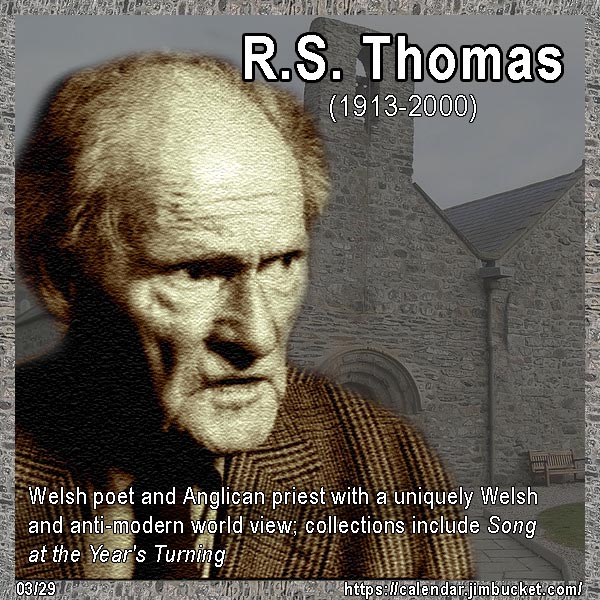
Mar. 29: R.S. Thomas, Welsh poet and priest

BORN MARCH 29:

R.S. Thomas (1913-2000) was a Welsh poet and Anglican priest. A fierce Welsh nationalist (who came to his "native tongue" only at the age of 30), he wrote poetry that interweaves his sometimes-progressive Christian faith with cultural issues and a "true Wales of my imagination," a Welsh-speaking aboriginal community that had remained in touch with the natural world. The Anglicization of Wales (including those Welsh only to happy to sell their patrimony for English money), and modernization in general, was represented in his poetry by "the machine," and by the specific machines that he preached against from the pulpit: refrigerators, washing machines, televisions, and other modern devices. A Welsh professor said of him that he was "a troubler of the Welsh conscience." He seems to have written over 40 books; his first major poetry collection, Song at the Year's Turning, is a good start.


Navigation:


Monday, March 28, 2022

Mar. 28: Mario Vargas Llosa, Peruvian author

BORN MARCH 28:

Mario Vargas Llosa (1936 - ) is a Peruvian novelist, journalist, short story writer, essayist, and former politician. He won the Nobel Prize in Literature in 2010 (among others), and is a leading representative of the so-called "Latin American Boom," writing about the Peruvian experience. Novels like The Time of the Hero, The Green House, and Conversation in the Cathedral brought him to international fame; Captain Pantoja and the Special Service and Aunt Julia and the Scriptwriter have been made into feature films. According to one source, he has written fifteen novels and three short story collections, as well as several collections of essays. His books have been translated into more than thirty languages.


Navigation:


Sunday, March 20, 2022

Mar. 20: Ovid, Roman poet

BORN MARCH 20:

Ovid (43 BCE-17 CE) in full Publius Ovidius Naso, was a Roman poet during the reign of Augustus. He is ranked with Virgil and Horace, his older contemporaries, and was enormously popular during his lifetime (even though the emperor banished him for the last decade of his life, perhaps on morals charges). He is best-known today for the Metamorphoses, a 15-book work of mythology, and one of the most important sources on the subject; and for collections of love poems like Love Affairs and The Art of Love.


Navigation:


Wednesday, March 16, 2022

Mar. 16: A. K. Ramanujan, Indian poet and scholar

BORN MARCH 16:

A. K. Ramanujan (1929-1993) was an Indian poet, scholar, professor, philologist, folklorist, translator, and playwright. Though he wrote widely and across many genres, he is best remembered for his poetry. However, one of his academic essays stirred interest--and controversy. "Three Hundred Ramayanas" demonstrates the spread of one of India's two greatest epics and its cultural impact beyond India itself, having been adapted to various languages, societies, religions, and periods. Hardline Hindu groups believe Ramanujan's work offends Hindu beliefs, and its inclusion in curricula has been the subject of protest actions--pro and con--in India's universities. Despite the title, Ramanujan's essay actually focuses on five "tellings" (by Valmiki, Kamban, the Jains, the Thais, and South Indian folk tellings); the figure of 300 is suggested by the work of another scholar.


Navigation: