Showing posts with label March. Show all posts

Thursday, March 31, 2022

Mar. 31: Andrew Lang, Scottish writer

BORN MARCH 31:

Andrew Lang (1844-1912) was a Victorian Scottish poet, novelist, and folklorist. He is best-known for the Fairy Book series of 14 colors, starting with The Blue Fairy Book. He also collaborated on translations of The Iliad and The Odyssey and wrote or edited a total of around 200 books, bringing lots of history, folk and fairy tales, and classic literature to a wider audience.


Navigation:


Wednesday, March 30, 2022

Mar. 30: Vincent van Gogh, Dutch artist

BORN MARCH 30:

Vincent van Gogh (1853-1890) was a Dutch Post-Impressionist painter. Little-known in his lifetime, he is now one of the world's best-known painters with some of the most recognizable works. In just ten years, he created about 2,100 artworks, 860 being oil paintings, including The Starry Night; Bedroom at Arles; several Self-Portraits; Café Terrace at Night; Wheatfield with Crows; The Night Café; Vase with Twelve Sunflowers; and more. Most of his works date to the last two years of his life. They are characterized by bold colors and dramatic brushwork. He spent time in psychiatric hospitals, and famously severed part of his own left ear; he died by his own hand at age 37. His younger brother Theo, an art dealer, supported Vincent financially, and it was Theo's wife who brought him to prominence after both Vincent's and Theo's deaths.


Navigation:


Tuesday, March 29, 2022

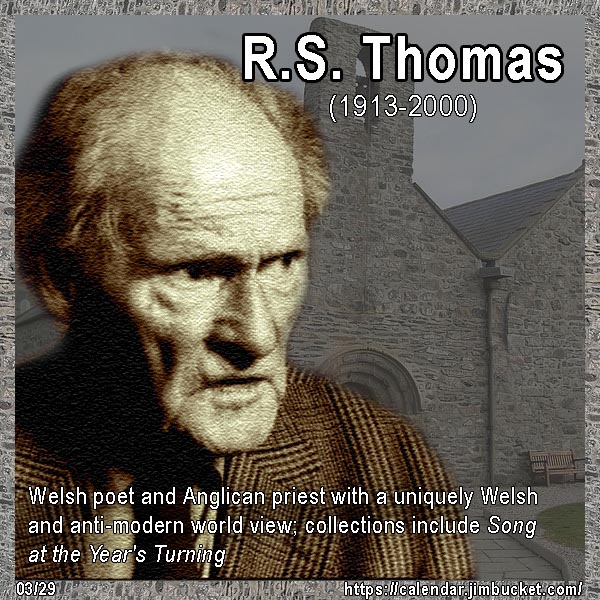
Mar. 29: R.S. Thomas, Welsh poet and priest

BORN MARCH 29:

R.S. Thomas (1913-2000) was a Welsh poet and Anglican priest. A fierce Welsh nationalist (who came to his "native tongue" only at the age of 30), he wrote poetry that interweaves his sometimes-progressive Christian faith with cultural issues and a "true Wales of my imagination," a Welsh-speaking aboriginal community that had remained in touch with the natural world. The Anglicization of Wales (including those Welsh only to happy to sell their patrimony for English money), and modernization in general, was represented in his poetry by "the machine," and by the specific machines that he preached against from the pulpit: refrigerators, washing machines, televisions, and other modern devices. A Welsh professor said of him that he was "a troubler of the Welsh conscience." He seems to have written over 40 books; his first major poetry collection, Song at the Year's Turning, is a good start.


Navigation:


Monday, March 28, 2022

Mar. 28: Mario Vargas Llosa, Peruvian author

BORN MARCH 28:

Mario Vargas Llosa (1936 - ) is a Peruvian novelist, journalist, short story writer, essayist, and former politician. He won the Nobel Prize in Literature in 2010 (among others), and is a leading representative of the so-called "Latin American Boom," writing about the Peruvian experience. Novels like The Time of the Hero, The Green House, and Conversation in the Cathedral brought him to international fame; Captain Pantoja and the Special Service and Aunt Julia and the Scriptwriter have been made into feature films. According to one source, he has written fifteen novels and three short story collections, as well as several collections of essays. His books have been translated into more than thirty languages.


Navigation:


Sunday, March 27, 2022

Mar. 27: Edward Steichen, Luxembourgish-American photographer

BORN MARCH 27:

Edward Steichen (1879-1973) was a Luxembourgish-American photographer credited with gaining photography its status as a "fine art." I knew Steichen's name before that of any other great photographer (even Ansel Adams) because an aunt passed along a copy of the book based on the project he curated while Director of the Department of Photography at New York's Museum of Modern Art: The Family of Man. The exhibit, featuring 503 photographs from 68 countries, was seen by nine million people at MOMA, then toured the world for eight years (and has experienced several revivals). The book (actually the exhibit's catalog), which has never been out of print, has sold over 4 million copies. Steichen also won an Academy Award for Best Documentary Feature for a war documentary, The Fighting Lady; in 2006, a print of one of his photographs sold for US$2.9 million--at the time, the highest price ever paid for a photograph at auction.


Navigation:


Saturday, March 26, 2022

Mar. 26: Joseph Campbell, American mythologist, writer and lecturer

BORN MARCH 26:

Joseph Campbell (1904-1987) was an American mythologist, writer and lecturer. Campbell was born in New York City and spent most of his life teaching there at Sarah Lawrence College. His first major work was also one of his most important and best-known: The Hero with a Thousand Faces, in which he finds a common structure underlying the hero stories of virtually every culture. His work was consulted by George Lucas when he began writing his Star Wars mythos; Lucas later funded the library that holds Campbell's collection. Something of an amateur and a popularizer, Campbell's work has been criticized by professionals in the field, but they can't deny his influence. His philosophy is summed up in the usually-misunderstood saying, "Follow your bliss." He also wrote the four-volume Masks of God series; numerous other works have been published of his essays, interviews (most famously Bill Moyers's The Power of Myth), and even travel journals.


Navigation:


Friday, March 25, 2022

Mar. 25: Flannery O'Connor, American writer

BORN MARCH 25:

Flannery O'Connor (1925-1964) was an American novelist, short story writer, and essayist who wrote two novels and 32 short stories, as well as other works. She often wrote in a sardonic Southern Gothic style and relied heavily on misfits in regional settings. A staunch Roman Catholic, she frequently examined questions of morality and ethics. Her novel Wise Blood is about a wounded returning WWII vet and how he copes with his loss of religious faith; the other one, The Violent Bear It Away, tells of a fourteen-year-old boy trying to escape his uncle's plans to make him a religious "prophet." Two of her short stories stand out: "A Good Man Is Hard to Find" (her best-known work) examines morality through the encounter of a family with an escaped convict. "Everything That Rises Must Converge" tells of the experience of a boy and his mother on a bus after the integration of their city's transportation system.


Navigation:


Thursday, March 24, 2022

Mar. 24: John Wesley Powell, American explorer

John Wesley Powell (1834-1902) was an American explorer, hardy Civil War vet (he lost an arm in battle) and professor of geology. He was appointed by President James A. Garfield as second director of the U.S. Geological Survey, and in 1869, led a three-month river trip that included the first official journey through the Grand Canyon, written up in The Exploration of the Colorado River and Its Canyons. He was also the first director of the Bureau of Ethnology at the Smithsonian.


Navigation:


Wednesday, March 23, 2022

Mar. 23: Kurosawa Akira, Japanese filmmaker

BORN MARCH 23:

Kurosawa Akira (1910-1998) was a Japanese filmmaker who is amongst a handful of the greatest in his craft. You can't really claim to know much about film if you don't know his. He directed thirty films over five decades, directing his first during World War II (after starting out as a painter and then working in the industry for most of a decade). Sixteen of his films featured the actor Toshiro Mifune. Some of his more significant works were Rashomon, famous for telling the same story (with variations) from different points of view; Ikiru, which examines the struggles of a terminally ill Tokyo bureaucrat and his final quest for meaning; Seven Samurai, the inspiration for Hollywood's The Magnificent Seven; Yojimbo, about two crime bosses vying for the services of a masterless samurai (the inspiration for the Spaghetti Western A Fistful of Dollars); Kagemusha, about a lower-class criminal who impersonates a dying warlord to discourage advances by his enemies; and Ran, with a plot derived from Shakespeare's King Lear. Kurosawa received the Academy Award for Lifetime Achievement in 1990.


Navigation:


Tuesday, March 22, 2022

Mar. 22: Louis L'Amour, American author of western novels

BORN MARCH 22:

Louis L'Amour (1908-1988) was an American author of western novels. Walk into my parents' den and you'll see a shelfful of paper backs with his name on the spine. My dad loved them, and while I haven't read all 105 of his works (89 novels, 14 short-story collections, and two full-length works of nonfiction), I've read a lot of them. Over three dozen were made into movies or TV shows, and he seldom strayed from the Old West. In the Sackett series (19 novels and two short stories), he created a dynasty of characters, some of whom have been played by the likes of Sam Elliott, Tom Selleck, and others. John Wayne, Anthony Quinn, and many more have played characters from his other books. Two of my favorites: The Californios, with tons of early California history; and Haunted Mesa, a "Weird West" sci-fi novel wrapped up with Pueblo Indian mythology.


Navigation:


Monday, March 21, 2022

Mar. 21: Johann Sebastian Bach, German composer

BORN MARCH 21:

Johann Sebastian Bach (1685-1750) German Baroque composer and musician. In "Top Ten" lists of the greatest composers of classical music, either Beethoven or Bach will likely be in the #1 slot. (If not, look to Mozart.) Composing for orchestra, keyboard, or voice, J. S. Bach (there were many other Bachs) was born in a musical family and orphaned at age 10. In the manner of a true genius, he often found it difficult to get along with his employers. He died of complications from eye surgery in 1750 at the age of 65. Among his more popular shorter pieces are "Jesu, Joy of Man's Desiring," Air on the G String, "Sheep May Safely Graze"; for longer listening try The Brandenburg Concertos; The Goldberg Variations; St. Matthew Passion; and The Well-Tempered Clavier. On the organ, the best is Toccata and Fugue in D minor. A true giant.


Navigation:


Sunday, March 20, 2022

Mar. 20: Ovid, Roman poet

BORN MARCH 20:

Ovid (43 BCE-17 CE) in full Publius Ovidius Naso, was a Roman poet during the reign of Augustus. He is ranked with Virgil and Horace, his older contemporaries, and was enormously popular during his lifetime (even though the emperor banished him for the last decade of his life, perhaps on morals charges). He is best-known today for the Metamorphoses, a 15-book work of mythology, and one of the most important sources on the subject; and for collections of love poems like Love Affairs and The Art of Love.


Navigation:


Saturday, March 19, 2022

Mar. 19: Richard Francis Burton, British explorer and writer

BORN MARCH 19:

Richard Francis Burton (1821-1890) was a British explorer and writer. Not so many men are cut from this cloth: a genuine adventurer who also wrote books of lasting interest. According to one count, he spoke twenty-nine European, Asian, and African languages (and tried to learn "monkey"); visited the Muslim holy city of Mecca when it was forbidden to Europeans on pain of death; translated The One Thousand and One Nights and The Kama Sutra; and traveled with the first Europeans to visit the Great Lakes of Africa in search of the source of the Nile. He also produced a "pseudotranslation," The Kasidah, claiming to be a translation of an original Persian text on Sufism, but in fact a wholly original work written by Burton. All this in addition to careers in the British Army in India and the diplomatic service in Equatorial Guinea, Brazil, Syria, and Italy. He was knighted by Queen Victoria in 1886.


Navigation:


Friday, March 18, 2022

Mar. 18: Edward Conze, Anglo-German Buddhist scholar


BORN MARCH 18:

Edward Conze (1904-1979) was an Anglo-German Buddhist scholar known for his many translations of seminal Buddhist works, as well as authoring such texts as Buddhism: Its Essence and Development; Buddhism: A Short History; and The Memoirs of a Modern Gnostic. Born in London of German parents (his father was a diplomat posted there), he grew up and was educated in Germany but fled (back) to Britain when the Nazis came to power in 1933. He converted to Buddhism after a mid-life crisis; he later taught in America (where one of my best professors was his student). His Buddhist Wisdom: The Diamond Sutra and The Heart Sutra has been lodged next to my bed for decades. Read it and reread it.


Navigation:


Thursday, March 17, 2022

Mar. 17: Kate Greenaway, English Victorian children's book artist and writer

BORN MARCH 17:

Catherine "Kate" Greenaway (1846-1901) was an English Victorian artist and writer, known for her children's book illustrations. Starting out as a creator of the new-fangled greeting card, she received her first commission to illustrate a children's book in 1867. She published her breakout book, Under the Window, in 1879, and sold over 100,000 copies. It was one of only two books that she wrote (the other is Marigold Garden, 1885) though she illustrated over 150 as a result of something called the "Greenaway vogue," and she became widely imitated. She died of breast cancer at the age of 55. The Kate Greenaway Medal was established in her honor in 1955, awarded annually in the UK to an illustrator of children's books.


Navigation:


Wednesday, March 16, 2022

Mar. 16: A. K. Ramanujan, Indian poet and scholar

BORN MARCH 16:

A. K. Ramanujan (1929-1993) was an Indian poet, scholar, professor, philologist, folklorist, translator, and playwright. Though he wrote widely and across many genres, he is best remembered for his poetry. However, one of his academic essays stirred interest--and controversy. "Three Hundred Ramayanas" demonstrates the spread of one of India's two greatest epics and its cultural impact beyond India itself, having been adapted to various languages, societies, religions, and periods. Hardline Hindu groups believe Ramanujan's work offends Hindu beliefs, and its inclusion in curricula has been the subject of protest actions--pro and con--in India's universities. Despite the title, Ramanujan's essay actually focuses on five "tellings" (by Valmiki, Kamban, the Jains, the Thais, and South Indian folk tellings); the figure of 300 is suggested by the work of another scholar.


Navigation:


Tuesday, March 15, 2022

Mar. 15: Cesare Beccaria, Italian philosopher and jurist

BORN MARCH 15:

Cesare Beccaria (1738-1794) was an Enlightenment-era Italian philosopher with some truly enlightened ideas. A criminologist and jurist, he is well-remembered for his work On Crimes and Punishments (1764), which argued against torture and the death penalty. This was a founding work in the fields of penology and criminology. Thus, Beccaria is considered the "father of modern criminal law" and the "father of criminal justice." As such, his ideas had a profound effect on the Founding Fathers of the United States as they framed the rights enumerated in the Constitution and its Bill of Rights.


Navigation:


Monday, March 14, 2022

Mar. 14: Albert Einstein, German/American physicist

BORN MARCH 14:

Albert Einstein (1879-1955) German/American physicist. Perhaps no scientist in history has achieved his level of public recognition: his name and face (not to mention his hairstyle) are known around the world. He coined "the world's most famous equation," E=mc2, part of his famous "theory of relativity," which says in essence that the amount of energy in any "thing" is equivalent to the amount of mass in that thing times the speed of light squared. Since his theory was accepted, it's Einstein's Universe and we're just living in it. During World War II, Einstein contributed to the Manhattan Project, which developed the atomic bomb for America. Some of his public reputation is based on his later opposition to nuclear weapons.


Navigation:


Sunday, March 13, 2022

Mar. 13: Mircea Eliade, Romanian historian of religion

BORN MARCH 13:

Mircea Eliade (1907-1986) Romanian historian of religion, philosopher, and fiction writer. Few thinkers have influenced my worldview as much as has Dr. Eliade (the advisor for my unfinished PhD had Eliade as his advisor for his PhD). His framing of religious thought in works like The Sacred and the Profane (the "two modes of being in the world") or The Myth of the Eternal Return: Cosmos and History is as useful as anything I've encountered. The books are short but deep, and deserve (require!) rereading. His book Shamanism popularized that word in religious discourse in English; From Primitives to Zen is a collection of religious texts that go, well, from indigenous cultures to Zen Buddhism (but excluding Judaism and Christianity as already readily available). Eliade is a must-read for anyone interested in humanity's approaches to "that world."


Navigation:


Saturday, March 12, 2022

Mar. 12: Jack Kerouac, American novelist

BORN MARCH 12:

Jack Kerouac (1922-1969) was an American novelist, poet, and pioneer of the Beat Generation, along with the likes of William S. Burroughs and Allen Ginsberg. He wrote over a dozen novels, most famously On the Road and The Dharma Bums, about ne'er-do-wells. His writing influenced '60s cultural icons like Bob Dylan, the Beatles, and the Doors. He died at age 47 as the result of alcoholism. Growing up in a French-speaking household in Massachusetts (his family was French-Canadian--he was born Jean-Louis), he learned to speak English at age six and didn't lose his accent until his late teens.


Navigation: