Showing posts with label German. Show all posts

Sunday, May 22, 2022

May 22: Richard Wagner, German composer

BORN MAY 22:

Richard Wagner (1813-1883) was a German composer mainly known for his operas. Thanks to Bugs Bunny and others, when most people think of opera they think of large women with horned helmets: that's a parody of Wagner. Much of his work centers on German legends and folklore; the complexity of his music is exhibited in his Tristan und Isolde (about ill-fated lovers), sometimes considered the beginning of modern music. His other works include Tannhauser, about a knight and minstrel whose music violates the rules of courtly (Platonic) love; Lohengrin, about another knight, a mysterious one, who arrives in a boat drawn by a swan to save a damsel in distress; Parsifal, based on Wolfram von Eschenbach's 13th-century account of that knight's quest for the Holy Grail; and above all his four-opera cycle Der Ring des Nibelungen (The Ring of the Nibelungs), a masterful blending of stories from Norse legendary sagas and the Nibelungenlied ("Song of the Nibelungs," the adventures of one Siegfried). Wagner's last years were turbulent, but his influence can be seen in many of the arts of the 20th century, including philosophy, literature, the visual arts, and theater. Wagner's most important stage works continue to be performed at a festival run by his descendants.


Navigation:


Thursday, May 5, 2022

May 5: Karl Marx, German philosopher

BORN MAY 5:

Karl Marx (1818-1883) was a German philosopher and with a handful of others--Darwin and Freud come to mind--a creator of the world in which we live. Politics since Marx either follows his thought or opposes it, but it can't ignore "Marxism" or "Marxist ideology." With his wife and children, he lived in London for decades, collaborating with another German thinker, Friedrich Engels. Much of his research was done in the Reading Room of the British Museum. Marxism 101 says that in history, human societies develop through class conflict. In capitalism, this is conflict between the ruling classes (the bourgeoisie) and the working classes (the proletariat). Capitalism, he said, produces internal tensions that will lead to its self-destruction and replacement by a new system: socialism. He advocated an organized revolution of the working class. His most important works are The Communist Manifesto (with Friedrich Engels--a mere pamphlet) and the monumental three-volume Das Kapital (Capital).


Navigation:


Monday, March 21, 2022

Mar. 21: Johann Sebastian Bach, German composer

BORN MARCH 21:

Johann Sebastian Bach (1685-1750) German Baroque composer and musician. In "Top Ten" lists of the greatest composers of classical music, either Beethoven or Bach will likely be in the #1 slot. (If not, look to Mozart.) Composing for orchestra, keyboard, or voice, J. S. Bach (there were many other Bachs) was born in a musical family and orphaned at age 10. In the manner of a true genius, he often found it difficult to get along with his employers. He died of complications from eye surgery in 1750 at the age of 65. Among his more popular shorter pieces are "Jesu, Joy of Man's Desiring," Air on the G String, "Sheep May Safely Graze"; for longer listening try The Brandenburg Concertos; The Goldberg Variations; St. Matthew Passion; and The Well-Tempered Clavier. On the organ, the best is Toccata and Fugue in D minor. A true giant.


Navigation:


Friday, March 18, 2022

Mar. 18: Edward Conze, Anglo-German Buddhist scholar


BORN MARCH 18:

Edward Conze (1904-1979) was an Anglo-German Buddhist scholar known for his many translations of seminal Buddhist works, as well as authoring such texts as Buddhism: Its Essence and Development; Buddhism: A Short History; and The Memoirs of a Modern Gnostic. Born in London of German parents (his father was a diplomat posted there), he grew up and was educated in Germany but fled (back) to Britain when the Nazis came to power in 1933. He converted to Buddhism after a mid-life crisis; he later taught in America (where one of my best professors was his student). His Buddhist Wisdom: The Diamond Sutra and The Heart Sutra has been lodged next to my bed for decades. Read it and reread it.


Navigation:


Monday, March 14, 2022

Mar. 14: Albert Einstein, German/American physicist

BORN MARCH 14:

Albert Einstein (1879-1955) German/American physicist. Perhaps no scientist in history has achieved his level of public recognition: his name and face (not to mention his hairstyle) are known around the world. He coined "the world's most famous equation," E=mc2, part of his famous "theory of relativity," which says in essence that the amount of energy in any "thing" is equivalent to the amount of mass in that thing times the speed of light squared. Since his theory was accepted, it's Einstein's Universe and we're just living in it. During World War II, Einstein contributed to the Manhattan Project, which developed the atomic bomb for America. Some of his public reputation is based on his later opposition to nuclear weapons.


Navigation:


Tuesday, February 22, 2022

Feb. 22: Arthur Schopenhauer, German philosopher

BORN FEBRUARY 22:

Arthur Schopenhauer (1788-1860) was a German philosopher best known for The World as Will and Representation, in which--influenced by Kant and perhaps Indian philosophy--he developed an atheistic metaphysical and ethical system, suggesting that the world we perceive is a representation and not something with its own existence. He also had one of the coolest hairdos ever.


Navigation:


Saturday, February 19, 2022

Feb. 19: Nicolaus Copernicus, German/Polish astronomer

BORN FEBRUARY 19:

Nicolaus Copernicus (1473-1543) German/Polish astronomer. Until his time, the accepted "truth" was that the earth was the center of the universe (after all, didn't God choose to put humans here?) and all celestial bodies revolved around it. But as observation of planetary motion became more refined, anomalies appeared. Copernicus resolved this by creating a model that placed the sun at the center of our solar system (heliocentrism). He published his findings in De revolutionibus orbium coelestium (On the Revolutions of the Heavenly Spheres) just before his death in 1543; it was a revolution in more ways than one. Galileo and others took up the charge and today everything is in its right place.


Navigation:


Tuesday, January 4, 2022

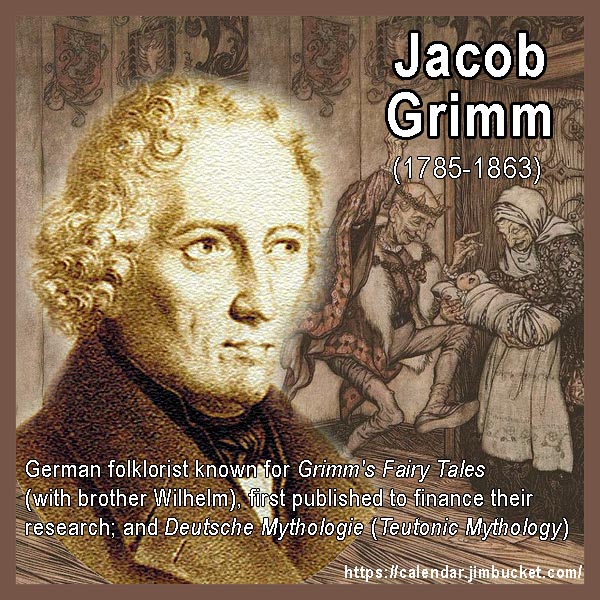
Jan. 4: Jacob Grimm, German folklorist

BORN JANUARY 4:

Jacob Grimm (1785-1863) German folklorist known for Kinder-und Hausmärchen (Children's and Household Tales, with brother Wilhelm), better known as Grimm's Fairy Tales, which the brothers first published to finance their research; and Deutsche Mythologie (Teutonic Mythology).


Navigation:


Monday, December 27, 2021

Dec. 27: Johannes Kepler, German astronomer

BORN DECEMBER 27:

Johannes Kepler (1571-1630) German astronomer and mathematician who codified the laws of planetary motion; he wrote Astronomia Nova (New Astronomy); Harmonices Mundi (The Harmony of the World); and Epitome Astronomiae Copernicanae (Epitome of Copernican Astronomy).


Navigation:


Friday, December 17, 2021

Dec. 17: Ludwig van Beethoven, German composer

BORN DECEMBER 17:

Ludwig van Beethoven (1770-1827) prototypical German composer best known for his Fifth and Ninth Symphonies (the other seven are pretty good, too); Concertos (Emperor); sonatas (Moonlight, Pathetique); opera Fidelio; "Fur Elise." In art, there's Picasso; in science, Einstein; in music, it's Beethoven.


Navigation:


Thursday, September 16, 2021

Sep. 16: Hildegard of Bingen

BORN SEPTEMBER 16th:

Hildegard of Bingen: (1098-1179) German abbess, philosopher, and mystic known for spiritual works Scivias (Know the Ways); Liber Vitae Meritorum (Book of Life's Merits); Liber Divinorum Operum (Book of Divine Works). In addition to her prolific output as a composer of sacred chant (her works make her the most recorded composer of such works in modern history), she is also (surprisingly) considered by some to be the founder of the scientific approach to natural history in Germany.


Navigation: