Showing posts with label Philosopher. Show all posts

Sunday, May 29, 2022

May 29: G. K. Chesterton, English novelist and lay theologian

BORN MAY 29:

G. K. Chesterton (1874-1936) was an English novelist, poet, philosopher, dramatist, journalist, lay theologian, and critic. Some of his theological works, such as Orthodoxy and The Everlasting Man, anticipate the point-of-view and style of C. S. Lewis. He wrote around 80 books, several hundred poems, around 200 short stories, 4,000 essays (mostly as newspaper columns), and several plays. He also wrote articles for the 14th edition (1929) of the Encyclopædia Britannica, including the entry on Charles Dickens and part of the entry on Humor. Among his more popular novels are The Napoleon of Notting Hill, in which a randomly selected King of England enacts some inane laws, and a local young man--the eponymous "Napoleon"--exploits them; and The Man Who Was Thursday, a send-up of anarchism in which most of the leading anarchists turn out to be secret policemen meant to defeat anarchism. Most of us today, though, will know him for the Father Brown stories, often adapted for film, radio, TV, and other media.


Navigation:


Wednesday, May 25, 2022

May 25: Ralph Waldo Emerson, American writer and philosopher

BORN MAY 25:

Ralph Waldo Emerson (1803-1882) was an American writer and perhaps the young country's first original philosopher. He was an essayist, lecturer, abolitionist, and poet, and a leader of the mid-19th century transcendentalist movement. In true American mode, he championed individualism, disseminating his ideology through dozens of published essays and more than 1,500 public lectures across the United States. Starting out as a pastor (like his father), he struck out on his own with the publication of his 1836 essay "Nature," which expressed the philosophy of transcendentalism. He would often lecture on a topic, then revise his notes to publish as essays. Some of the more important of these are "The American Scholar," "Self-Reliance," "The Over-Soul," "Experience," and others. He returned again and again to the ideas of individuality, freedom, the ability of humankind to achieve almost anything, and the relationship between the soul and the outside world. He was also a mentor and friend of Henry David Thoreau, another transcendentalist.


Navigation:


Wednesday, May 18, 2022

May 18: Bertrand Russell, British philosopher and mathematician

BORN MAY 18:

Bertrand Russell (1872-1970) was a British philosopher, mathematician, historian, and activist who wrote the Principia Mathematica with Alfred North Whitehead, as well as a number of atheistic pieces such as What I Believe and Why I Am Not a Christian. He also wrote a wonderful History of Western Philosophy. Surprising, then, that given his skepticism, he received a Nobel Prize in Literature in 1950, which cited his "varied and significant writings in which he champions humanitarian ideals and freedom of thought."


Navigation:


Thursday, May 5, 2022

May 5: Karl Marx, German philosopher

BORN MAY 5:

Karl Marx (1818-1883) was a German philosopher and with a handful of others--Darwin and Freud come to mind--a creator of the world in which we live. Politics since Marx either follows his thought or opposes it, but it can't ignore "Marxism" or "Marxist ideology." With his wife and children, he lived in London for decades, collaborating with another German thinker, Friedrich Engels. Much of his research was done in the Reading Room of the British Museum. Marxism 101 says that in history, human societies develop through class conflict. In capitalism, this is conflict between the ruling classes (the bourgeoisie) and the working classes (the proletariat). Capitalism, he said, produces internal tensions that will lead to its self-destruction and replacement by a new system: socialism. He advocated an organized revolution of the working class. His most important works are The Communist Manifesto (with Friedrich Engels--a mere pamphlet) and the monumental three-volume Das Kapital (Capital).


Navigation:


Tuesday, May 3, 2022

May 3: Niccolo Machiavelli, Italian Renaissance author

BORN MAY 3:

Niccolo Machiavelli (1469-1527) was an Italian Renaissance diplomat, author, philosopher, and historian best known for The Prince (Il Principe), written about 1513 but not published until 1532. He also wrote comedies, songs, and poetry, but in most people's minds he was a ruthless political animal who advocated the unscrupulous acts in The Prince. One of his leadership maxims was, "It is better to be feared than to be loved"; he claimed that throughout the course of  history, politics had always been played with deception, treachery, and criminal acts: any action could be excused if it benefited the ruler. Some are unsure whether Machiavelli believed these things and was recommending them to rulers, or perhaps was just publicizing them as a warning to an unwary public. Some even see them as satire, a serious jester's slap at bad rulers. In any case, the term "Machiavellian" has come to describe these cunning, scheming, and unscrupulous actions.


Navigation:


Tuesday, March 15, 2022

Mar. 15: Cesare Beccaria, Italian philosopher and jurist

BORN MARCH 15:

Cesare Beccaria (1738-1794) was an Enlightenment-era Italian philosopher with some truly enlightened ideas. A criminologist and jurist, he is well-remembered for his work On Crimes and Punishments (1764), which argued against torture and the death penalty. This was a founding work in the fields of penology and criminology. Thus, Beccaria is considered the "father of modern criminal law" and the "father of criminal justice." As such, his ideas had a profound effect on the Founding Fathers of the United States as they framed the rights enumerated in the Constitution and its Bill of Rights.


Navigation:


Tuesday, February 22, 2022

Feb. 22: Arthur Schopenhauer, German philosopher

BORN FEBRUARY 22:

Arthur Schopenhauer (1788-1860) was a German philosopher best known for The World as Will and Representation, in which--influenced by Kant and perhaps Indian philosophy--he developed an atheistic metaphysical and ethical system, suggesting that the world we perceive is a representation and not something with its own existence. He also had one of the coolest hairdos ever.


Navigation:


Sunday, January 9, 2022

Jan. 9: Simone de Beauvoir, French writer and philosopher

BORN JANUARY 9:

Simone de Beauvoir (1908-1986) French novelist, philosopher, and pioneering feminist (though she would have rejected the label); She Came to Stay; The Second Sex; Memoirs of a Dutiful Daughter.


Navigation:


Wednesday, January 5, 2022

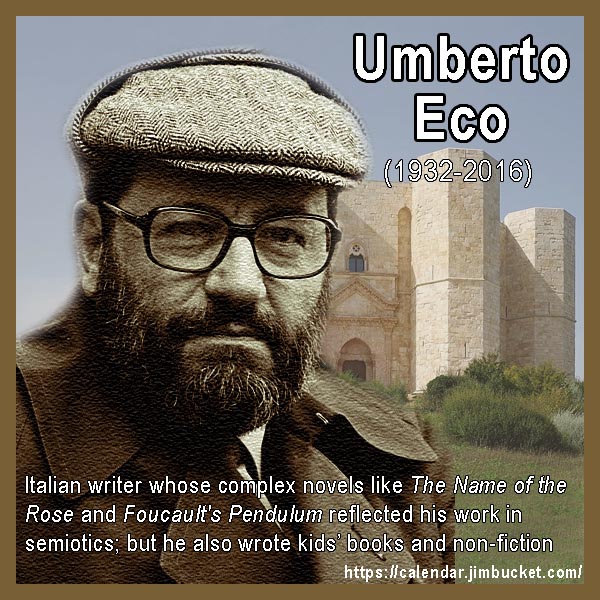
Jan. 5: Umberto Eco, Italian writer

BORN JANUARY 5:

Umberto Eco (1932-2016) Italian novelist, critic, and philosopher whose complex novels reflected his work in semiotics; The Name of the Rose; Foucault's Pendulum; The Island of the Day Before; The Prague Cemetery. But he also wrote children's books, and far more non-fiction than his "mere" seven novels.


Navigation:


Sunday, November 21, 2021

Nov. 21: Voltaire, French philosopher and satirist

BORN NOVEMBER 21:

Voltaire (1694-1778) French philosopher and satirist born François-Marie Arouet; his pen name may be based on an anagram of his surname. He was famed for his wit, his criticism of the Church, and his advocacy of such Enlightenment values as freedom of speech, freedom of religion, and separation of church and state. Known especially for Candide, as well as Micromégas, Zadig, and others.


Navigation:


Thursday, November 11, 2021

Nov. 11: Fyodor Dostoyevsky, Russian writer and philosopher

BORN NOVEMBER 11:

Fyodor Dostoyevsky (1821-1881) Russian novelist, short story writer, essayist, journalist and philosopher. Though something of a radical, the experience of being arrested and standing in front of a firing squad when his pardon arrived from the czar (plus four years at hard labor) cured him of extreme acts. The literary world is the better for it, as he wrote Crime and Punishment; The Idiot; The Brothers Karamazov; and Notes from Underground. Joseph Stalin said, "Nobody understands human psychology like Dostoyevsky, and that's why I've banned him."


Navigation:


Sunday, November 7, 2021

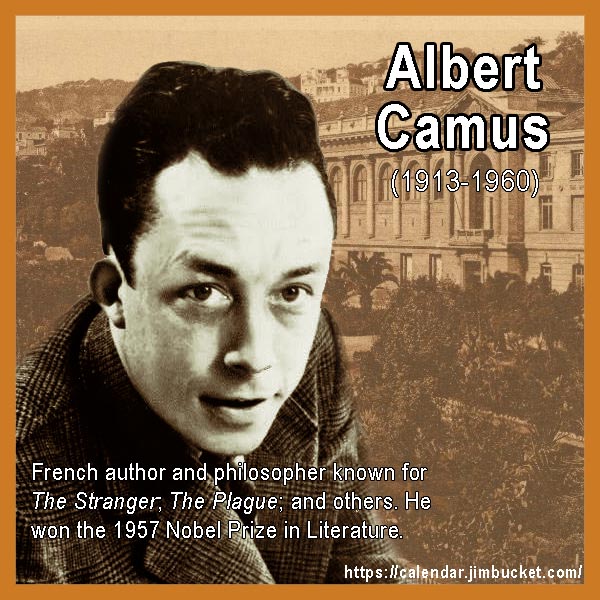
Nov. 7: Albert Camus, French writer and philosopher

BORN NOVEMBER 7:

Albert Camus (1913-1960) French philosopher, author, and journalist. Considered to be an existentialist, a label he rejected, his writings contributed to an even more extreme point of view: absurdism. Works include The Stranger, The Plague, and The Myth of Sisyphus. He won the Nobel Prize in Literature in 1957.


Navigation:


Friday, November 5, 2021

Nov. 5: Will Durant, American historian and philosopher

BORN NOVEMBER 5:

Will Durant (1885-1981) American writer, historian, and philosopher best known for his mammoth 11-volume encyclopedic work, The Story of Civilization, co-written with his wife Ariel. Published over a 40-year period, it began with Our Oriental Heritage and ended with The Age of Napoleon. He also wrote The Story of Philosophy.


Navigation:


Wednesday, October 20, 2021

Oct. 20: John Dewey, American educator

BORN OCTOBER 20:

John Dewey (1859-1952) American philosopher, psychologist, and educator. His influence on American education is so vast--he published more than 700 articles in 140 journals, and wrote approximately 40 books, in addition to operating pragmatic "teaching lab" schools and teaching in universties--that it's hard today to separate out what is Dewey and what is not.

He wrote (among many those others) Democracy and Education; The Public and its Problems; Art as Experience; Freedom and Culture; and Knowing and the Known.


Navigation:


Thursday, October 7, 2021

Oct. 7: Niels Bohr, Danish physicist

BORN OCTOBER 7th:

Niels Bohr (1885-1962) Danish physicist (and philosopher of science) known for Atomic Physics and Human Knowledge; Nobel Prize in Physics (1922). His primary contributions were in the areas of atomic structure and quantum theory; his theory of the atom superseded that of Ernest Rutherford, and in turn was displaced by that of Heisenberg, Schrödinger, et al.


Navigation:


Saturday, October 2, 2021

Oct. 2: Mahatma Gandhi, Indian Social Activist


BORN OCTOBER 2nd:

Mahatma Gandhi (1869-1948) Indian lawyer, activist, and philosopher who used nonviolence in a successful campaign to end British colonial rule in India. He was inspired by the writings of Thoreau and Tolstoy, and in turn inspired Dr. Martin Luther King, Jr. Though named Mohandas, he was widely known as "Mahatma," meaning "Great Soul." His writings included an autobiography, The Story of My Experiments with Truth.

Navigation:


Sunday, September 5, 2021

Sep. 5: Tommaso Campanella, Italian philosopher-monk

BORN SEPTEMBER 5th:

Tommaso Campanella (1568-1639) Italian philosopher-monk and poet known for his heterodox views, for which he was tortured and then imprisoned for 27 years, where he wrote among other works his utopian novel La città del Sole (The City of the Sun).


Navigation: