Showing posts with label Novelist. Show all posts

Sunday, May 29, 2022

May 29: G. K. Chesterton, English novelist and lay theologian

BORN MAY 29:

G. K. Chesterton (1874-1936) was an English novelist, poet, philosopher, dramatist, journalist, lay theologian, and critic. Some of his theological works, such as Orthodoxy and The Everlasting Man, anticipate the point-of-view and style of C. S. Lewis. He wrote around 80 books, several hundred poems, around 200 short stories, 4,000 essays (mostly as newspaper columns), and several plays. He also wrote articles for the 14th edition (1929) of the Encyclopædia Britannica, including the entry on Charles Dickens and part of the entry on Humor. Among his more popular novels are The Napoleon of Notting Hill, in which a randomly selected King of England enacts some inane laws, and a local young man--the eponymous "Napoleon"--exploits them; and The Man Who Was Thursday, a send-up of anarchism in which most of the leading anarchists turn out to be secret policemen meant to defeat anarchism. Most of us today, though, will know him for the Father Brown stories, often adapted for film, radio, TV, and other media.


Navigation:


Friday, May 20, 2022

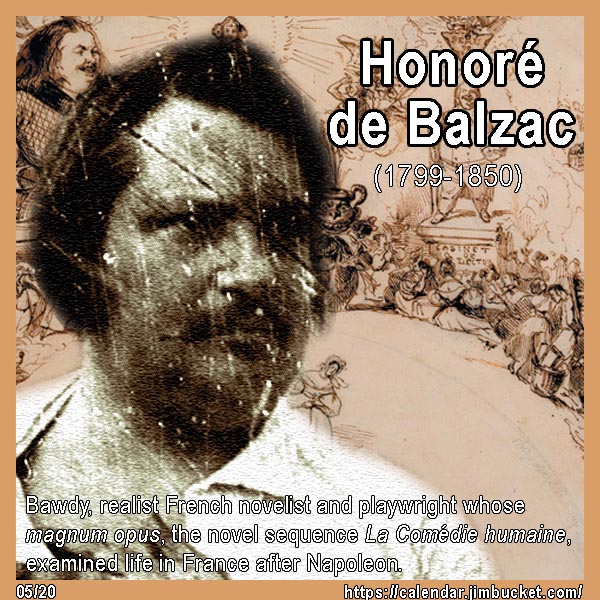
May 20: Honoré de Balzac, French novelist and playwright

BORN MAY 20:

Honoré de Balzac (1799-1850) was a famously bawdy French novelist and playwright. His magnum opus is the novel sequence La Comédie humaine (The Human Comedy), a panorama of post-Napoleonic French life. Regarded as a founder of realism in European literature, he is remembered for his multi-faceted characters; his writing influenced writers such as Zola, Dickens, Flaubert, and Henry James. He suffered from health problems (and the effects of an irascible character) throughout his life; his family relations were often strained by financial and personal drama. La Comédie humaine consists of 91 finished novels, stories, and essays, and another 46 unfinished (some of which exist only as titles). Balzac published 49 novels and novellas during his lifetime, including Eugénie GrandetLe Père Goriot, and La Cousine Bette; around a dozen more were published posthumously. He also published seven plays and numerous short stories. Many of his works have been adapted into films and television series.


Navigation:


Monday, May 9, 2022

May 9: J. M. Barrie, Scottish novelist and playwright

BORN MAY 9:

J. M. Barrie (1860-1937) was a Scottish novelist and playwright whose other works (there were nearly 70) were overshadowed by that one annoying character who showed up in five of Barrie's novels and plays: Peter Pan. The character grew, as did Carroll's Alice (in Wonderland), from Barrie's close acquaintance with the children of a family (raising the usual unfounded speculations posthumously). The boy on whom the character was based, Peter Llewelyn Davies, threw himself under a train as it was pulling into a London Underground station when he was 63. Anyway, the story may also have popularized (if not downright introduced) the name Wendy. His best-known non-Peter work may be The Admirable Crichton, written for the stage and adapted to film, TV, and radio at least five times.


Navigation:


Monday, May 2, 2022

May 2: Jerome K. Jerome, British humorist

BORN MAY 2:

Name Jerome K. Jerome (1859-1927) was an English humorist and playwright who wrote the comic travelogue Three Men in a Boat and its sequel Three Men on the Bummel, as well as the books of essays Idle Thoughts of an Idle Fellow and Second Thoughts of an Idle Fellow. Three Men in a Boat--the story of, well, three men messing about in a boat on the Thames--was a phenomenon, and popularized boating on the Thames such that boat registrations went up 50% the year after it was published. It has never been out of print, and has been adapted into films, TV, radio shows, stage plays, and even a musical. None of his subsequent novels (at least 10), essay collections (at least 15), short stories (at least 11), plays (at least 24), nor his autobiography ever achieved the success of that first silly book.


Navigation:


Sunday, May 1, 2022

May 1: Harry Leon Wilson, American novelist

BORN MAY 1:

Harry Leon Wilson (1867-1939) was an American novelist who, though not a household name today, brought pleasure to thousands (if not millions) by writing the novels that became four films: Merton of the Movies (filmed in 1924, a film that is now lost; 1932, as Make Me a Star; and 1947, with Red Skelton); and Ruggles of Red Gap (1935), with Charles Laughton as an English "gentleman's gentleman" who has been gambled away to a couple of gauche, nouveau riche American millionaires. Merton was also done as a stage and radio play. After working in the publishing industry in New York, Wilson settled permanently at Carmel-by-the-Sea, California, in an artists' community that included Jack London, Upton Sinclair, Ambrose Bierce, Sinclair Lewis, and others. This is where he wrote his most famous novels.


Navigation:


Thursday, April 28, 2022

Apr. 28: Harper Lee, American novelist

BORN APRIL 28:

(Nelle) Harper Lee (1926-2016) was an American novelist. When her first (and almost only) novel, To Kill a Mockingbird, was published in 1960 (and won the 1961 Pulitzer Prize for Fiction), she was not an unknown in the publishing world. She was a lifelong friend of Truman Capote ("Dill" in TKAM was based on him). His first novel was published in 1948, and Breakfast at Tiffany's ten years later; she lived near him in Manhattan, and accompanied him to Kansas to do the research on In Cold Blood. At Christmas in 1956, friends gave her a gift of a year's wages with a note: "You have one year off from your job to write whatever you please. Merry Christmas." What she wrote was a mangled manuscript called Go Set a Watchman. With the help of seasoned editor Tay Hohoff at Lippincott, it became the polished To Kill a Mockingbird, a book which she said was not a "coming of age" story but a look at the irrational prejudices of adults as seen through the eyes of children. She was never to publish another novel until in 2015, HarperCollins announced it would publish Go Set a Watchman, first described as a "sequel" to TKAM, but later admitted to be an early draft. Allegations that unscrupulous background players (a lawyer, an agent, etc.) coerced Lee into doing what she said she never would--publish another novel--were never proven, though it is suspicious that this all happened just two and a half months after her sister--a lawyer who had been her protector--passed away. (I refuse to read it, not least because it portrays my one of my fictional heroes, Atticus Finch, as something of a racist.)


Navigation:


Sunday, April 24, 2022

Apr. 24: Anthony Trollope, English novelist

BORN APRIL 24:

Anthony Trollope (1815-1882) was an English novelist probably best known today for the the six novels of the series The Chronicles of Barsetshire, which included Barchester Towers. He wrote another series of six, a series of five, and 30 stand alone novels; over 40 short stories; 17 works of non-fiction; at least 20 articles; two plays; and several volumes of collected letters. This raises the question: how did he become "one of the most prolific writers of all time" while fulfilling his duties as a postal clerk and inspector? The answer was: a new-found discipline (previously he had been known as unpunctual and insubordinate) that pushed him to write on the trains during his inspection journeys. (There's a lesson in this for you, Jim Bucket!)


Navigation:


Sunday, April 17, 2022

Apr. 17: Isak Dinesen, Danish author

BORN APRIL 17:

Isak Dinesen (1885-1962) was a Danish author who wrote novels, poems, and short stories, and was known for Out of Africa; Seven Gothic Tales; and "Babette's Feast." She was a woman of many names: born Karen Dinesen, "Isak" is a pen name, as was Tania Blixen, Osceola, and Pierre Andrézel. She married Baron Bror Fredrik von Blixen-Finecke, and ended up with the weighty name Baroness Karen Christenze von Blixen-Finecke. "Isak Dinesen" will do nicely. Out of Africa, which became a film starring Meryl Streep and Robert Redford that won Best Picture and Best Director (Sydney Pollack) Oscars, was based on her life while living in Kenya (1914-1931); the film version of her story "Babette's Feast" won the Oscar for Best Foreign Language Film.


Navigation:


Saturday, April 16, 2022

Apr. 16: Anatole France, French "man of letters"

BORN APRIL 16:

Anatole France (born François-Anatole Thibault, 1844-1924) was a French poet, journalist, and novelist; he had several best-sellers, and was considered the "ideal French man of letters" in his day--indeed, the citation for his 1921 Nobel Prize in Literature mentioned that he had "a true Gallic temperament." He grew up in his father's bookstore, which specialized in the French Revolution. His many novels include Thaïs, about a legendary 4th-century female Egyptian saint; At the Sign of the Reine Pédauque, about the tribulations of a young man at the beginning of the 18th century; Penguin Island, a satirical fictional history, in which a nearly-blind missionary baptizes a bunch of birds and the Lord, to fix the problem, turns the birds into humans (they establish Penguinia, a country with a history which mirrors that of France); The Gods Are Athirst, about the rise and fall of a painter-turned-jurist in the dark years of the Reign of Terror during the French Revolution; and The Revolt of the Angels, about the well-known story of the war in heaven between the angels led by the Archangel Michael and those led by Satan. He also wrote poetry, memoirs, plays, and literary and social criticism.


Navigation:


Sunday, April 10, 2022

Apr. 10: Lew Wallace, American writer

BORN APRIL 10:

Lew Wallace (1827-1905) was an American lawyer and a Union general in the American Civil War. (He also served on the military commission for the trials of the Lincoln assassination conspirators.) He later served as governor of the New Mexico Territory, during which time he completed his most famous work (while living at the Palace of the Governors in Santa Fe), Ben-Hur, subtitled A Tale of the Christ. It has been called "the most influential Christian book of the nineteenth century," and is known to a certain generation of moviegoers for the epic 1959 film version, which won a record 11 Academy Awards in 1960. Published in 1880, it was the first book to dislodge Harriet Beecher Stowe's 1852 Uncle Tom's Cabin in sales, and was itself not bumped from the top of the US all-time bestseller list until 1936 with the publication of Margaret Mitchell's Gone with the Wind. The protagonist, Judah Ben-Hur, was a Jewish prince from Jerusalem enslaved by the Romans at the beginning of the first century CE. Parallel to his narrative is that of Jesus, from the same region and around the same age. The two young men's lives intersect throughout the story, and Judah converts to Christianity late in the story.


Navigation:


Thursday, March 31, 2022

Mar. 31: Andrew Lang, Scottish writer

BORN MARCH 31:

Andrew Lang (1844-1912) was a Victorian Scottish poet, novelist, and folklorist. He is best-known for the Fairy Book series of 14 colors, starting with The Blue Fairy Book. He also collaborated on translations of The Iliad and The Odyssey and wrote or edited a total of around 200 books, bringing lots of history, folk and fairy tales, and classic literature to a wider audience.


Navigation:


Monday, March 28, 2022

Mar. 28: Mario Vargas Llosa, Peruvian author

BORN MARCH 28:

Mario Vargas Llosa (1936 - ) is a Peruvian novelist, journalist, short story writer, essayist, and former politician. He won the Nobel Prize in Literature in 2010 (among others), and is a leading representative of the so-called "Latin American Boom," writing about the Peruvian experience. Novels like The Time of the Hero, The Green House, and Conversation in the Cathedral brought him to international fame; Captain Pantoja and the Special Service and Aunt Julia and the Scriptwriter have been made into feature films. According to one source, he has written fifteen novels and three short story collections, as well as several collections of essays. His books have been translated into more than thirty languages.


Navigation:


Friday, March 25, 2022

Mar. 25: Flannery O'Connor, American writer

BORN MARCH 25:

Flannery O'Connor (1925-1964) was an American novelist, short story writer, and essayist who wrote two novels and 32 short stories, as well as other works. She often wrote in a sardonic Southern Gothic style and relied heavily on misfits in regional settings. A staunch Roman Catholic, she frequently examined questions of morality and ethics. Her novel Wise Blood is about a wounded returning WWII vet and how he copes with his loss of religious faith; the other one, The Violent Bear It Away, tells of a fourteen-year-old boy trying to escape his uncle's plans to make him a religious "prophet." Two of her short stories stand out: "A Good Man Is Hard to Find" (her best-known work) examines morality through the encounter of a family with an escaped convict. "Everything That Rises Must Converge" tells of the experience of a boy and his mother on a bus after the integration of their city's transportation system.


Navigation:


Tuesday, March 22, 2022

Mar. 22: Louis L'Amour, American author of western novels

BORN MARCH 22:

Louis L'Amour (1908-1988) was an American author of western novels. Walk into my parents' den and you'll see a shelfful of paper backs with his name on the spine. My dad loved them, and while I haven't read all 105 of his works (89 novels, 14 short-story collections, and two full-length works of nonfiction), I've read a lot of them. Over three dozen were made into movies or TV shows, and he seldom strayed from the Old West. In the Sackett series (19 novels and two short stories), he created a dynasty of characters, some of whom have been played by the likes of Sam Elliott, Tom Selleck, and others. John Wayne, Anthony Quinn, and many more have played characters from his other books. Two of my favorites: The Californios, with tons of early California history; and Haunted Mesa, a "Weird West" sci-fi novel wrapped up with Pueblo Indian mythology.


Navigation:


Sunday, March 13, 2022

Mar. 13: Mircea Eliade, Romanian historian of religion

BORN MARCH 13:

Mircea Eliade (1907-1986) Romanian historian of religion, philosopher, and fiction writer. Few thinkers have influenced my worldview as much as has Dr. Eliade (the advisor for my unfinished PhD had Eliade as his advisor for his PhD). His framing of religious thought in works like The Sacred and the Profane (the "two modes of being in the world") or The Myth of the Eternal Return: Cosmos and History is as useful as anything I've encountered. The books are short but deep, and deserve (require!) rereading. His book Shamanism popularized that word in religious discourse in English; From Primitives to Zen is a collection of religious texts that go, well, from indigenous cultures to Zen Buddhism (but excluding Judaism and Christianity as already readily available). Eliade is a must-read for anyone interested in humanity's approaches to "that world."


Navigation:


Saturday, March 12, 2022

Mar. 12: Jack Kerouac, American novelist

BORN MARCH 12:

Jack Kerouac (1922-1969) was an American novelist, poet, and pioneer of the Beat Generation, along with the likes of William S. Burroughs and Allen Ginsberg. He wrote over a dozen novels, most famously On the Road and The Dharma Bums, about ne'er-do-wells. His writing influenced '60s cultural icons like Bob Dylan, the Beatles, and the Doors. He died at age 47 as the result of alcoholism. Growing up in a French-speaking household in Massachusetts (his family was French-Canadian--he was born Jean-Louis), he learned to speak English at age six and didn't lose his accent until his late teens.


Navigation:


Friday, March 11, 2022

Mar. 11: Douglas Adams, British author

BORN MARCH 11:

Douglas Adams (1952-2001) was an English author, screenwriter, essayist, satirist, and playwright. Best known for his five book trilogy The Hitchhiker's Guide to the Galaxy (first heard as a BBC radio comedy, and later adapted to a TV series, several stage plays, comics books, a video game, and a feature film), he wrote in several media. He also wrote two books starring Dirk Gently, the "holistic detective," along with scripts for Dr. Who and sketches for Monty Python. Sadly, he died at age 49 after resting from his regular workout at a private gym. The irony would not have been lost on him.


Navigation:


Wednesday, March 9, 2022

Mar. 9: Haniel Long, American writer of the Southwest

BORN MARCH 9:

Haniel Clark Long (1888-1956) was an American poet, novelist, publisher, and academic. Born in Burma of American missionaries, he returned to the states at age three and, a married man and father, moved to Santa Fe for health reasons in his early forties. And there he stayed, promoting New Mexican authors and publishing more of his own poetry until, in 1936, he published his novella Interlinear to Cabeza de Vaca. This is a fictionalized account of the true story of Alvar Nunez Cabeza de Vaca, a Spanish conquistador who was shipwrecked in Florida in 1528 near what is now Galveston, Texas, and set out with four other survivors to walk back to Mexico, where the arrived in 1536, having been the first Europeans to traverse parts of the American Southwest and northern Mexico. He brought back stories of Cibola, the fabled "Seven Cities of Gold," which spurred the vast explorations of Francisco Vazquez de Coronado. Though Long wrote many more books, notably Pinon Country--which depicts the colorful people and the landscape of the Southwest--Interlinear (also called The Power Within Us) remains the book for which he's best known.


Navigation:


Sunday, February 27, 2022

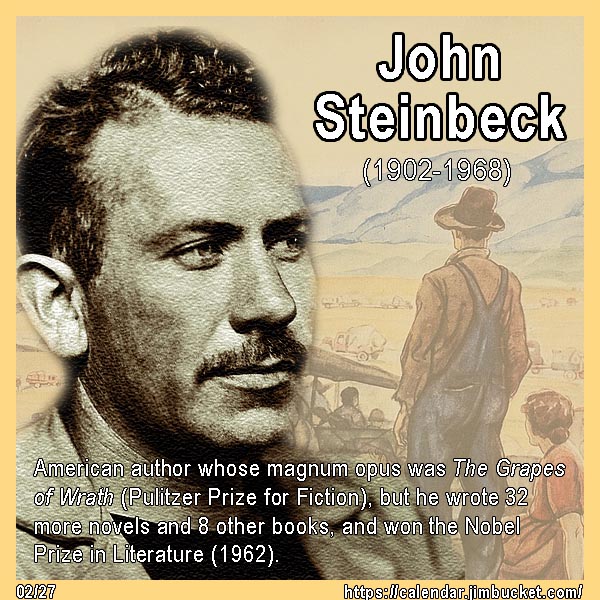
Feb. 27: John Steinbeck, American author

BORN FEBRUARY 27:

John Steinbeck (1902-1968) was an American author of novels (33), non-fiction books (6), and short stories (2 collections), who has been called "a giant of American letters." Generally set in central California (or Baja California, Mexico), his books include The Grapes of Wrath (Pulitzer Prize for Fiction, 1940), about Depression-era migrants from Oklahoma; Of Mice and Men, about two other vagrants; Cannery Row, set in Monterey not far from his birthplace in Salinas, CA; Tortilla Flat, East of Eden, The Red Pony, The Pearl, and many more, leading to the Nobel Prize in Literature in 1962. His work frequently explored the themes of fate and injustice, especially as these applied to downtrodden or everyman protagonists.


Navigation:


Saturday, February 26, 2022

Feb. 26: Victor Hugo, French author

BORN FEBRUARY 26:

Victor Hugo (1802-1885) French author, considered one of the greatest writers in the French language. Exiled for political reasons for 15 years in mid-life, he returned a national hero. As he entered his 80th year, Paris celebrated by holding a six-hour parade past his house, and the street he lived on was renamed in his honor. Best known as a poet in French, he's better known to readers of English for two novels: Notre-Dame de Paris (English title The Hunchback of Notre-Dame), and Les Miserables, a book far more complex than the movies (and musical) based on it. Hugo is buried in the Pantheon, a place of honor, with the likes of Rousseau, Voltaire, Dumas, and the Curies; and his face has been used on French currency.


Navigation: