Showing posts with label Christian. Show all posts

Sunday, May 29, 2022

May 29: G. K. Chesterton, English novelist and lay theologian

BORN MAY 29:

G. K. Chesterton (1874-1936) was an English novelist, poet, philosopher, dramatist, journalist, lay theologian, and critic. Some of his theological works, such as Orthodoxy and The Everlasting Man, anticipate the point-of-view and style of C. S. Lewis. He wrote around 80 books, several hundred poems, around 200 short stories, 4,000 essays (mostly as newspaper columns), and several plays. He also wrote articles for the 14th edition (1929) of the Encyclopædia Britannica, including the entry on Charles Dickens and part of the entry on Humor. Among his more popular novels are The Napoleon of Notting Hill, in which a randomly selected King of England enacts some inane laws, and a local young man--the eponymous "Napoleon"--exploits them; and The Man Who Was Thursday, a send-up of anarchism in which most of the leading anarchists turn out to be secret policemen meant to defeat anarchism. Most of us today, though, will know him for the Father Brown stories, often adapted for film, radio, TV, and other media.


Navigation:


Tuesday, May 10, 2022

May 10: Karl Barth, Swiss theologian

BORN MAY 10:

Karl Barth (1886-1968) was a Swiss theologian known for his commentary on The Epistle to the Romans, and as part of the Confessing Church, which opposed Protestant cooperation with the Nazis. He was also working on an unfinished multi-volume Church Dogmatics. (The fourth of a planned five volumes was published mainly in note form, and the fifth was never started. What was finished was published in thirteen books.) His influence reached beyond theologians like Dietrich Bonhoeffer, Rudolf Bultmann, Hans Küng, and Reinhold Niebuhr, to novelists such as Flannery O'Connor and John Updike. A pastor like his father, he was also a university professor who lectured in the United States on a visit in 1962. In the same year he was featured on the cover of Time magazine.


Navigation:


Tuesday, April 12, 2022

Apr. 12: Francisco Garces, Spanish Franciscan missionary

BORN APRIL 12:

Name Francisco Garces (1738-1781) was a pioneering Spanish Franciscan missionary and explorer of northern Mexico, the American southwest, and both Californias. Born in Aragon in north-central Spain, he was ordained a priest in 1763. He was among the Franciscans who replaced the Jesuits when the King of Spain expelled them from his domains, and was assigned to the renowned Mission San Xavier del Bac now near Tucson, Arizona. (He was in the group of Franciscans that took charge of present-day Sonora, Mexico and Arizona, USA. Other Franciscans, under the doughty Junípero Serra, took Baja California and expanded into what is now the state of California, USA.) Not resting on his laurels, Garcés conducted extensive explorations in the Sonoran, Colorado, and Mojave Deserts, along the Gila River, and the Colorado River from the Gulf of California and Lower Colorado River Valley to the Grand Canyon, recording encounters with the Native American tribes along the way. Twice he traveled with the conquistador Juan Bautista de Anza, and also entered the San Joaquin Valley in 1776. With Juan Díaz he established two missions on the lower Colorado River near modern Yuma; in July 1781, he and his fellow friars were killed in a violent native uprising. He left behind two diaries (available online in English and Spanish), one covering the first de Anza expedition (January-July, 1774) and the other covering the second (October-December, 1776).


Navigation:


Sunday, April 10, 2022

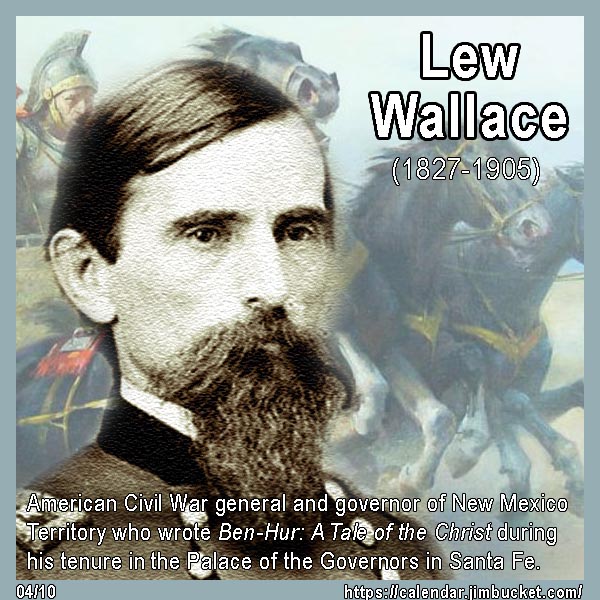
Apr. 10: Lew Wallace, American writer

BORN APRIL 10:

Lew Wallace (1827-1905) was an American lawyer and a Union general in the American Civil War. (He also served on the military commission for the trials of the Lincoln assassination conspirators.) He later served as governor of the New Mexico Territory, during which time he completed his most famous work (while living at the Palace of the Governors in Santa Fe), Ben-Hur, subtitled A Tale of the Christ. It has been called "the most influential Christian book of the nineteenth century," and is known to a certain generation of moviegoers for the epic 1959 film version, which won a record 11 Academy Awards in 1960. Published in 1880, it was the first book to dislodge Harriet Beecher Stowe's 1852 Uncle Tom's Cabin in sales, and was itself not bumped from the top of the US all-time bestseller list until 1936 with the publication of Margaret Mitchell's Gone with the Wind. The protagonist, Judah Ben-Hur, was a Jewish prince from Jerusalem enslaved by the Romans at the beginning of the first century CE. Parallel to his narrative is that of Jesus, from the same region and around the same age. The two young men's lives intersect throughout the story, and Judah converts to Christianity late in the story.


Navigation:


Tuesday, March 29, 2022

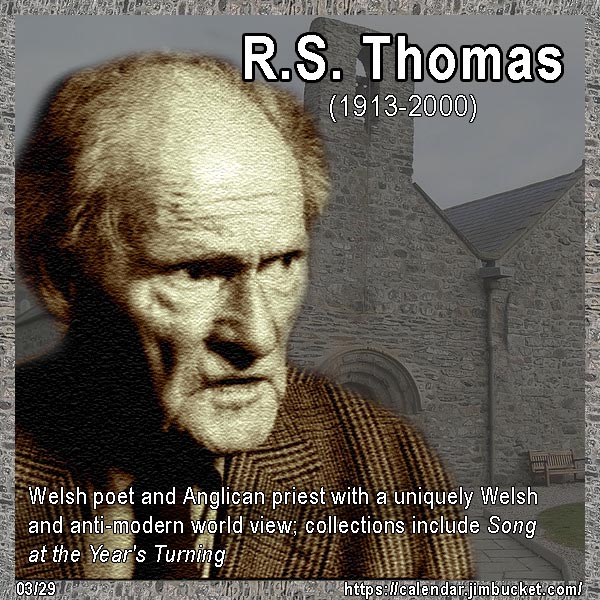
Mar. 29: R.S. Thomas, Welsh poet and priest

BORN MARCH 29:

R.S. Thomas (1913-2000) was a Welsh poet and Anglican priest. A fierce Welsh nationalist (who came to his "native tongue" only at the age of 30), he wrote poetry that interweaves his sometimes-progressive Christian faith with cultural issues and a "true Wales of my imagination," a Welsh-speaking aboriginal community that had remained in touch with the natural world. The Anglicization of Wales (including those Welsh only to happy to sell their patrimony for English money), and modernization in general, was represented in his poetry by "the machine," and by the specific machines that he preached against from the pulpit: refrigerators, washing machines, televisions, and other modern devices. A Welsh professor said of him that he was "a troubler of the Welsh conscience." He seems to have written over 40 books; his first major poetry collection, Song at the Year's Turning, is a good start.


Navigation:


Friday, March 25, 2022

Mar. 25: Flannery O'Connor, American writer

BORN MARCH 25:

Flannery O'Connor (1925-1964) was an American novelist, short story writer, and essayist who wrote two novels and 32 short stories, as well as other works. She often wrote in a sardonic Southern Gothic style and relied heavily on misfits in regional settings. A staunch Roman Catholic, she frequently examined questions of morality and ethics. Her novel Wise Blood is about a wounded returning WWII vet and how he copes with his loss of religious faith; the other one, The Violent Bear It Away, tells of a fourteen-year-old boy trying to escape his uncle's plans to make him a religious "prophet." Two of her short stories stand out: "A Good Man Is Hard to Find" (her best-known work) examines morality through the encounter of a family with an escaped convict. "Everything That Rises Must Converge" tells of the experience of a boy and his mother on a bus after the integration of their city's transportation system.


Navigation:


Monday, February 14, 2022

Feb. 14: James Albert Pike, American Episcopal priest

BORN FEBRUARY 14:

James Albert Pike (1913-1969) American civil servant and law professor who was ordained an Episcopal priest in 1946 and consecrated bishop in 1958. An early proponent of ordination of women and racial desegregation within mainline churches, he became increasingly radical in his views until at last he was accused of heresy by a small group of fellow bishops. He hosted his own television talk show and wrote seven books, the last of which (The Other Side) sealed his reputation as a nut job for its discussion of his experiences of seances and other paranormal phenomena following his son's suicide by gunshot. He died wandering in the Israeli desert after a vehicular breakdown on his way to Qumran to research "the historical Jesus."


Navigation:


Monday, November 29, 2021

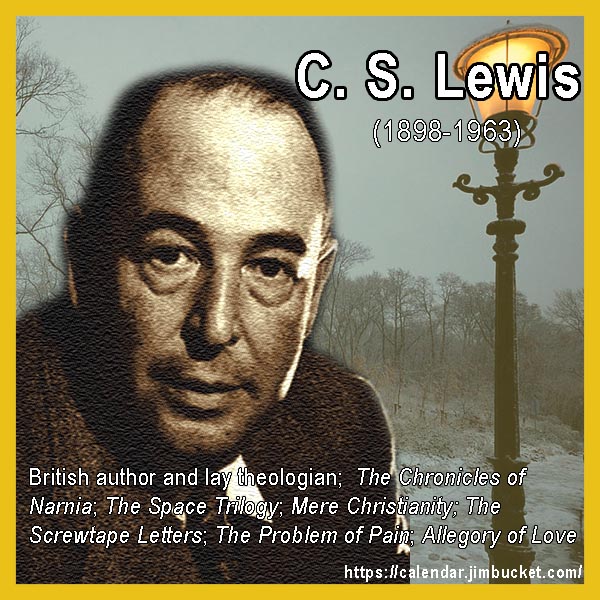
Nov. 29: C. S. Lewis, British writer and lay theologian

BORN NOVEMBER 29:

C. S. Lewis (1898-1963) British novelist, poet, essayist, and lay theologian, as well as a professor at both Oxford and Cambridge, and a chum of Tolkien. Though best known for his series like The Chronicles of Narnia and The Space Trilogy, his explicitly theological works (Mere Christianity; The Screwtape Letters) were also popular. The Allegory of Love reflects his work as a medievalist.


Navigation:


Sunday, October 24, 2021

Oct. 24: William Penn, English Quaker

BORN OCTOBER 24:

William Penn English Quaker and philosopher; founder of "Penn's Woods" (Pennsylvania). Wrote Christian polemics like the epigrammatic Fruits of Solitude; and No Cross, No Crown, written during imprisonment in the Tower of London.


Navigation:


Saturday, October 23, 2021

Oct. 23: Ignatius of Loyola, Spanish monk

BORN OCTOBER 23:

Ignatius of Loyola (1491-1556) Spanish Roman Catholic theologian and founder of the Jesuits; wrote the Autobiography and Spiritual Exercises, which are still used today.


Navigation:


Tuesday, October 5, 2021

Oct. 5: Jonathan Edwards, American Puritan preacher


BORN OCTOBER 5th:

Jonathan Edwards (1703-1758) American Puritan "hell-fire and brimstone" preacher who wrote "Sinners in the Hands of an Angry God." Best known for that fiery work, he was in fact a well-educated man with a keen sense of esthetics and Enlightenment thinking. He died at age 54 from a smallpox inoculation weeks after becoming president of what is now Princeton University.


Navigation: