Showing posts with label Scientist. Show all posts

Tuesday, May 17, 2022

May 17: Edward Jenner, English physician and scientist

BORN MAY 17:

Edward Jenner (1749-1823) was an English physician and scientist who, in creating the first smallpox vaccine, pioneered the very concept of vaccines themselves. The "father of immunology," he is a hero. In his day, smallpox was killing around 10% of the population, and as high as 20% in more densely-populated areas (towns and cities) where infection spread more easily. Had he lived today, however, he could probably not have accomplished this feat: he tested his hypothesis by injecting pus acquired from a woman with cowpox into both arms of an eight-year-old boy, the son of his gardener. The boy suffered a fever, but no full-blown infection. He then twice exposed the boy to a weakened ("variolated") form of smallpox, and he showed no signs of the disease. Jenner went on to great scientific and political achievements, and died of a stroke at 73.


Navigation:


Wednesday, May 4, 2022

May 4: Thomas Henry Huxley, English biologist

BORN MAY 4:

Thomas Henry Huxley (1825-1895) was an English biologist and anthropologist and one of the Huxleys, grandfather (by his son Leonard) of Julian Huxley, evolutionary biologist and the first Director of UNESCO; Aldous Huxley, author of Brave New World, The Perennial Philosophy, and The Doors of Perception; and Andrew Huxley, who won the 1963 Nobel Prize in Physiology or Medicine for his work on the mechanisms of the nerve cell. Thomas's defense of Darwin's theory of evolution earned him the nickname "Darwin's Bulldog," and his 1860 debate with Church of England bishop Samuel Wilberforce boosted acceptance of evolution as well as Huxley's own career, though accounts of the debate may be fabricated to some degree. Although virtually self-taught, Huxley became one of the finest comparative anatomists of the later 19th century, working on (among other things) the relationship between apes and humans. He also made the bird-dinosaur connection widely accepted today. It was he who coined the term "agnosticism" and elaborated on it to frame the nature of claims in terms of what is knowable and what is not, a major contribution to the modern worldview. His works include an Autobiography and Selected Essays; Man's Place in Nature, and Other Essays; Science and Culture, and Other Essays; On the Relations of Man to the Lower Animals; and Evolution and Ethics, and Other Essays.


Navigation:


Friday, April 15, 2022

Apr. 15: Leonardo da Vinci, Italian "Renaissance Man"

BORN APRIL 15:

Leonardo da Vinci (1452-1519) was an Italian polymath. When people say "Renaissance Man," I think of Leonardo. Bastard son of a pencil-pushing lawyer and a lower-class mom named Caterina, he was followed by a dozen half-siblings much younger than he, one by some 40 years. (Dad was busy.) Both his mother and father married--to other people--the year after he was born. But he had the good fortune to grow up 20 miles from Florence, where he studied and worked for the artist Verrocchio (who himself was a student of the great sculptor Donatello). But beyond the Mona Lisa and the Last Supper, he worked as a military engineer. His Notebooks and manuscripts run to around 13,000 pages, including some rather mundane things like lists of groceries and people who owed him money. But there are also sketches for paintings and projects never realized; scientific studies of anatomy and biology; architectural drawings; "flying machines," including a prototype for a helicopter; a sort of tank; a chariot with spinning scythes out in front of the horses; shoes for walking on water; musical instruments; a mechanical knight; hydraulic pumps; finned mortar shells; and a steam-powered cannon. He may well have been homosexual. His tenderness for animals (he purchased caged birds and released them, but this may have been to observe their flight) suggests he may have been vegetarian.


Navigation:


Thursday, April 14, 2022

Apr. 14: Christiaan Huygens, Dutch mathematician and scientist

BORN APRIL 14:

Christiaan Huygens (1629-1695) was a Dutch mathematician, astronomer, and physicist who made groundbreaking contributions in mechanics and optics (where, he is best known for his wave theory of light; the Treatise on Light is one of his major works). He has been called the first theoretical physicist and is one of the founders of modern mathematical physics. He improved the design of telescopes and discovered Saturn's largest moon, Titan (the first to be discovered). He also invented the pendulum clock, a breakthrough in timekeeping and the most accurate way of keeping time for almost 300 years.


Navigation:


Wednesday, April 13, 2022

Apr. 13: Thomas Jefferson, American president and polymath

BORN APRIL 13:

Thomas Jefferson (1743-1826) was an American statesman, lawyer, architect, philosopher, and U.S. Founding Father who was the new nation's first secretary of state (under George Washington), second vice president (under John Adams) and third president. His resume was such that President John F. Kennedy in 1962 told a group of Nobel Prize winners at a White House dinner: "I think this is the most extraordinary collection of talent, of human knowledge, that has ever been gathered together at the White House, with the possible exception of when Thomas Jefferson dined alone. Someone once said that Thomas Jefferson was a gentleman of 32 who could calculate an eclipse, survey an estate, tie an artery, plan an edifice, try a cause, break a horse, and dance the minuet." His reputation has been tarnished by the keeping of over 600 slaves on his plantation, Monticello, but at least he took one step toward eventual emancipation by signing the Act Prohibiting Importation of Slaves in 1807. Nevertheless, he fathered at least six children with Sally Hemings, a mixed-race enslaved woman who was his late wife's half-sister. He was a man of many accomplishments: the principal author of the Declaration of Independence; president of the American Philosophical Society; knew several languages; founded the University of Virginia; made the Louisiana Purchase (doubling the nation's size) and sending out Lewis and Clark's "Corps of Discovery" to obtain scientific, geographic, and ethnological knowledge. Jefferson died on July 4, 1826, the 50th anniversary of U.S. independence, and the same day as his long-time friend (and sometime political rival) John Adams. Historians generally rank Thomas Jefferson as one of the greatest presidents in American history.


Navigation:


Monday, March 14, 2022

Mar. 14: Albert Einstein, German/American physicist

BORN MARCH 14:

Albert Einstein (1879-1955) German/American physicist. Perhaps no scientist in history has achieved his level of public recognition: his name and face (not to mention his hairstyle) are known around the world. He coined "the world's most famous equation," E=mc2, part of his famous "theory of relativity," which says in essence that the amount of energy in any "thing" is equivalent to the amount of mass in that thing times the speed of light squared. Since his theory was accepted, it's Einstein's Universe and we're just living in it. During World War II, Einstein contributed to the Manhattan Project, which developed the atomic bomb for America. Some of his public reputation is based on his later opposition to nuclear weapons.


Navigation:


Thursday, March 3, 2022

Mar. 3: Alexander Graham Bell, Scottish-born American scientist

BORN MARCH 3:

Alexander Graham Bell (1847-1922) Scottish-born scientist who became a "British-subject in Canada" from 1870-1882, then an American citizen in 1882. He is credited with patenting the first practical telephone, and he co-founded the American Telephone and Telegraph Company (AT&T) in 1885. Both his mother and wife were deaf, and his work on behalf of the deaf community is legendary: the telephone was almost a by-product of his research on hearing and speech, including hearing devices. (He considered his invention an intrusion on his real work as a scientist and refused to have a telephone in his study.) He was also the second president (for five years) of the National Geographic Society. But the story I like best about him is this: In his 20s, Bell found himself living across the river from the Six Nations Reserve for Native Americans (in Canada, "First Peoples") and learned the Mohawk language. He translated it into a system of phonetic symbols developed by his father (called "Visible Speech"), and was subsequently awarded the title of Honorary Chief, and so participated in a ceremony where he donned a Mohawk headdress and danced traditional dances.


Navigation:


Saturday, February 19, 2022

Feb. 19: Nicolaus Copernicus, German/Polish astronomer

BORN FEBRUARY 19:

Nicolaus Copernicus (1473-1543) German/Polish astronomer. Until his time, the accepted "truth" was that the earth was the center of the universe (after all, didn't God choose to put humans here?) and all celestial bodies revolved around it. But as observation of planetary motion became more refined, anomalies appeared. Copernicus resolved this by creating a model that placed the sun at the center of our solar system (heliocentrism). He published his findings in De revolutionibus orbium coelestium (On the Revolutions of the Heavenly Spheres) just before his death in 1543; it was a revolution in more ways than one. Galileo and others took up the charge and today everything is in its right place.


Navigation:


Tuesday, February 15, 2022

Feb. 15: Galileo Galilei, Italian astronomer

BORN FEBRUARY 15:

Galileo Galilei (1564-1642) Italian astronomer, physicist and engineer variously called the "father" of observational astronomy, modern physics, the scientific method, and modern science, who studied applied physics and used the telescope to observe the phases of Venus, the four largest satellites of Jupiter, Saturn's rings, and lunar craters, and sunspots. His observations were published in the marvelously-titled The Starry Messenger. His advocacy of the Copernican view that the earth revolves around the sun got him in hot water with the Roman Inquisition, which concluded that the theory contradicted Holy Scripture. Galileo defended his views in Dialogue Concerning the Two Chief World Systems (the Copernican and the traditional Ptolemaic, which said that everything circled the earth). He was tried by the Inquisition and forced to recant, and spent the rest of his life under house arrest.


Navigation:


Saturday, February 12, 2022

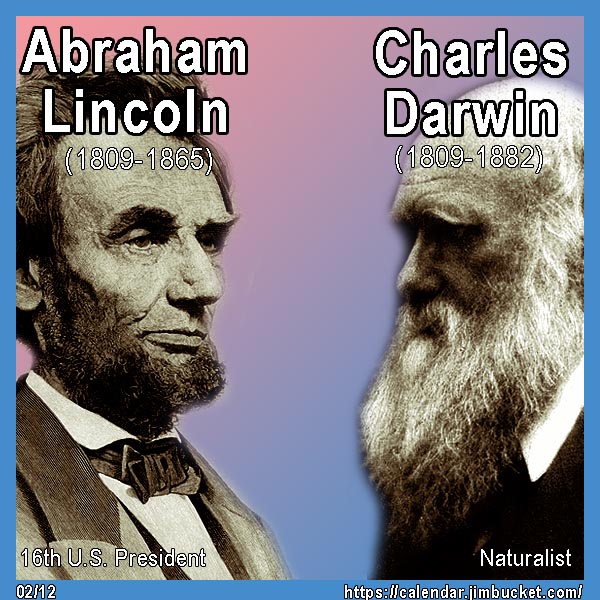
Feb. 12: Abraham Lincoln, American president AND Charles Darwin, English naturalist

BORN FEBRUARY 12:

Sometimes the stars align and a birthday is shared by two people who are so outstanding that I can't pick one over the other. Such is the case with February 12, and not only were these two titans born on the same calendar date, but it was in the same year: February 12, 1809!

  • Abraham Lincoln (1809-1865) was arguably the greatest of the 46 American presidents (so far). He led the country admirably through its darkest episode--the War between the States--and paid the price with his own blood when assassinated by a rebel sympathizer. His speeches set a standard never met by others; see the "House Divided" speech, the "First Inaugural Address," the renowned "Gettysburg Address," and the "Second Inaugural Address."
  • Charles Darwin (1809-1882) was a humble English naturalist whose writings completely revised our understanding of who we are: the result of natural processes rather than the special creation of God. His Voyage of the Beagle is a wonderfully readable account of a five-year journey around South America; The Origin of Species and The Descent of Man set out his theory in clear, logical prose. Though his idea has been tweaked and clarified as new evidence has come to light, it has never been replaced.


Navigation:


Friday, February 11, 2022

Feb. 11: Thomas A. Edison, American inventor

BORN FEBRUARY 11:

Thomas A. Edison (1847-1931) was an American scientist, inventor, and businessman who held over a thousand patents in fields such as the generation of electric power; mass communication; sound recording; and motion pictures. His inventions included the phonograph, the motion picture camera, and early versions of the electric light bulb. He literally changed our world. Before Edison, the only way to hear music or see a drama was through live performance! He was also noted for his work ethic and the organization of his operations. He left behind a Diary and numerous published papers.


Navigation:


Tuesday, January 11, 2022

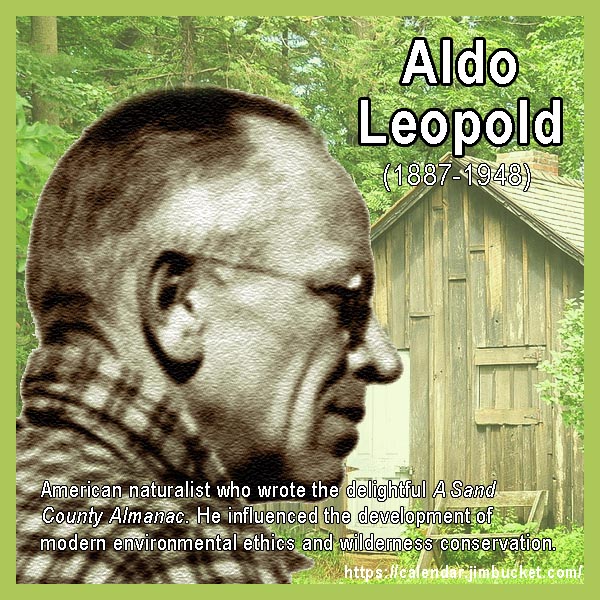
Jan. 11: Aldo Leopold, American naturalist

BORN JANUARY 11:

Aldo Leopold (1887-1948) American naturalist. His A Sand County Almanac is a delight to read; a professor at the University of Wisconsin, he influenced the development of modern environmental ethics and the movement for wilderness conservation.


Navigation:


Sunday, January 2, 2022

Jan. 2: Isaac Asimov, American sci-fi writer and scientist

BORN JANUARY 2:

Isaac Asimov (1920-1992) prolific American sci-fi writer and professor of biochemistry; with Robert A. Heinlein and Arthur C. Clarke, considered one of the "Big Three" science fiction writers. The Foundation series (seven books) is required reading; then, maybe, the stories in I, Robot; the Galactic Empire series; the Robot series; Nightfall; and essay collections.


Navigation:


Tuesday, December 28, 2021

Dec. 28: Arthur Eddington, English scientist and writer

BORN DECEMBER 28:

Arthur Eddington (1882-1944) English astronomer, physicist, mathematician, philosopher who (most importantly for many of us) became a household name as a popularizer of science; The Mathematical Theory of Relativity; The Nature of the Physical World; and New Pathways in Science.


Navigation:


Monday, December 27, 2021

Dec. 27: Johannes Kepler, German astronomer

BORN DECEMBER 27:

Johannes Kepler (1571-1630) German astronomer and mathematician who codified the laws of planetary motion; he wrote Astronomia Nova (New Astronomy); Harmonices Mundi (The Harmony of the World); and Epitome Astronomiae Copernicanae (Epitome of Copernican Astronomy).


Navigation:


Wednesday, December 22, 2021

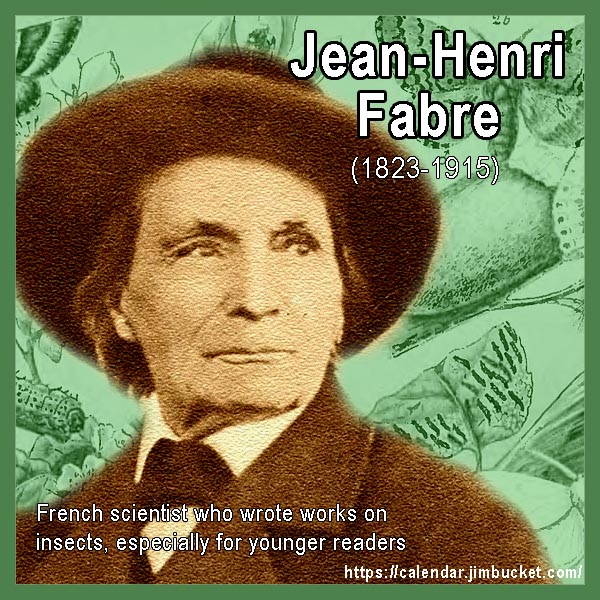
Dec. 22: Jean-Henri Fabre, French scientist and writer

BORN DECEMBER 22:

Jean-Henri Fabre (1823-1915) French naturalist, entomologist, and author who wrote works on insects, especially for younger readers. Known for his "lively style," Fabre was the rare individual who could teach something about bugs while keeping it "fun." Try Fabre's Book of Insects, a retelling of his Souvenirs entomologiques (also worth a look--if you read French).


Navigation:


Wednesday, December 15, 2021

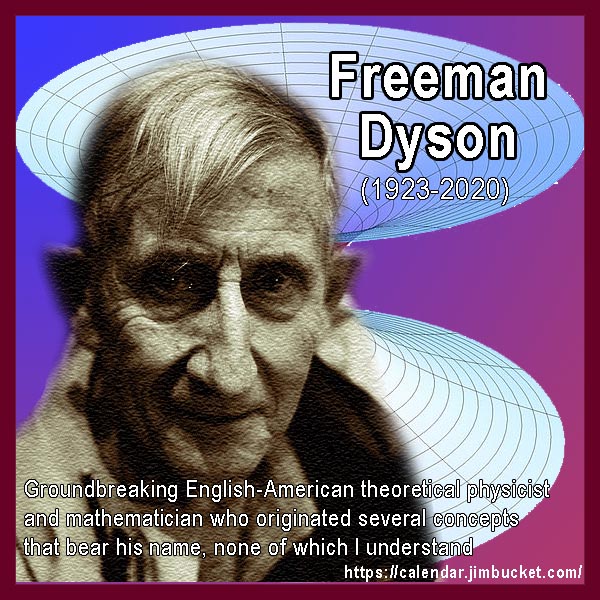
Dec. 15: Freeman Dyson, English-American physicist

BORN DECEMBER 15:

Freeman Dyson (1923-2020) groundbreaking English-American theoretical physicist and mathematician who originated several concepts that bear his name, none of which I understand. Look, I applaud advances in we humans' grasp of the infinite mysteries of the universe. But just like I don't know the technology behind my TV or the process of making sourdough bread, I'm just gonna sit back and reap the benefits of the knowledge of others, and appreciate their efforts.


Navigation:


Thursday, November 25, 2021

Nov. 25: Joseph Wood Krutch, American writer

BORN NOVEMBER 25:

Joseph Wood Krutch (1893-1970) American writer, critic, and naturalist whose nature books on the American Southwest include The Desert Year; he also wrote The Twelve Seasons and The Measure of Man.


Navigation:


Tuesday, November 9, 2021

Nov. 9: Carl Sagan, American scientist and author

BORN NOVEMBER 9:

Carl Sagan (1934-1996) American scientist and author best known for his presentation Cosmos: A Personal Voyage, and numerous other accessible essays on science, as well as representing the scientific worldview in the popular media. He won the Pulitzer Prize for General Non-Fiction in 1978. What's more, Sagan's work inspired a generation of scientists, including his successor in the Cosmos series, Neil deGrasse Tyson (who actually met him in person at age 17).


Navigation:


Monday, October 18, 2021

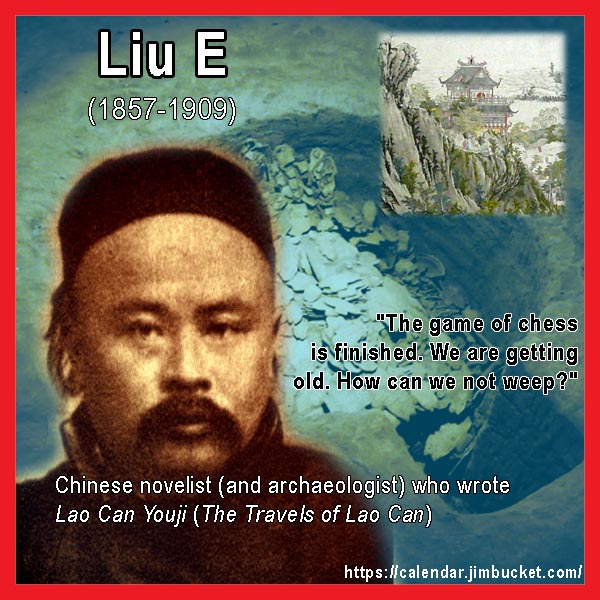
Oct. 18: Liu E, Chinese novelist

BORN OCTOBER 18:

Liu E (1857-1909) Chinese novelist who wrote the social satire Lao Can Youji (The Travels of Lao Can).

In his younger days he worked in the government, and privately raised funds to purchase rice to feed the poor during difficult times.

Later he became an archaeologist, working especially with so-called "oracle bones" (carved ox bones and turtle shells superheated to create cracks thought to convey messages), publishing a work called The Repository of Turtles.


Navigation: