Friday, May 20, 2022

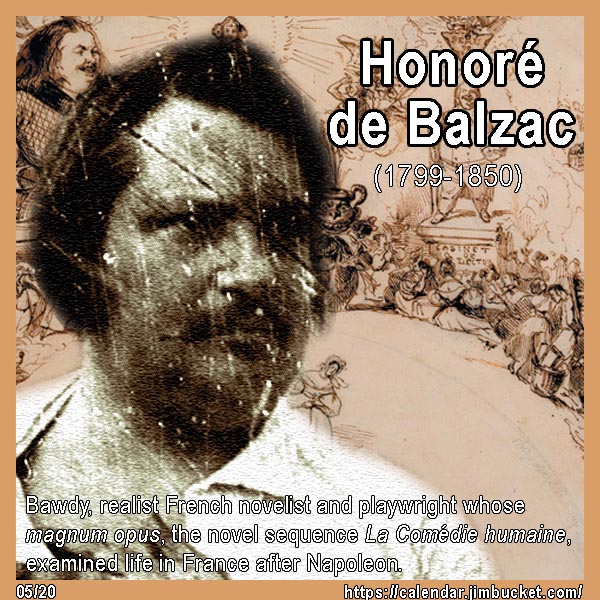
May 20: Honoré de Balzac, French novelist and playwright

BORN MAY 20:

Honoré de Balzac (1799-1850) was a famously bawdy French novelist and playwright. His magnum opus is the novel sequence La Comédie humaine (The Human Comedy), a panorama of post-Napoleonic French life. Regarded as a founder of realism in European literature, he is remembered for his multi-faceted characters; his writing influenced writers such as Zola, Dickens, Flaubert, and Henry James. He suffered from health problems (and the effects of an irascible character) throughout his life; his family relations were often strained by financial and personal drama. La Comédie humaine consists of 91 finished novels, stories, and essays, and another 46 unfinished (some of which exist only as titles). Balzac published 49 novels and novellas during his lifetime, including Eugénie GrandetLe Père Goriot, and La Cousine Bette; around a dozen more were published posthumously. He also published seven plays and numerous short stories. Many of his works have been adapted into films and television series.


Navigation:


Thursday, May 19, 2022

May 19: Malcolm X, American Muslim minister and civil rights activist

BORN MAY 19:

Malcolm X (1925-1965) was an American Muslim minister and icon of the civil rights movement. Born Malcolm Little, upon his release from prison at age 22 (for larceny and breaking and entering), he changed his name to "X," eschewing his "white slavemaster name" and using "X" as a signifier for his unknown African name. (After making the pilgrimage to Mecca as a member of the Nation of Islam--he had converted in prison--he changed his name again to el-Hajj Malik el-Shabazz). He stood against the mainstream non-violent civil rights movement--he called Martin Luther King Jr. a "chump" for his perceived cooperation with the "white establishment." Rejecting that strategy, he famously argued that black people should advance their cause "by any means necessary." Dozens of streets, schools, colleges, and libraries have been named after Malcolm X. He was assassinated in 1965, most likely at the hands of the Nation of Islam, though some look to the NYPD, the FBI, or the CIA.


Navigation:


Wednesday, May 18, 2022

May 18: Bertrand Russell, British philosopher and mathematician

BORN MAY 18:

Bertrand Russell (1872-1970) was a British philosopher, mathematician, historian, and activist who wrote the Principia Mathematica with Alfred North Whitehead, as well as a number of atheistic pieces such as What I Believe and Why I Am Not a Christian. He also wrote a wonderful History of Western Philosophy. Surprising, then, that given his skepticism, he received a Nobel Prize in Literature in 1950, which cited his "varied and significant writings in which he champions humanitarian ideals and freedom of thought."


Navigation:


Tuesday, May 17, 2022

May 17: Edward Jenner, English physician and scientist

BORN MAY 17:

Edward Jenner (1749-1823) was an English physician and scientist who, in creating the first smallpox vaccine, pioneered the very concept of vaccines themselves. The "father of immunology," he is a hero. In his day, smallpox was killing around 10% of the population, and as high as 20% in more densely-populated areas (towns and cities) where infection spread more easily. Had he lived today, however, he could probably not have accomplished this feat: he tested his hypothesis by injecting pus acquired from a woman with cowpox into both arms of an eight-year-old boy, the son of his gardener. The boy suffered a fever, but no full-blown infection. He then twice exposed the boy to a weakened ("variolated") form of smallpox, and he showed no signs of the disease. Jenner went on to great scientific and political achievements, and died of a stroke at 73.


Navigation:


Monday, May 16, 2022

May 16: Louis "Studs" Terkel, American author

BORN MAY 16:

Louis "Studs" Terkel (1912-2008) was an American author and historian best known for oral histories of "everyday Americans." Born in NYC, at age 8 he moved with his family to Chicago, then America's "second city," with which he was ever after associated. Though he took a law degree at U of C, he went to work in radio, taking various jobs until he landed The Studs Terkel Program in 1952, which ran 45 years until 1997; on tis show he interviewed such diverse guests as Martin Luther King Jr., Leonard Bernstein, Bob Dylan, Dorothy Parker, Tennessee Williams, and Frank Zappa. In the meantime (late '40s and early '50s) he did the unscripted Studs' Place on TV, in which famous people and interesting characters passed through his greasy-spoon diner in Chicago. All this interviewing got him into the oral history racket, for which most of us outside of Chicago know him. In the '70s he wrote Hard Times, about the Great Depression, and Working, in which (per the subtitle) "People Talk About What They Do All Day and How They Feel About What They Do." In 1985 he won a Pulitzer Prize for General Non-Fiction for "The Good War": An Oral History of World War Two. The nickname "Studs," by the way, comes from the time he was reading James T. Farrell's Studs Lonigan trilogy while acting in a play with another actor named "Louis."


Navigation:


Sunday, May 15, 2022

May 15: L. Frank Baum, American children's author

BORN MAY 15:

L. Frank Baum (1856-1919) was an American children's author best known for the Wizard of Oz and its 13 sequels. He also wrote 41 other novels, 83 short stories, over 200 poems, and at least 42 scripts, but his place in history (and in my heart) depends on the 1939 film adaptation of WoO, a perfect "hook" on which to hang Joseph Campbell's teachings about "The Hero's Journey"--especially since this time he's a she. Born in New York state, and spending most of his career in the Midwest, he died in Los Angeles trying to establish a movie studio focused on producing films for children.


Navigation:


Saturday, May 14, 2022

May 14: Thomas Gainsborough, English painter

BORN MAY 14:

Thomas Gainsborough (1727-1788) was an English painter best known--in my world, at least--for his The Blue Boy which hung (and hangs) at the Huntington Library, about five or six miles (an easy bike ride) from my childhood home. Until I was around 40, entry was free, and in my teen years I went often (often with a girl, to take pictures of her in the lush gardens). Anyway, uh, Gainsborough, yeah: One of the most important British artists of the second half of the 18th century, he was a prolific painter of portraits, also known for his landscapes. Gainsborough was a founding member of the Royal Academy. Other famous paintings (he made more than 300, 220 of which were portraits) include Mr. and Mrs. Andrews; The Watering Place; and the charming Girl with Pigs.


Navigation:


Friday, May 13, 2022

May 13: Georges Braque, French cubist

BORN MAY 13:

Name Georges Braque (1882-1963) was a French artist who co-founded (with Picasso) the modern style known as Cubism. After identifying with the Fauvist "wild beasts" from 1905, he became closely associated with Picasso until 1912. For a time the work of one was indistinguishable from that of the other, though Picasso's brash showmanship finally eclipsed Braque's fame. His later works reflect a softening of the sometimes-harsh cubist style. Cubism, by the way, is essentially an early-20th-century style in which objects are analyzed, broken up, and reassembled in an abstracted form; instead of depicting them from a single viewpoint, the artist depicts the subject from a multitude of viewpoints simultaneously to represent it in a greater context. One listing of Braque's works names 243 paintings and drawings, aside from sculptures.


Navigation:


Thursday, May 12, 2022

May 12: Dante Gabriel Rossetti, English poet and painter

BORN MAY 12:

Dante Gabriel Rossetti (actually Gabriel Charles Dante Rossetti, 1828-1882) was an English poet and painter, and one of the Rossetti clan. Co-founder of the Pre-Raphaelite Brotherhood (with William Holman Hunt and John Everett Millais), he was later the main inspiration for a second generation of artists and writers influenced by the movement, including William Morris and Edward Burne-Jones. His sensual art was part of a "medieval revival," influenced by Dante and Sir Thomas Malory, among others. His poetry includes "The Blessed Damozel" and the sonnet sequence, The House of Life.


Navigation:


Wednesday, May 11, 2022

May 11: Salvador Dali, Spanish surrealist artist

BORN MAY 11:

Salvador Dali (1904-1989) was a Spanish surrealist artist known for the striking and bizarre images in his work. He lived in France during the Spanish Civil War, and the U.S. during World War II. His genres included painting, graphic arts, film, sculpture, design, and photography, sometimes in collaboration with other artists. He also wrote: fiction, poetry, autobiography, essays, and criticism. But his public persona is perhaps better remembered than anything he produced: the mustache, the pet ocelot ("Babou"), and the public behavior that might best be interpreted as "performance art." One of his best-known paintings is the one with the dripping clocks, Persistence of Memory; the disjointed figure in Soft Construction with Boiled Beans (Premonition of Civil War); the slightly more traditional (less surrealistic) Christ of Saint John of the Cross and Crucifixion (Corpus Hypercubus); and way out there on the edge, The Hallucinogenic Toreador.


Navigation: